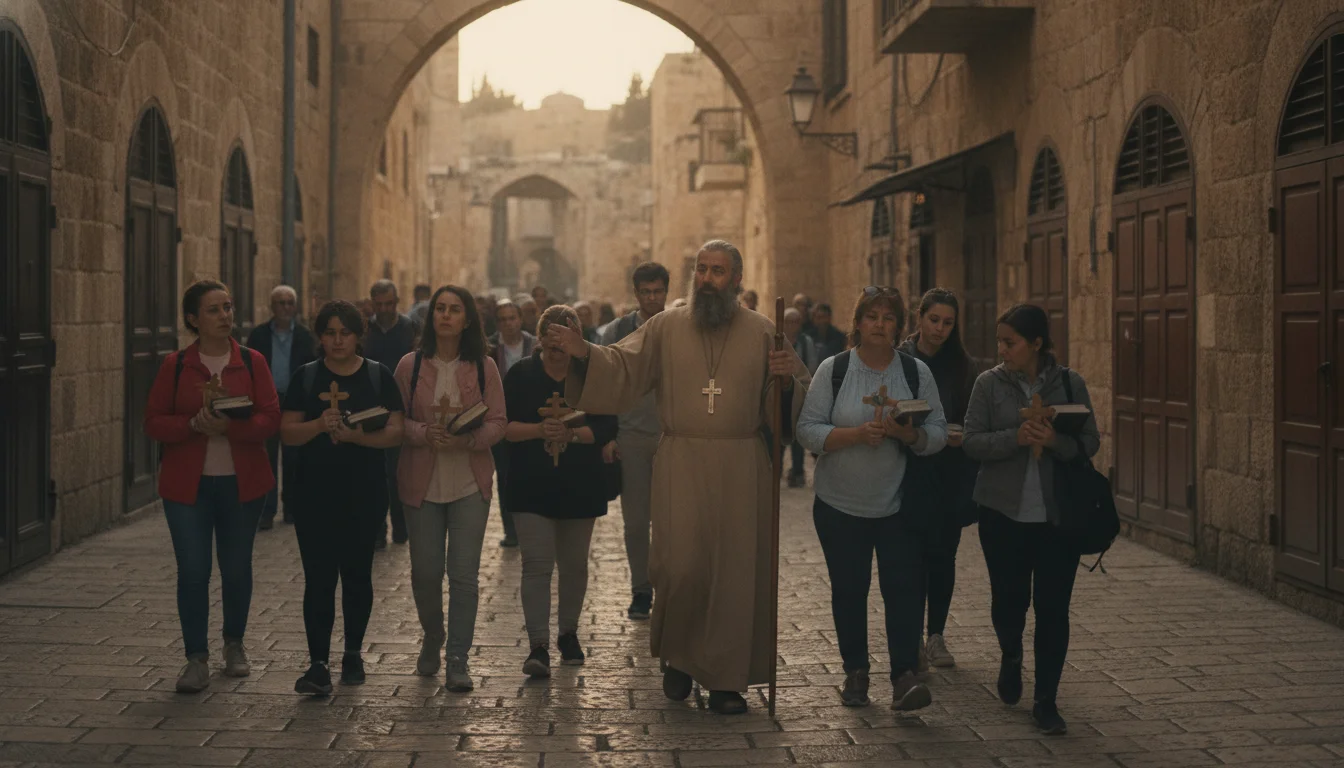
Every year around the start of Lent, a pastor calls me with the same idea and the same worry in the same breath. The idea is beautiful: walk his people through Holy Week in the actual streets where it happened, stand on the Mount of Olives on Palm Sunday, read the resurrection account in the garden on Easter morning. The worry is logistics. He has never led a trip like this, Easter is the busiest week of the year in Jerusalem, and he is not sure he can pull a group together in time.
I have built heritage journeys for more than forty years, and I want to take that worry apart piece by piece. This guide is written for you, the person organizing and leading the trip, not for the traveler in seat 14B. Your decisions are different. You are choosing dates, setting deposits, recruiting your congregation, protecting a budget, and standing in front of your people as the one responsible. Let me walk you through how an Easter group pilgrimage actually comes together, and why the timing that scares people is the same timing that makes it unforgettable.
Why Easter Changes the Whole Planning Calendar
A regular Holy Land trip and an Easter pilgrimage are not the same project, and the difference is entirely about the calendar.
Holy Week in Jerusalem is the single most requested window of the year. Hotels in the Old City area, the good guides, the coaches, the restaurant tables large enough for a group of twenty-five, all of it gets claimed early. For most heritage destinations I tell leaders that six to nine months of lead time is comfortable. For Easter I say the opposite: start now, whatever now is. Nine to twelve months out is the healthy range, and I have booked strong Easter groups eighteen months ahead without blinking.
There is a second wrinkle worth knowing before you pick a week. Western Easter and Orthodox Easter often fall on different Sundays, and in Jerusalem both are felt. The city fills differently depending on which calendar you are traveling around, and processions like the Holy Fire ceremony follow the Orthodox date. Decide early which Easter your congregation is traveling for, because that one choice drives your dates, your hotel pricing, and how dense the crowds will be around you. If you want the full planning sequence laid out step by step, our complete guide to planning a group pilgrimage is the pillar I point every new leader to first.
The One Number That Decides Whether You Can Afford to Lead
Here is the question underneath most leaders’ hesitation, even when they never say it out loud: how am I supposed to pay my own way to lead a trip I am giving to everyone else?
You are not. With fifteen or more paying participants, the group leader travels free. That covers your full trip on the same terms as a traveler: international flights, hotel accommodation, ground transportation, included site entries, and the group meals built into the itinerary. It is not a partial discount. A group of fifteen generates enough room inside the trip’s own economics to carry one complimentary seat, and that seat is yours, because you are the reason the group exists.
For a congregation this reframes the entire conversation. You are not asking your board to fund an expensive trip for the pastor. You are organizing a journey your people pay into, and your seat is part of how the structure holds together. Larger groups open even more room: once you get toward twenty-five or thirty travelers, there is often space for a reduced or complimentary second seat for a co-leader or a spouse, which matters a great deal if you would rather not travel and lead alone. I break the fifteen threshold down in more detail in how the leader-free model works, and if you want the exact head-count math, how many people you need for a free leader spot walks through it.
If you land at twelve committed instead of fifteen, the trip is not dead. We run groups of ten to fourteen all the time. They simply do not qualify for the free-leader benefit yet, so either the leader pays a traveler’s price or the group agrees to absorb a small premium. My honest advice: plan as though you will reach fifteen, because Easter interest tends to firm up fast once real dates exist.
Building the Holy Week Itinerary Around Your People
The reason Easter in Jerusalem is worth the planning strain is that the week itself becomes your itinerary. You are not inventing an experience. You are following one that is already written into the geography.
A well-built Holy Week journey lets your group move through the days in order. Palm Sunday on the Mount of Olives, walking down toward the city the way the Gospels describe. Time in the Garden of Gethsemane. The Via Dolorosa through the Old City. The Upper Room and the Garden Tomb. Then Easter morning itself, a sunrise service or a communion your group holds together in a place that makes Scripture stop being abstract. Your job as the leader is to be present in those moments, to read the passage aloud, to lead the reflection. The operator’s job is to make the buses, the entries, the timing, and the crowds disappear into the background so your attention stays on your people.
Most Easter groups pair the Jerusalem core with the Galilee: the Sea of Galilee, Capernaum, the Mount of Beatitudes, a boat ride where a moment of worship on the water lands differently than it does in a sanctuary. A ten-day frame gives you room for both without rushing, and I lay out a sample structure in our ten-day Holy Land itinerary. If you want to understand the full cost picture before you commit to a shape, what a church trip to Israel costs gives you real ranges to work from.
Christmas in the Holy Land as a Group Trip
Easter is the most requested pilgrimage window, but it is not the only one that turns a season into an itinerary, and several leaders who call me about Easter are actually better suited to Christmas.
A Christmas in the Holy Land group trip centers on Bethlehem, and the emotional pull is obvious: Manger Square, the Church of the Nativity, a Christmas Eve service a few steps from where the story begins. The planning logic mirrors Easter almost exactly. Bethlehem fills for the holiday, the good access gets claimed early, and the same nine-to-twelve-month lead time applies. The trade you are weighing as an organizer is weather and mood. December in the Judean hills is cool and can be wet, the daylight is shorter, and the tone of the trip is quieter and more reflective than the intensity of Holy Week. For some congregations that stillness is exactly the point. If your people respond more to the incarnation than to the passion, build toward Christmas and use the same recruiting and deposit structure I describe below.
Pentecost, Passover, and the High Holidays: Matching the Feast to Your Congregation
Two more windows come up often, and they let me speak to both the Christian and the Jewish congregations I work with, because heritage travel belongs to both.
A Pentecost pilgrimage to Jerusalem as a group carries a particular theological weight for churches. Pentecost falls fifty days after Easter, and standing in Jerusalem during that season, reading Acts 2 in the city where the church was born, gives the day a dimension no sanctuary can. It is a quieter travel window than Easter itself, which often means friendlier pricing and lighter crowds, so if your congregation cares about the birth of the church more than the passion narrative, Pentecost is worth a serious look. It rewards leaders who plan the theme deliberately.
For a synagogue, the framing shifts but the structure does not. A Passover heritage trip for a congregation is less about a single site and more about the arc of the story: the journey from bondage to freedom, connecting the Seder your community keeps at home to the land the story points toward. And a High Holidays heritage trip for a synagogue, timed around Rosh Hashanah and Yom Kippur, brings your members to Jerusalem for the most solemn days on the calendar, praying at the Western Wall as the year turns. In both cases the planning fundamentals are identical to the Christian pilgrimages: pick the feast, lock the dates far ahead, recruit from your core, and use the free-leader model to take the rabbi’s cost off the table. The feast changes. The mechanics of leading a group do not.
How to Recruit and Reach Fifteen Before the Deadline
This is the part that keeps leaders up at night, so let me be concrete.
Start with your core, not your whole membership list. You do not need to convince fifteen strangers. You need the eight or ten people who already lean toward this, and then you let them bring others. Couples travel together. Friends bring friends. A Bible study or a chavurah often signs up as a unit. I have watched a group go from thirteen to nineteen in the final eight weeks simply because the trip stopped being an idea and became a date on a page.
Give people a real reason and a real date. Vague interest never fills a group. “We are walking Holy Week in Jerusalem next April, ten days, here is the day-by-day” is a decision people can actually make. Tie the trip to what your congregation is already studying or preaching through and the interest sharpens on its own.
Set a deposit and a deadline. Nothing converts a maybe into a yes like a modest, refundable-window deposit with a clear cutoff. It also protects your date, because Easter inventory does not wait. A structured payment plan makes the trip reachable for more of your people, and I cover how to set one up in group trip payment plans. If cost is the main barrier in your community, fundraising for a congregation trip has approaches I have seen work, and recruiting for a church trip goes deeper on filling the seats.
The Leader’s Real Job Once the Logistics Are Handled
Here is what I most want you to carry out of this. When the free-leader model takes your personal cost off the table and a good operator takes the logistics off your plate, your attention is freed for the only thing you cannot delegate.
You are not the trip’s accountant or its travel agent. You are its shepherd. Your role on Easter morning is to be fully present for your people in the place that undoes them, to read the resurrection account with a steady voice, to hold the communion cup where it means the most. Everything else, the coaches and the entries and the crowd management, is our problem, not yours. That is the whole design. The free seat and the handled logistics exist so your focus stays where it belongs.
FAQ: Planning an Easter Group Pilgrimage
How far ahead do I need to start planning an Easter pilgrimage?
Nine to twelve months is the healthy range, and earlier is better. Holy Week is the busiest travel window of the year in Jerusalem, so hotels, guides, and coaches get claimed well in advance. Decide early whether you are traveling for Western or Orthodox Easter, since the two often fall on different Sundays and shape your dates and pricing.
Does the group leader really travel free at Easter?
Yes. With fifteen or more paying participants, the leader’s full trip is covered on the same terms as a traveler: flights, hotels, ground transportation, and included site entries. Below fifteen the trip still runs, but the leader pays a participant’s price or the group covers the seat by agreement. Larger groups can sometimes open a second reduced or free seat for a co-leader or spouse.
Can we do Christmas in the Holy Land instead of Easter?
Absolutely, and the planning logic is nearly identical. A Christmas group trip centers on Bethlehem and Manger Square, with the same long lead time since the holiday fills the town early. The trade is weather and tone: December is cooler and quieter, which suits congregations drawn to the reflective side of the story.
We are a synagogue, not a church. Does this work for Passover or the High Holidays?
It works exactly the same way. A Passover heritage trip follows the arc from bondage to freedom, and a High Holidays trip brings your members to Jerusalem for Rosh Hashanah and Yom Kippur. The feast is different, but the mechanics of leading a group, recruiting from your core, planning far ahead, and the free-leader threshold, are the same.
How do I actually reach fifteen people?
Start with the core who already want to go, not your whole membership, then let them bring others. Give them concrete dates and a real day-by-day itinerary, set a modest deposit with a clear deadline, and offer a payment plan so cost is not the wall. Most groups that begin at twelve reach fifteen before departure once the trip becomes real.
If you are weighing an Easter pilgrimage for your congregation, the two things that decide it are usually the calendar and the leader’s cost, and both are more workable than they look. You can see how the group experience comes together on our group heritage tours page, or explore the full route on our Israel heritage page.
Contact us and we will help you lock the right Easter week and run the numbers for your group.