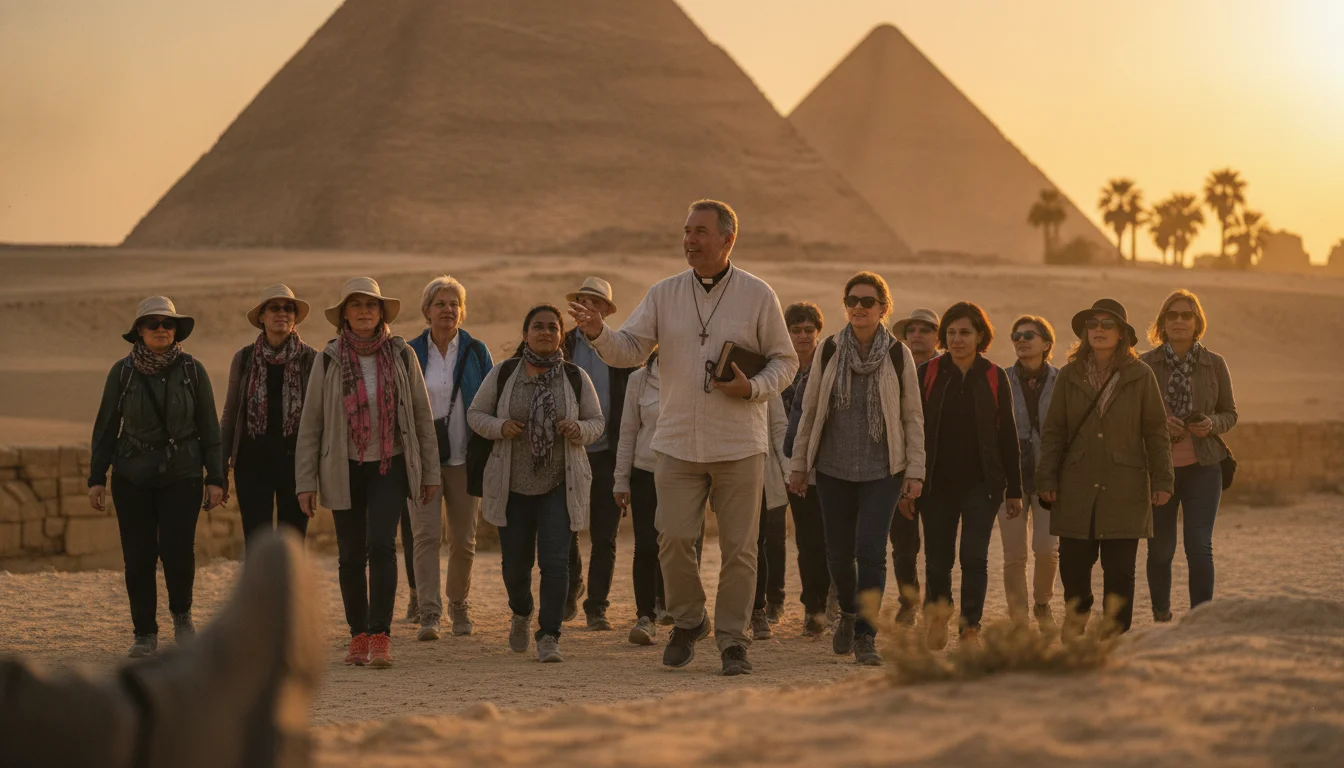
When a pastor tells me he wants to take his congregation to Egypt, I can usually hear two things in his voice at once. Real excitement, because the Bible practically opens in Egypt and never fully leaves it. And a quiet worry, because Egypt sounds harder to organize than Israel or Greece, and he is not sure where a leader even begins. I want to take that second feeling off the table right now. A church group tour to Egypt is very organizable, and as the person leading it, you have fewer moving parts to manage than you think.
I have built heritage journeys for more than forty years, and I want to walk you through this the way I would if you called me tomorrow. Not as a traveler deciding whether to go, but as the leader deciding whether to build the trip. We will cover the routes that matter to a congregation, how the money works (including why your own seat is likely free), and the practical decisions that sit on your desk and no one else’s.
Why Egypt Belongs on a Congregation’s List
Most groups think of Egypt as the pyramids and a Nile cruise, and those are worth every minute. But for a church or a synagogue, Egypt is something more. It is where Joseph rose, where Israel was formed in slavery and delivered out of it, where the infant Jesus was carried for safety, and where some of the earliest Christian communities took root. You are not sightseeing. You are walking your people through the front third of Scripture.
That is the frame I encourage every leader to hold. When you present Egypt to your congregation as a discipleship experience rather than a vacation, the whole trip recruits differently. People do not sign up to see a pyramid. They sign up to stand where the Exodus began and read it aloud together. Your job as the organizer is to give them that reason clearly, and Egypt hands it to you.
The Leader Travels Free at Fifteen: How That Works
Let me handle the money question early, because it is usually the real reason a leader hesitates.
On a group heritage tour, when you gather fifteen or more paying participants, your seat as the group leader is covered. That means your international flights, your hotels, your ground transportation, your site entries, and the group meals built into the itinerary. You lead the trip at no personal cost. This is not a coupon or a partial credit. It is a complimentary spot built into the economics of a group booking, and it exists because you are the reason the group exists.
Here is why the number is fifteen and not eight. Below fifteen, the fixed costs of a trip (the Egyptologist guide, the coach, the local operators, the coordination) get spread across too few travelers, and there is no room to carry a free seat without raising everyone’s price. At fifteen, those costs are shared widely enough that your seat fits inside the structure. Larger groups make the math friendlier still, which is why a group of twenty-five or thirty can sometimes unlock a second reduced or complimentary seat for a co-leader or a spouse. If that matters to you, raise it early so we can build toward it. I go deeper on the mechanics in our guide on how the free-leader benefit works, and the pillar on how to plan a group pilgrimage walks the full process from first idea to departure.
What this changes for you is simple. You are no longer asking your board to fund the pastor’s expensive trip. You are organizing a journey your people pay into, and your participation is part of how it is priced.
Congregation Trip to the Exodus Route
If there is one itinerary that defines a faith tour of Egypt, it is the Exodus. A congregation trip to the Exodus route is not a single stop. It is a movement across the land that mirrors the story itself, and as the leader you get to decide how much of it your group can hold.
The route usually starts in the Nile Delta and around Cairo, where Israel lived and labored in Goshen, then moves toward the wilderness of the Sinai Peninsula where the people wandered. Depending on your days and your group’s stamina, you can anchor the Exodus in Scripture readings at each major beat: the bondage, the plagues, the Passover, the crossing, the wilderness. I have watched a group read Exodus 14 out loud near the water and go completely silent afterward. That is the kind of moment you are building.
Your decisions here are practical. How many days can your congregation realistically take off? An Exodus-focused week runs differently than a twelve-day journey that also folds in the pyramids and Alexandria. Older travelers and younger families move at different paces across the wilderness. Part of your job as organizer is to be honest with your operator about who is actually coming, so the itinerary fits your people rather than an ideal group. Get that right and the route carries real weight. Get it wrong and you spend the trip managing tired travelers instead of leading them.
Church Group Trip to Mount Sinai, Egypt
For many leaders, the emotional peak of the whole journey is Mount Sinai. A church group trip to Mount Sinai in Egypt is one of the most requested elements I build, and it deserves its own paragraph of honest planning, because it asks the most of your group physically.
Mount Sinai, traditionally identified with Jebel Musa in the southern Sinai, is where Moses received the Law. The classic experience is the pre-dawn climb to reach the summit for sunrise, often followed by a visit to Saint Catherine’s Monastery at the base, home to the site of the burning bush and one of the oldest continuously operating monasteries in the world. It is unforgettable. It is also a real climb, several hours up in the dark, and not everyone in a congregation can or should attempt it.
This is where you earn your keep as the leader. Before anyone signs up, you need to set expectations plainly. Some of your travelers will summit. Others will stay at the monastery and have a meaningful morning there. Both are good outcomes, and framing it that way in advance prevents disappointment on the mountain. I always tell leaders to talk with their operator about camel-assisted options for part of the ascent and about the timing, because summer and winter change the climb completely. Handle those conversations early and Mount Sinai becomes the story your group tells for years. Leave them to the last minute and it becomes a logistics scramble at 2 a.m.
Congregation Trip to Alexandria, Egypt
Cairo, Sinai, and the Nile get most of the attention, but I encourage church and synagogue leaders to look hard at Alexandria too. A congregation trip to Alexandria, Egypt adds a layer most groups miss, and it speaks directly to both Christian and Jewish heritage.
Alexandria was one of the great centers of the ancient world. It was home to a large Jewish community, and it is where the Hebrew Scriptures were translated into Greek as the Septuagint, the very version quoted throughout the New Testament. For a Christian group, it is tied to Mark and to the roots of one of the earliest churches. For a Jewish congregation, it is a story of diaspora life, scholarship, and survival. The city carries a Mediterranean feel that is very different from Cairo, and a day or two there gives your group a change of pace and a fuller picture of biblical history.
As the organizer, Alexandria is mostly a question of days and driving. It sits a few hours from Cairo, so folding it in means budgeting the road time and deciding whether the extra depth is worth it for your particular group. For many congregations, especially those who have studied the intertestamental period or the early church, it is a clear yes.
Building a Group That Reaches Fifteen
This is the part leaders worry about most, so let me be direct about it.
You do not recruit fifteen strangers. You start with the eight to ten people in your community who already want to go, then let them bring others. Every heritage trip I have run started with a small committed core. Couples come together. Friends bring friends. A Bible study group travels as a unit. Fifteen is very reachable when you begin with the people leaning in rather than the whole membership roll. Our guide on recruiting for a church trip breaks this down step by step.
A few things move people from interested to committed:
- Give them a real date and a real itinerary. “We are walking the Exodus route and climbing Mount Sinai next March, ten days, here is what we will see” converts. “We might do Egypt someday” never does.
- Tie the trip to what your community is already studying or preaching through. If you are in Exodus this year, the trip sells itself.
- Offer a payment plan. Egypt is a considered purchase for most families, and a deposit plus monthly installments removes the single biggest barrier. Our group payment plan guide shows how to structure it.
- Plan far enough ahead. Six to nine months is the sweet spot for a group of fifteen to thirty. That gives people time to budget, request time off, and commit, and it gives you time to build interest, which is the real work.
Your Real Job Once the Money Is Handled
Here is what I most want you to hear. When the free-leader model takes your personal cost off the table, it also frees up your attention. You stop being the trip’s accountant and get to be its shepherd.
That is the whole point. Your role on a heritage journey is to guide your people through a spiritual experience, to read the Passover account in the land where it happened, to lead a moment of reflection at the summit of Sinai, to be present for your congregation in the places that move them. The operator’s job is to make everything else invisible: the visas, the internal flights, the guides, the security, the hotels, the meals. The free seat is part of how we keep your focus where it belongs. You can see how the group experience is structured on our group heritage tours page, and the full country overview lives on our Egypt heritage page.
FAQ: Leading a Church Group Tour to Egypt
How many people do I need for the group leader to travel free to Egypt?
Fifteen. With fifteen or more paying participants, your full trip cost as the leader is covered, including international flights, hotels, ground transportation, and site entries. Below fifteen, the trip is still possible, but you pay a participant’s price or the group agrees to cover your seat.
Can we combine Mount Sinai, the Exodus route, and Alexandria in one trip?
Yes, and many groups do. The main constraint is days. A trip that climbs Mount Sinai, traces the Exodus, and adds Alexandria usually needs eleven to fourteen days. If your congregation can only spare a week, we focus the itinerary on one or two of those rather than rushing all three.
Is Egypt safe for a church group?
Egypt runs organized faith tours regularly, and reputable operators build trips around established tourism regions with experienced local guides and appropriate security. As the leader, the smart move is to ask your operator directly about current conditions for your specific route and dates, and to share honest guidance with your travelers.
How physically demanding is the Mount Sinai climb, and what if some travelers cannot do it?
The summit climb is several hours, often before dawn, and it is not for everyone. Plan for a split group: those who summit and those who spend a meaningful morning at Saint Catherine’s Monastery instead. Setting that expectation before people sign up prevents disappointment on the mountain.
How far ahead should I start planning a group trip to Egypt?
Six to nine months for a group of fifteen to thirty, and nine to twelve months for larger groups or trips timed around a holiday. The lead time is as much about recruiting your people as it is about booking. Concrete dates and a real itinerary are what move a congregation from interested to committed.
If you are weighing whether an Egypt trip is realistic for your community, the free-leader math is usually the thing that tips it. I am happy to help you shape a route around your congregation, your days, and your dates.
Contact us and we will run the numbers with you and build an itinerary that fits your group.