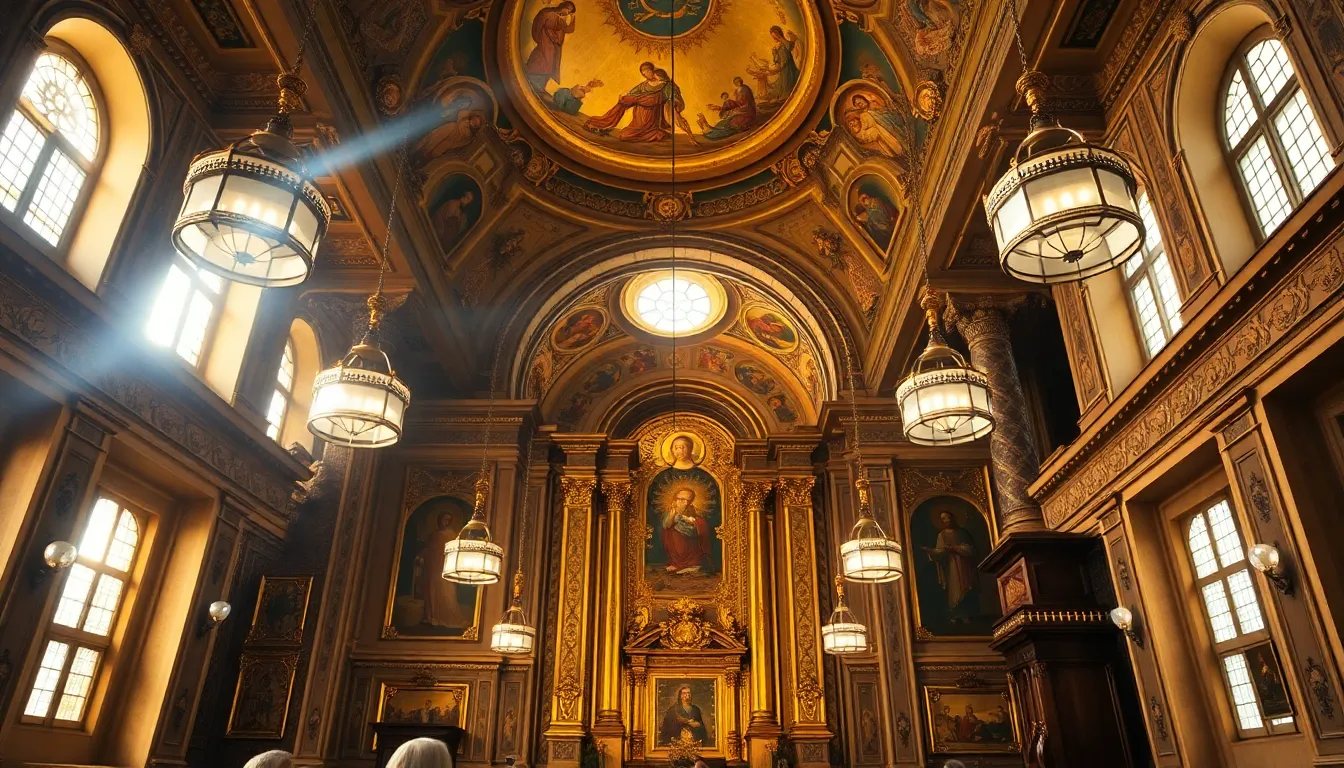
The first time I brought a Protestant group into a working Greek Orthodox church, I watched the whole room slow down. There was incense in the air, gold on every wall, a priest chanting in a language nobody understood, and people kissing icons by the door. One of the pastors leaned over to me and whispered, “I have no idea what I’m looking at.” That is an honest place to start. Most groups I lead come from Western traditions, Catholic or Protestant, and Orthodox Christianity is genuinely foreign to them. It is also one of the oldest continuous expressions of the faith on earth, and you cannot understand Greece without it.
So before you bring your congregation into these spaces, let me give you the primer I wish someone had given me. Not a theology course. Just enough to walk in with understanding instead of confusion.
Where the Eastern Church Comes From
The split most people half-remember is the Great Schism of 1054, when the Christian church divided into the Roman Catholic West and the Eastern Orthodox East. But that date is misleading on its own. The division was centuries in the making, and the Eastern church was not breaking away from anything. It was continuing.
When Paul preached in Corinth and Thessaloniki, when John wrote to the seven churches of Asia, the center of gravity in early Christianity was the Greek-speaking eastern Mediterranean. The New Testament was written in Greek. The first great church councils, Nicaea, Constantinople, Ephesus, Chalcedon, all happened in the East. The Nicene Creed your congregation recites on Sunday was hammered out by Greek-speaking bishops. Orthodox Christians see themselves as the unbroken inheritors of that world, and historically they have a strong case.
This matters for your group because it reframes what they are seeing. A Greek Orthodox church is not an exotic offshoot. It is a window into the form Christianity took in the very region where it first spread into Europe. When you stand in one, you are closer to the early church than you are in most Western buildings.
The Calendar Your Group Should Know About
Here is a practical thing that trips groups up constantly. The Orthodox church often celebrates the major feasts on different dates than the West.
The reason is the calendar. Most Orthodox churches, including the Church of Greece for fixed feasts, use a revised calendar, but the date of Easter, called Pascha, is still calculated by the older Julian reckoning and the traditional rules. The result is that Orthodox Easter usually falls on a different Sunday than Western Easter, sometimes by a week, sometimes by more than a month. Christmas in Greece is December 25, the same as the West, but some Orthodox communities elsewhere keep January 7.
Why does this matter for planning? If you want your group to witness Orthodox Holy Week, which is one of the most moving things you can experience in Greece, you need to check the specific year’s Pascha date, not Western Easter. The Good Friday procession, the midnight resurrection service with every candle lit from one flame, these are extraordinary, and they happen on the Orthodox date. I tell every leader to confirm the calendar before locking dates if liturgical timing matters to them.
Reading an Icon Without Getting It Wrong
The icons are the thing your group will have the most questions about, and the thing most likely to be misunderstood. In a Western frame, people see paintings and assume decoration, or they see people kissing images and worry about idolatry. Both readings miss it.
Orthodox theology is careful here. An icon is not worshiped. It is venerated, treated as a window, a point of contact with the person it depicts, the way you might kiss a photograph of someone you love. The honor passes through the image to the person. The famous defense of this came out of the iconoclast controversy in the eighth and ninth centuries, when the church fought hard over whether images were permissible at all and concluded that, because God became visible in Christ, the divine could be depicted.
A few things to tell your group so they read icons well:
- The style is intentional, not primitive. The flat perspective, the elongated figures, the gold backgrounds. These are theological choices meant to show a transfigured reality, not a naturalistic one.
- The gestures and colors carry meaning. Christ’s hand position, the letters in the halo, the specific reds and blues for Mary. None of it is arbitrary.
- Veneration is voluntary. Your group members are welcome to observe respectfully without participating. Nobody expects a Protestant visitor to kiss an icon, and nobody minds if they simply look.
When I explain this before we enter, the whole experience changes. People stop being puzzled spectators and start actually seeing.
A Living Tradition, Not a Museum
The thing I most want your group to grasp is that Orthodoxy in Greece is alive. These are not historical sites preserved for tourists. They are working churches full of people who have prayed in this exact way for a very long time.
You will see it in small things. The old women lighting candles on a Tuesday morning. The priest who has been chanting the same liturgy of Saint John Chrysostom that has been sung, with little change, since the fourth century. The monasteries of Meteora and Mount Athos where monks still keep a rhythm of prayer that predates every Western institution your group knows.
For pastors and educators especially, this is a gift. Your people get to encounter Christianity practiced in an unbroken line from the world of the New Testament. You do not have to agree with every Orthodox doctrine to be moved by that continuity. I have watched it reshape how groups think about their own tradition. When you see how the faith was held in the East, you understand your own branch of the family better.
For the full route through Paul’s Greece and the major sites, our hub page on spiritual sites in Greece lays out the geography. And if your group is tracing the apostle specifically, our guide to Paul in Athens and Corinth connects the Orthodox present to the apostolic past.
Visiting an Orthodox Church Respectfully
A short practical note, because the questions always come. Dress modestly. Shoulders and knees covered for everyone, and many churches expect women to have a head covering available, though in Greece this is often relaxed for visitors. Move quietly, especially during a service, when standing is the norm and pews are rare or absent. Photography is sometimes fine and sometimes forbidden, so I always ask first. And if a service is underway, your group is welcome to stand at the back and witness it. You do not need to take communion or venerate anything to be present and respectful.
These are small courtesies, and they open doors. Greek Orthodox communities are warm to faith visitors who come with genuine interest rather than a camera and a checklist.
FAQ: Greek Orthodox History and Heritage
What is the difference between Greek Orthodox and Catholic Christianity?
They share the first thousand years of church history and most core doctrine, then divide formally in 1054 over questions of papal authority, the wording of the Nicene Creed, and several theological points. The Orthodox church has no pope and is organized as a communion of self-governing national churches, including the Church of Greece. For a visiting group, the most visible differences are the icons, the calendar, the standing liturgy, and the married parish priests.
Why does Greek Orthodox Easter fall on a different date?
Orthodox Easter, or Pascha, is calculated using the older Julian-based rules, so it usually lands on a different Sunday than Western Easter. The gap ranges from a week to over a month depending on the year. If you want your group to experience Orthodox Holy Week, confirm the Orthodox Pascha date for your travel year rather than assuming the Western date.
Are visitors allowed inside Greek Orthodox churches?
Yes, and they are welcomed. Dress modestly, move quietly, and ask before photographing. During a service, stand respectfully at the back. You are not expected to venerate icons or take communion. Most Orthodox communities are gracious to faith travelers who come with real curiosity.
Is it idol worship when people kiss the icons?
No, and this is the most common misunderstanding. Orthodox theology draws a sharp line between worship, which belongs to God alone, and veneration, which honors the person an icon depicts. The icon functions as a window, and the honor passes through it. Your group members can observe without participating, and no one will mind.
Why should a Protestant or Catholic group care about Orthodox sites?
Because Orthodoxy preserves Christianity in the form it took in the very region where Paul and John planted the first European churches. The language, the early councils, the unbroken liturgy. Encountering it gives your congregation a deeper understanding of the early church and, often, of their own tradition.
If you want your group to walk into these spaces with understanding instead of confusion, that preparation is part of what we build into every Greece journey. The history is rich, the sites are living, and a little context turns a confusing visit into a genuine encounter. You can see how we structure these trips on our Greece heritage page or learn how the group experience works on our group heritage tours page.
Contact us whenever you are ready to start planning.