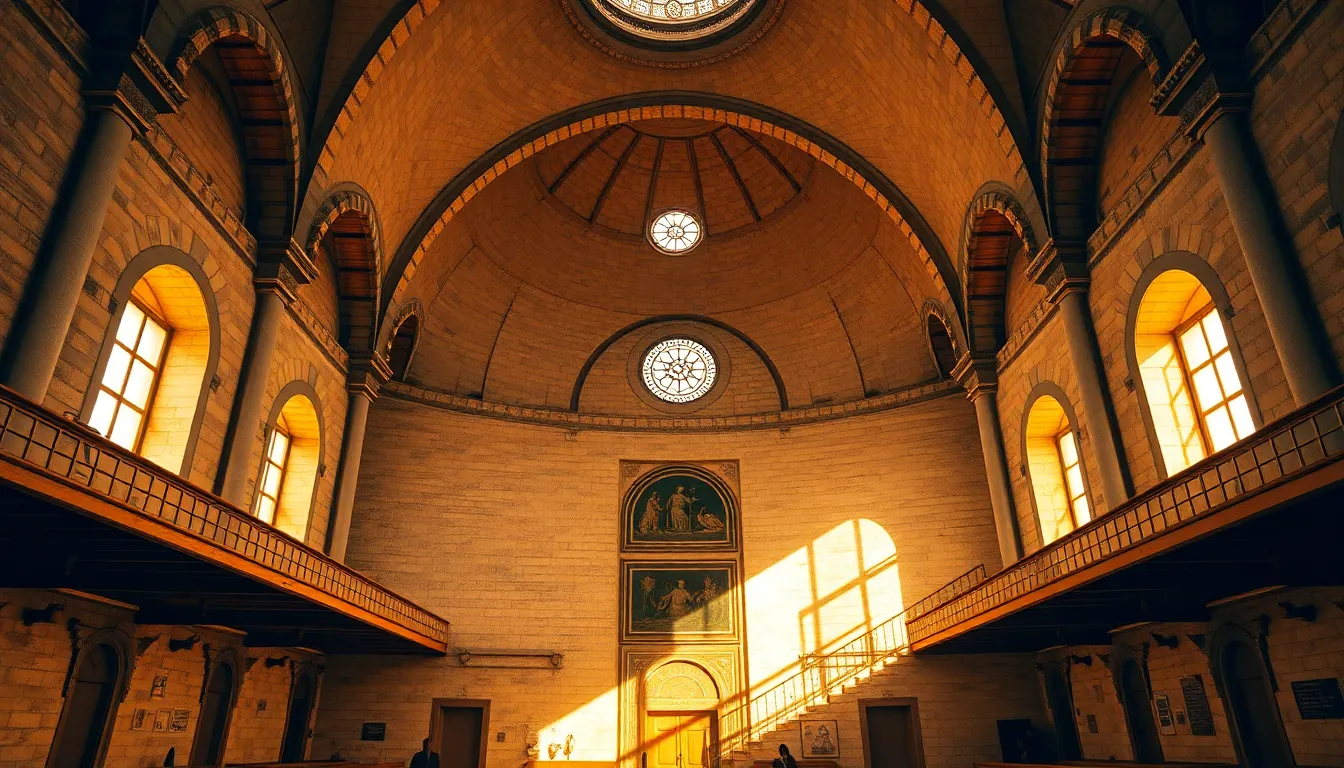
When I bring a group into the Monastirioton synagogue in Thessaloniki, I usually wait until everyone is seated before I tell them the number. Before the war, this city had more than thirty synagogues. Today, one survives as the functioning communal synagogue. You are sitting in it. The room is quiet when I say this, and then it changes. People look at the walls differently. They understand that they are not visiting a representative example of something. They are inside the last one.
This guide is for rabbis and community leaders bringing a group to Thessaloniki, the city once known as the Jerusalem of the Balkans. The Monastirioton synagogue is the living heart of what remains, and how a group experiences it is worth thinking through before you arrive.
How One Synagogue Survived
To understand why the Monastirioton matters, you have to understand what surrounded it. Thessaloniki was, for centuries, the most Sephardic city on earth. By the early twentieth century roughly half the population was Jewish, and the city held dozens of synagogues, each tied to a community of origin, families from Castile, from Aragon, from Italy, from the Balkans. It was a Jewish city with other populations alongside it, not a city with a Jewish minority. You can read the full story in our guide to Jewish heritage in Greece.
Almost all of it was destroyed. In the spring and summer of 1943, the Germans deported nearly the entire community to Auschwitz. The synagogues were looted, burned, or torn down, and many of the buildings that survived the deportations were later destroyed in the war or demolished afterward.
The Monastirioton survived almost by accident. It had been built in 1925 by Jews who came to Thessaloniki from Monastir, the city now called Bitola in North Macedonia, which is where its name comes from. During the occupation, the building was requisitioned and used by the Red Cross as a storehouse. That use is part of why it was spared the fate of the other synagogues. When the war ended and the few survivors returned, the Monastirioton was still standing, and it became the central synagogue of the rebuilt community.
There is a hard irony in this that I do not hide from groups. The synagogue survived because it was emptied of its purpose. It came through the war as a warehouse. That it is once again a house of prayer is the result of a small, determined community choosing to rebuild Jewish life in a city that had lost almost everything.
What the Synagogue Is Like Inside
The Monastirioton is a dignified building in the eclectic style of the 1920s, with a women’s gallery above and a bimah in the Sephardic arrangement. It is not enormous, and that is part of its character. This is a working communal synagogue, not a grand showpiece. It serves the Jewish community of Thessaloniki, which today numbers around 1,000 people, the remnant of a community that once counted more than fifty thousand.
Memorial plaques line the walls, carrying the names of families and of the synagogues that no longer exist. For a visiting group, these plaques are part of the experience. You are sitting among the recorded memory of an entire vanished Jewish world, gathered into the one room that came through.
How a Group Experiences It Today
The Monastirioton is an active synagogue, and that shapes how a visit works. This is not a museum with fixed opening hours and a ticket desk. Access is arranged with the Jewish community of Thessaloniki, and visits are coordinated in advance. That coordination is part of the respect the place is owed, and we handle it for the groups we bring.
Praying in the Room
For a Jewish group, the most meaningful thing is often the simplest. Davening in the Monastirioton, in the one surviving communal synagogue of a city that was once half Jewish, is a moment that stays with people. Some groups time a visit to coincide with a service and pray alongside the local community. Others hold a short tefillah of their own in the room. Either way, the act of prayer in this specific space carries a weight that no commentary from me can add to.
Meeting the Living Community
When it can be arranged, I try to give groups some contact with the community itself, even briefly. Thessaloniki’s Jews are not a memory. They are a small, resilient, present community that chose to stay and rebuild. Hearing from someone who lives that reality, who carries the city’s Jewish life forward today, changes the visit from an encounter with the past into an encounter with continuity. Congregations consistently tell me this is what they remember most.
Connecting It to the Wider City
The Monastirioton does not stand alone. A full day in Jewish Thessaloniki usually includes the Jewish Museum, which tells the story of the community with rigor, and the Holocaust memorial near the old railway station, from which the deportation trains departed. The synagogue is the living center of that day, the place where the story is not only told but still lived. The broader Sephardic story behind the city runs through our guide to Sephardic heritage in Greece, and the events that emptied it are covered in our account of the Holocaust of Greek Jewry.
Planning a Visit With a Group
A visit to the Monastirioton needs to be arranged in advance with the Jewish community of Thessaloniki, and it should be built into a fuller day in the city rather than treated as a quick stop. Give Thessaloniki at least two full days on a Jewish heritage itinerary. The synagogue, the museum, the memorial, and the old neighborhoods where the community lived all deserve unhurried time.
At Heritage Tours, we coordinate these visits directly with the community, and we build the day around what your group is looking for. A congregation with roots in Salonica will want different time and different attention than a group encountering the city for the first time.
The group leader travels free when you bring fifteen or more participants. If you are a rabbi planning a journey to Thessaloniki for your community, we would be glad to help you build the day around the Monastirioton properly.
FAQ: The Monastirioton Synagogue
Why is the Monastirioton the only synagogue left in Thessaloniki?
Before the war, Thessaloniki had more than thirty synagogues. Nearly all were destroyed when the community was deported in 1943, or demolished during and after the war. The Monastirioton survived largely because it was requisitioned and used as a Red Cross storehouse during the occupation, which spared it. It became the central synagogue of the rebuilt community.
When was the Monastirioton synagogue built?
It was built in 1925 by Jews who had come to Thessaloniki from Monastir, the city now called Bitola in North Macedonia, which is the source of its name. It is one of the relatively few synagogues in the city built in the modern era, and the only one still serving the community today.
Can groups visit and pray in the Monastirioton?
Yes, with advance coordination. The Monastirioton is an active communal synagogue rather than a museum, so visits are arranged in advance with the Jewish community of Thessaloniki. Groups can pray in the room, and where possible we time visits to allow contact with the living community.
How large is the Jewish community of Thessaloniki today?
Around 1,000 people, the remnant of a community that once numbered more than fifty thousand and made up roughly half the city. They are a small, resilient, present community that chose to rebuild Jewish life in the city after the war.
What else should a group see in Jewish Thessaloniki?
Alongside the Monastirioton, a full day usually includes the Jewish Museum of Thessaloniki and the Holocaust memorial near the old railway station, where the deportation trains departed. Plan at least two full days in the city to give the sites the time they deserve.
If you are imagining this visit for your community, I would be glad to help you arrange it properly. The Monastirioton is the living center of Jewish Thessaloniki, and a visit done with care stays with a group. You can see how we structure these journeys on our Greece heritage page or learn how the group experience works on our group heritage tours page.
Contact us whenever you are ready to start planning.