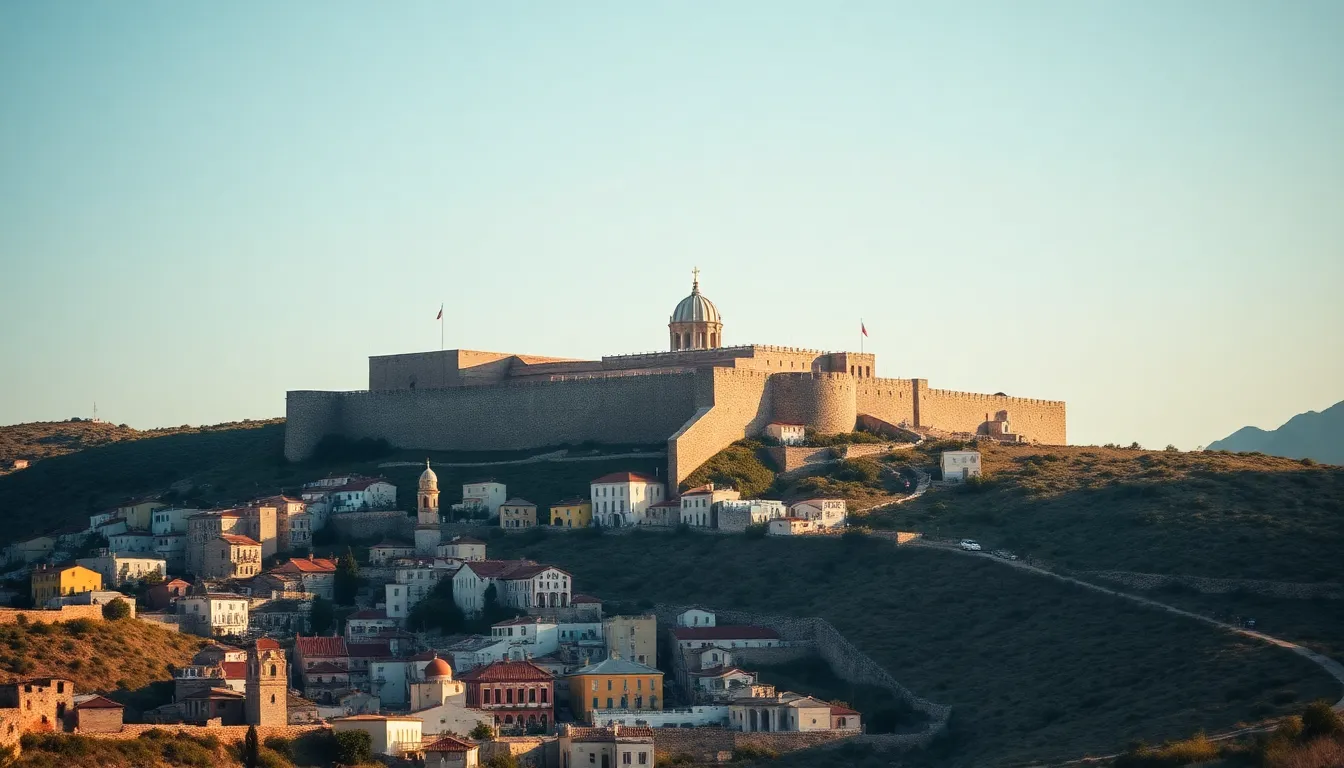
You see it before the boat even docks. As you come into the harbor at Patmos, the whole island rises to a single point, and crowning that point is a dark stone fortress that looks more like a castle than a church. That is the Monastery of Saint John the Theologian. I have brought a lot of groups to this island, and the first reaction is almost always the same. People expected a quiet chapel. They did not expect a fortress on a hill that has guarded the memory of the Book of Revelation for nine hundred years.
Patmos is where John was exiled, and where, “in the Spirit on the Lord’s day,” he received the visions that became the last book of the Bible. The monastery is the heart of that story on the ground. Let me walk you through what it is, why it matters, and how to visit it well with a group.
What the Monastery Actually Is
The Monastery of Saint John the Theologian was founded in 1088 by a monk named Christodoulos, who received the island from the Byzantine emperor as a place to build a religious community. From the start it was built to survive. The Aegean in that era was raided by pirates and contested by rival powers, so the monastery went up as a fortress, with high battlemented walls, a single defensible gate, and the church and living quarters tucked safely inside.
That defensive design is exactly why so much survives. Behind those walls the community kept its treasures intact through centuries that destroyed lesser sites. Today the whole hilltop town of Chora and the monastery within it are recognized as a UNESCO World Heritage Site, together with the nearby Cave of the Apocalypse.
For a group, the first thing to grasp is that this is a living monastery, not a museum. Monks still live and pray here. You are a guest in an active community, and that shapes how you visit.
Why Patmos and the Book of Revelation
The reason your group is here is John’s exile. Revelation opens with John writing that he was “on the island called Patmos, because of the word of God and the testimony of Jesus.” He was banished here, almost certainly by Roman authority, and it was on this rocky island that he received and recorded his visions of the churches, the throne, the judgments, and the new Jerusalem.
The monastery sits above the traditional site of those visions. Partway down the hill, between the harbor at Skala and the hilltop town, is the Cave of the Apocalypse, a small grotto where tradition holds that John heard the voice “like a trumpet” and dictated the Revelation to his disciple. The cave is its own stop, and many groups read from Revelation 1 inside or just outside it.
What the monastery adds is permanence. The island gave John his visions; the monastery is how the church has kept and honored them across the centuries. Standing at both, your people feel the whole arc, from a lonely exile to a fortress built to guard the memory.
What Your Group Will See Inside
Inside the walls, the monastery rewards a slow visit.
The main church, or katholikon, is rich with Byzantine frescoes and icons, dim and incense-soaked in the way these churches are. Off the courtyards you will find several chapels, including one dedicated to Christodoulos, the founder, whose relics are kept here.
The treasury and museum are the real surprise for most groups. The monastery holds one of the most important collections of religious manuscripts and icons outside the great centers, including ancient codices, illuminated gospels, and historic documents. For pastors and educators, this is a window into how the text and faith were copied, guarded, and passed down by hand.
Take time on the walls and in the courtyards too. The views over the Aegean from the ramparts are extraordinary, and they make the island’s isolation, the very thing that exiled John, easy to feel.
How to Structure the Visit
Here is the order that works for me with a group.
Begin lower down at the Cave of the Apocalypse, before the climb to the monastery. Read Revelation 1:9 to 19 at or near the cave, where the exile and the vision are most vivid. It sets the spiritual frame for everything above.
Then go up to the monastery. Walk the walls, visit the katholikon, and give real time to the treasury. A short reflection works well in one of the courtyards rather than inside the working church, out of respect for the monks and other pilgrims.
Leave room to simply stand on the ramparts and look out at the sea that held John in exile. Some of the quietest, most meaningful minutes my groups have spent on Patmos were up there, saying nothing.
For where Patmos fits in a wider journey, many groups add the island as an extension to a mainland Pauline route. Our guide to following the Apostle Paul through Greece shows how the trip is built, and our overview of spiritual sites in Greece places Patmos among them.
A Practical Word on Access and Respect
Two things shape a visit here, and I am honest about both with leaders.
The first is the climb and the layout. The monastery sits at the top of a steep hill, and the town of Chora around it is a maze of narrow, stepped lanes. Many groups take a short bus or taxi ride from the harbor up toward Chora rather than walking the whole climb. Inside the monastery there are steps and uneven stone underfoot. For a mixed-age group, build in time and consider transport up the hill.
The second is dress and conduct. This is an active Orthodox monastery with a real dress code. Shoulders and knees should be covered for both men and women, modest dress throughout, and quiet inside the church. Photography is restricted in parts of the complex, especially the treasury, so follow the posted rules and your guide’s direction. I brief every group on this before we arrive, because a respectful group is always welcomed warmly.
Patmos is reached by ferry, so plan your sea crossing and the island’s slower pace into the itinerary rather than treating it as a quick add-on. We handle the logistics so your group can focus on the place.
FAQ: Visiting the Monastery of Saint John on Patmos
What is the Monastery of Saint John the Theologian?
It is a fortified Byzantine monastery founded in 1088 on the hilltop of Patmos, built like a fortress to survive pirate raids. It honors the apostle John and stands above the traditional site where he received the Book of Revelation. The complex is a UNESCO World Heritage Site.
How is the monastery connected to the Book of Revelation?
John was exiled to Patmos and received his visions there, as Revelation 1 records. The monastery sits above the Cave of the Apocalypse, the grotto where tradition holds John heard the voice and dictated the book. Together they form the heart of the Revelation story on the island.
Is there a dress code for the monastery?
Yes. It is an active Orthodox monastery, so shoulders and knees must be covered for both men and women, and modest, quiet conduct is expected inside the church. Photography is restricted in some areas, especially the treasury. Following the dress code is required for entry.
How do groups get up to the monastery?
The monastery crowns a steep hill above the harbor at Skala. Most groups take a short bus or taxi ride up toward the town of Chora and then walk the final stepped lanes, which keeps the climb manageable for mixed-age travelers.
How much time should we plan on Patmos?
Plan most of a day. Patmos is reached by ferry and moves at a slower pace, and a good visit covers the Cave of the Apocalypse, the monastery church, the treasury, and time on the walls without rushing.
Patmos rewards groups that come unhurried. The fortress on the hill, the cave below, and the sea all around make Revelation feel less like a riddle and more like a place. If you are planning a Greece heritage journey for your congregation, I would be glad to help you build Patmos into it well. You can see how we structure these trips on our Greece heritage page or explore our group heritage tours.
Contact us whenever you are ready to start the conversation.