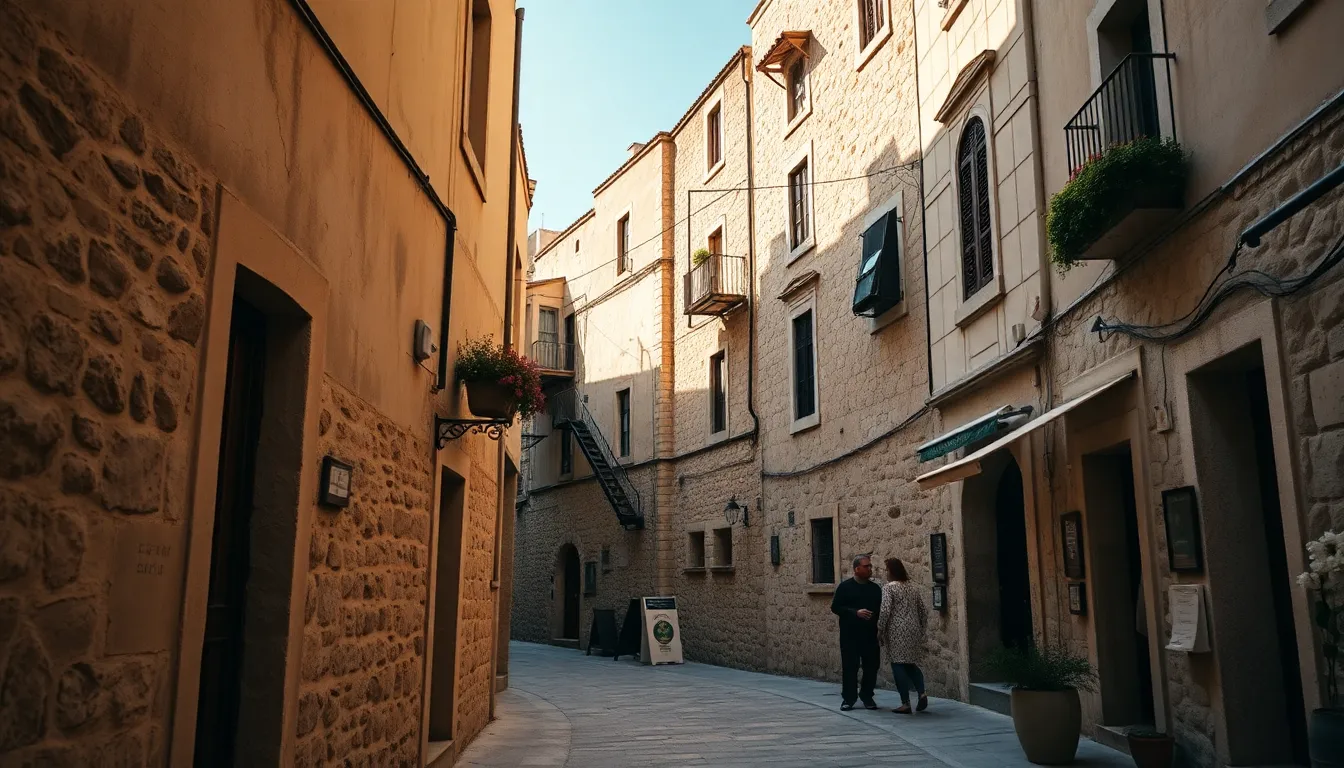
The first time I brought a group into La Juderia, we entered through the old city walls in the late afternoon, when the stone holds the warmth of the day and the streets empty out. We turned a corner and a woman in the group stopped walking. She had grown up hearing her grandmother talk about Rhodes, about the courtyards and the sea air, and she had not expected the place to still be standing. It is. The Jewish Quarter of Rhodes is one of the few in Europe where you can walk the actual streets a community walked for four and a half centuries. That is the trip I want to help you give your congregation.
This guide is for rabbis and community leaders thinking about Rhodes as part of a Jewish heritage journey to Greece. The quarter is small. You can walk it in an afternoon. But what it holds, and what it lost, deserves slow attention.
What La Juderia Was
La Juderia, the Jewish Quarter, sits inside the medieval walled city of Rhodes, in the far southeastern corner of Greece, closer to the Turkish coast than to Athens. Jews lived on Rhodes long before the Sephardic expulsion, but the community that shaped the quarter took form after 1492, when Jews expelled from Spain settled across the Ottoman Mediterranean. Rhodes became one of their homes.
The community here was modest in size, roughly 4,000 at its height and around 1,700 by the eve of the Second World War. It was never a great metropolis like Thessaloniki. What made Rhodes distinct was its character: an island Sephardic culture, Ladino-speaking, tightly woven, shaped by trade and proximity to Turkey and by the slow rhythm of island life. People here called their home “la chica Yerushalayim,” the little Jerusalem. They meant it.
The quarter occupied the eastern section of the old city, near the harbor. The Knights of Saint John had built the walled city centuries earlier, and the Jewish community lived inside those same walls, in the same stone houses, for generation after generation. When you walk it today, you are walking medieval streets that Jewish families called home into the 1940s.
Walking the Streets Today
What survives at La Juderia is unusual, and it is worth understanding why. Many Jewish quarters in Europe were destroyed during the war, or torn down and rebuilt afterward, or absorbed so completely into modern cities that nothing recognizable remains. La Juderia survived as architecture. The narrow lanes, the stone arches, the small courtyards, the worn thresholds are physically intact.
The Square of the Jewish Martyrs
The heart of the quarter is the Square of the Jewish Martyrs, known in the old days as the Place of the Sea Horses for the fountain at its center. This is where I gather a group first, because the square tells the whole story. People lived around it. Children played here. And in July 1944, the entire Jewish community of Rhodes was assembled in this square before deportation.
A memorial stands here now, with inscriptions in several languages. Standing in the square with your congregation, you can see the houses the community lived in rising on every side. The distance between ordinary life and catastrophe was the width of this small plaza.
The Streets and Courtyards
From the square, the lanes run in every direction. You can still read the shape of the community in the buildings: homes, small workshops, the spaces where businesses once operated. Above some doorways you can find the marks where a mezuzah was once fixed. These are not grand monuments. They are the fabric of a daily Jewish life that lasted centuries, and that ordinariness is exactly what makes the place land for a group.
I encourage leaders to let people wander a little here, within reason, and then gather again. The quarter is small enough that no one gets lost, and a few quiet minutes alone in these streets does something a guided line cannot.
The Kahal Shalom Synagogue
At the center of any visit to La Juderia is the Kahal Shalom synagogue, built in 1577. It is the oldest synagogue in Greece still in use, and one of the oldest in the eastern Mediterranean.
The interior is beautiful in the Sephardic island style, restrained rather than ornate. The bimah sits elevated in the center of the room, and a women’s gallery runs above, following the tradition the community carried from Spain through the Ottoman world. The floor is laid with black and white pebble mosaic, the same hochlakia work you see across the Dodecanese islands, which roots the building unmistakably in this particular place.
During the summer months, services are held here for the small remaining community and for Jewish travelers who come to pray. For a visiting group, davening in Kahal Shalom, in a room where prayer has continued for four and a half centuries, is the kind of moment that defines a trip.
Adjacent to the synagogue is the Jewish Museum of Rhodes, housed in the women’s prayer rooms. The collection holds photographs, documents, ketubot, religious objects, and the records of families who lived in the quarter. The museum was built and is sustained largely by descendants of the Rhodes community scattered across the world, in the United States, in Africa, in Israel. Walk through it and you understand that this community did not simply vanish. It dispersed, and it remembers.
What Happened in July 1944
I tell groups this part plainly, because it matters and because the quarter cannot be understood without it. By the summer of 1944, Rhodes was under German occupation. The Jews of Rhodes, along with the Jews of nearby Kos, were assembled and held, then put on boats and sent across the Aegean to the mainland, and from there deported by rail to Auschwitz. Of roughly 1,700 deported, only around 150 survived.
The community of Rhodes, after more than four centuries on the island, was effectively erased in a matter of weeks. The deportation from a remote Aegean island, reached only by sea, carried out so late in the war, is one of the details that stays with people. The reach of the destruction extended even here.
The names of those deported are recorded on the memorial in the square. Reading some of them aloud with your group is a practice we encourage. These were not abstract figures. They lived in the houses you just walked past.
Building Rhodes Into a Group Itinerary
Rhodes pairs naturally with the wider Jewish heritage route through Greece. Most dedicated itineraries center on Thessaloniki, Rhodes, and Ioannina, each representing a different Jewish tradition and a different chapter. You can see how the three fit together in our guide to Jewish heritage in Greece.
For La Juderia itself, plan a full day on Rhodes. The Old City, the quarter, the Kahal Shalom synagogue, and the museum deserve unhurried time, and the Square of the Martyrs deserves a place where your group can sit rather than pass through. Rhodes also connects thematically to the wider Sephardic story that runs through Greece, which we cover in our guide to Sephardic heritage in Greece, and to the broader history of the Holocaust of Greek Jewry.
At Heritage Tours, we build these itineraries from the ground up for each community. A congregation with family roots in Rhodes will want different time and different attention than a group encountering the island for the first time. The itinerary should reflect who is traveling.
The group leader travels free when you bring fifteen or more participants. For many congregations, that changes the math on a dedicated heritage journey. If you are a rabbi weighing this trip for your community, we would be glad to talk it through.
FAQ: The Jewish Quarter of Rhodes
Where is the Jewish Quarter of Rhodes?
La Juderia sits in the eastern section of the medieval walled Old City of Rhodes, near the harbor, in the far southeastern corner of Greece. The whole quarter is walkable on foot in an afternoon, and the Old City is closed to most traffic, so you move through it the way the community did.
Can you visit the Kahal Shalom synagogue?
Yes. The Kahal Shalom synagogue, built in 1577, is open to visitors and is the oldest synagogue in Greece still in use. During the summer months, services are held for the small remaining community and for visiting Jewish travelers. The adjacent Jewish Museum of Rhodes is part of the same visit.
What happened to the Jewish community of Rhodes?
In July 1944, under German occupation, the roughly 1,700 Jews of Rhodes were assembled in the Square of the Jewish Martyrs and deported across the Aegean, then by rail to Auschwitz. Only around 150 survived. The community, after more than four centuries on the island, was effectively destroyed.
How long does a visit to La Juderia take?
The quarter itself can be walked in two to three hours, but we recommend a full day on Rhodes so the Old City, the synagogue, the museum, and the Square of the Martyrs each get unhurried time. Rushing this visit costs your group the quiet moments that make it matter.
Why was Rhodes called the little Jerusalem?
The community called Rhodes “la chica Yerushalayim,” the little Jerusalem, because of how deeply rooted and self-contained Jewish life on the island was. It was a tightly woven Sephardic community, Ladino-speaking, with its own synagogues, schools, and traditions sustained over four and a half centuries.
If you are beginning to imagine this journey for your congregation, I would be glad to help you shape it. The streets are real, the synagogue still stands, and the story settles on people once they are standing in it. You can see how we structure these trips on our Greece heritage page or learn how the group experience works on our group heritage tours page.
Contact us whenever you are ready to start planning.