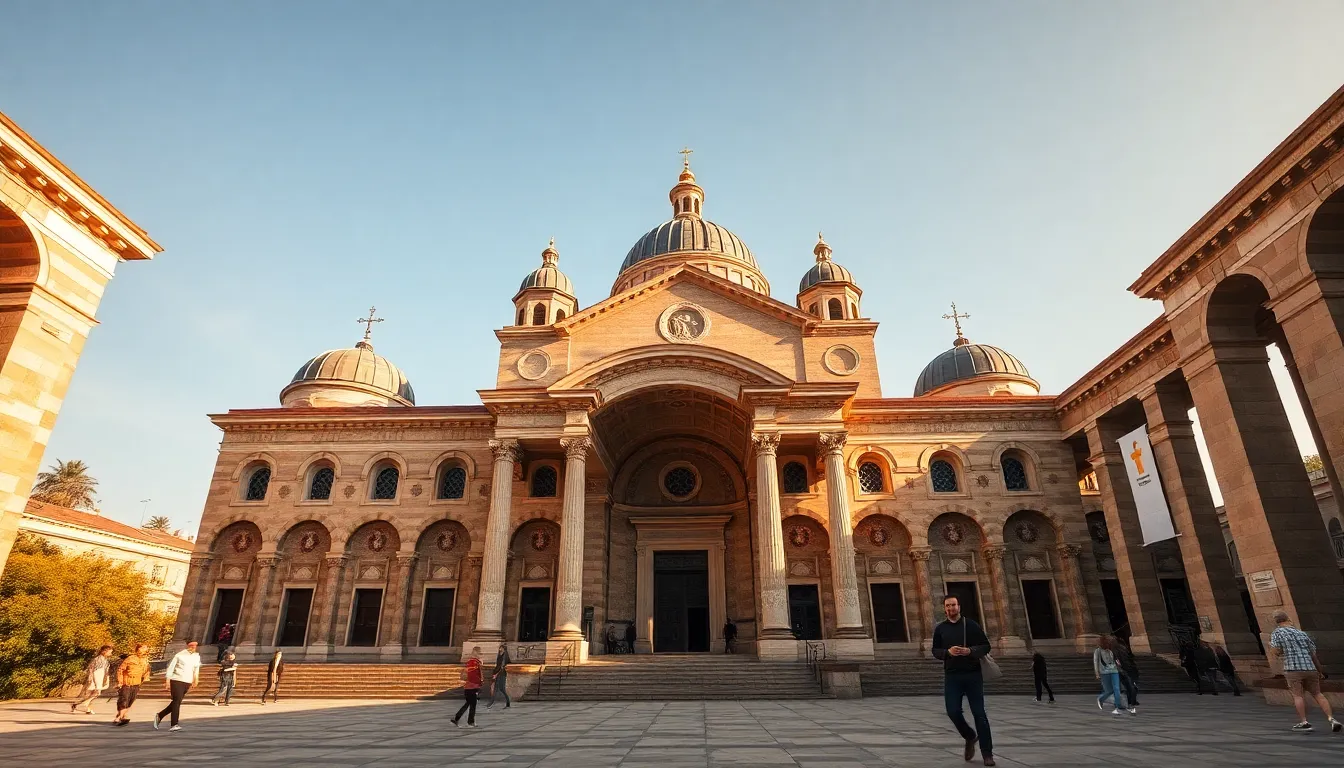
Thessaloniki is a loud, modern, lived-in city, and most of my groups arrive expecting ruins and instead find traffic, cafes, and a working harbor. So I take them off the busy street and through the doors of Hagios Demetrios, and the city changes register completely. Inside that great five-aisled basilica it goes cool and quiet, the early mosaics catch the light, and the whole long Christian history of the city is suddenly standing around you. This is the church of the city’s patron saint, built over the place where he died, and it is the single best stop in Thessaloniki for a heritage group.
Paul preached here, in the synagogue, on his second journey. The city he addressed grew into one of the great centers of Byzantine Christianity, and Hagios Demetrios is the proof of it in stone. Let me tell you what the basilica is, who Demetrius was, and how to visit it well with a group.
Who Saint Demetrius Was
Demetrius is the patron saint of Thessaloniki, and the church exists because of him.
Tradition holds that Demetrius was a Christian in the city during the persecutions of the early fourth century, under the emperor Galerius, who ruled from Thessaloniki. He was imprisoned for his faith and martyred, by tradition speared to death in the Roman baths near the site where the basilica now stands. He became the city’s protector, credited over the centuries with defending Thessaloniki in times of siege, and devotion to him grew into one of the strongest local cults in the Byzantine world.
For a group, Demetrius gives the city a human face. Paul’s preaching planted the seed; Demetrius shows what it cost to keep the faith a couple of centuries later, in the same city, under Roman power. The basilica honors a real martyr on the ground where he is remembered to have died.
What the Basilica Actually Is
The Basilica of Saint Demetrius is a great early Christian church, a five-aisled basilica of the kind that was the standard for major churches in the early Byzantine centuries. The first church here rose in the fifth century over the site of the saint’s martyrdom, replacing earlier structures.
The building has been through fire and rebuilding more than once. A major fire in 1917 destroyed much of the city center and badly damaged the basilica, which was carefully restored afterward. Because of that long, layered history, Hagios Demetrios is part of the group of Paleochristian and Byzantine monuments of Thessaloniki recognized together as a UNESCO World Heritage Site.
What makes it special inside are the early mosaics that survived. Several panels date from the centuries right after the church was built, showing Saint Demetrius with the children and the officials who restored the church. They are among the finest early Byzantine mosaics anywhere, and they let your group look the early church almost in the eye.
The Crypt Below the Church
The part that surprises groups most is underground, and I always make sure we go down.
Beneath the basilica is the crypt, built around the traditional spot of the saint’s martyrdom and the Roman baths associated with it. For a long time this lower level was buried and forgotten; it was rediscovered after the 1917 fire and is now open as a museum space.
Down in the crypt you walk among ancient masonry, fragments of sculpture and inscriptions, and a fountain associated with the saint’s veneration. It is dim, cool, and reverent, and it puts you at the lowest and oldest layer of the site, close to where the story began. Reading or reflecting here, beneath the great church, with the martyrdom tradition all around you, is one of the quietest and most affecting moments a group can have in Thessaloniki.
What to Do With Your Group
Here is how I structure the visit.
Begin in the main basilica. Let your people take in the scale of the five aisles and find the surviving early mosaics; point them out, because they are easy to walk past. This is the place to talk about Thessaloniki as a city Paul addressed and the church it grew into. The two letters to the Thessalonians make a natural reading thread.
Then go down to the crypt. The change in atmosphere does the work. A short reflection on faithfulness under persecution fits the place, with Demetrius as the example and the early believers Paul wrote to as the backdrop. Keep voices low; this is an active church and people come here to pray.
Hagios Demetrios sits within easy reach of the city’s other Byzantine landmarks, so it pairs naturally with the Rotunda and a walk through the old upper town. For where Thessaloniki fits in the wider journey, see our guide to following the Apostle Paul through Greece, and our overview of spiritual sites in Greece places the basilica among them.
A Practical Word on Access
This is one of the easier major sites for a mixed-age group, which is a relief after some of the climbs elsewhere in Greece.
The main basilica is at street level and largely step-free, so most of your group can move through it comfortably. The crypt is reached by stairs down to the lower level, so anyone who cannot manage steps can stay and rest in the main church while the rest of the group goes below. No one needs to miss the visit.
It is an active church, so dress modestly, with shoulders and knees covered, and keep quiet inside, especially if a service is underway. Photography is usually allowed without flash, but follow any posted signs. Entry to the basilica is generally free, with a small charge sometimes applying to the crypt museum. We brief the group before we arrive so everyone walks in ready and respectful, and we set the pace around the people you bring.
FAQ: Visiting the Basilica of Saint Demetrius
Who was Saint Demetrius of Thessaloniki?
Demetrius is the patron saint of Thessaloniki, a Christian martyred in the city during the early fourth-century persecutions, by tradition speared in the Roman baths near the basilica site. He became the city’s protector, and the great basilica was built over the place of his martyrdom.
What is the Basilica of Saint Demetrius?
It is a great five-aisled early Christian church first built in the fifth century over the saint’s martyrdom site. Rebuilt after a major fire in 1917, it preserves outstanding early Byzantine mosaics and is part of a UNESCO World Heritage Site in Thessaloniki.
What is in the crypt below the basilica?
The crypt is built around the traditional site of the saint’s martyrdom and the associated Roman baths. Rediscovered after the 1917 fire, it now holds ancient masonry, sculpture and inscription fragments, and a fountain tied to the saint’s veneration, and it is open as a museum space.
Is the basilica accessible for older travelers?
Yes. The main basilica is at street level and largely step-free, making it one of the easier sites in Greece for a mixed-age group. The crypt is reached by stairs, so anyone who cannot manage steps can rest in the main church while others go below.
How long should a group spend at Hagios Demetrios?
Plan forty-five minutes to an hour. That allows time to take in the basilica and its mosaics, descend to the crypt, and hold a short reflection without rushing, often paired with the nearby Rotunda on the same Thessaloniki walk.
Hagios Demetrios turns Thessaloniki from a stopover into one of the richest stops on a Greek heritage journey. If you are planning a Greece heritage trip for your congregation, I would be glad to help you build the city in well. You can see how we structure these trips on our Greece heritage page or explore our group heritage tours.
Contact us whenever you are ready to start the conversation.