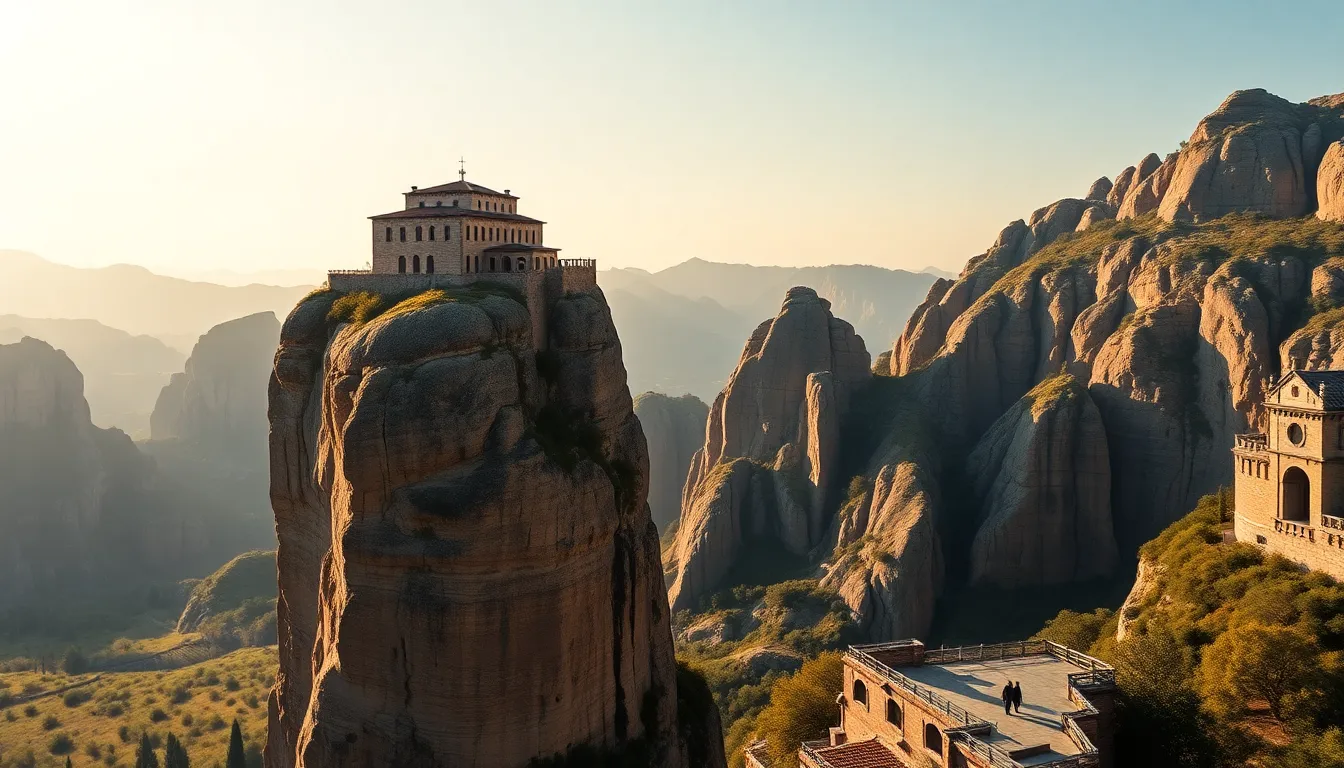
The first time a group sees Meteora, the bus goes quiet on its own. You come around a bend in the road near Kalambaka and the rock pillars just appear, hundreds of feet of sheer grey stone rising straight out of the plain, and perched on top of them, impossibly, are monasteries. Somebody always asks the same question: how on earth did anyone build up there? And of all those monasteries, the largest and the oldest, the one crowning the highest pillar, is the Great Meteoron. That is the one I make sure my groups stand inside.
Meteora means “suspended in the air,” and the name fits. For a faith group, this is a place where the landscape preaches before you say a word. Let me tell you what the Great Meteoron is, why monks climbed up here in the first place, and how to visit it well.
What the Great Meteoron Actually Is
The Great Meteoron, properly the Holy Monastery of the Transfiguration, is the largest and oldest of the surviving Meteora monasteries. It was founded in the fourteenth century by Saint Athanasios the Meteorite, the monk who first organized a community on these rocks and gave the place its name.
It sits on the highest and broadest of the pillars, which is why it grew into the most important of the cluster. At its peak, Meteora held more than twenty monasteries on these summits. Six remain active today, and the Great Meteoron is the grandest of them. The whole Meteora complex is a UNESCO World Heritage Site, recognized for both its natural drama and its monastic heritage.
For a group, the headline is the combination. You are visiting a working Orthodox monastery, set in one of the most extraordinary landscapes in Europe, with a history of devotion stretching back six centuries.
Why Monks Climbed These Rocks
The natural question deserves a real answer, because it teaches something.
Hermits first sought out these pillars precisely because they were unreachable. The early monks wanted solitude, separation from the world, and protection in dangerous times, and a sheer rock summit gave them all three. Living suspended between earth and sky was the point. It made the spiritual idea physical.
For centuries the only way up was terrifying. Monks and supplies were hauled to the top in nets and baskets on long ropes, or up retractable wooden ladders that could be pulled in. The story goes that the ropes were replaced “only when the Lord let them break.” Your group will hear that line, and it lands, because they can look down the drop and feel exactly what kind of trust that took.
That history is worth dwelling on with a congregation. These communities chose the hardest possible place to seek God, and they kept the lamp of faith burning through Ottoman centuries when much around them did not survive. The rocks are a sermon on devotion and endurance.
What Your Group Will See Inside
Once you reach the top, the Great Meteoron rewards the climb.
The main church, the katholikon dedicated to the Transfiguration, is covered in Byzantine frescoes, dim and reverent. Take time here, but keep voices low, because it is a place of prayer.
The monastery also preserves the old kitchen, the refectory, and the cellars, which give a vivid picture of how a self-sufficient community lived on a rock with no easy access to anything. There is a small museum and treasury with manuscripts, icons, and historic objects. And there is an ossuary, where the skulls of past monks are kept, a sobering and honest reminder of mortality that many groups find unexpectedly moving.
Then there are the views. From the terraces of the Great Meteoron you look out over the other monasteries on their own pillars and across the whole valley. It is one of the great views in Greece, and it is the natural place to pause and let your people take it in.
How to Structure the Visit
Here is the shape that works with a group.
Plan the Great Meteoron as the centerpiece of a Meteora day, paired with one or two of the smaller monasteries nearby so your people get variety without exhausting themselves. Each monastery keeps its own opening days, and they rotate, so the schedule has to be checked in advance. We handle that so you do not arrive on a closed day.
Inside, move through the church, the historic rooms, and the museum at an unhurried pace, then gather on a terrace for a short reflection. The Transfiguration is the dedication of the main church, and it is a fitting theme: a mountaintop, a glimpse of glory, a call to come back down and serve. Reading that account with the valley spread out below you is a moment groups remember.
For where Meteora fits in a wider journey, it pairs naturally with a Pauline mainland route. Our guide to following the Apostle Paul through Greece shows how trips are built, and our overview of spiritual sites in Greece places Meteora among them.
A Practical Word on Access and Dress
I am always straight with leaders about Meteora, because the access shapes everything.
The Great Meteoron involves a real climb. From the parking area you descend a path and then climb a long flight of stone steps cut into the rock, well over a hundred of them, to reach the entrance. There are handrails, but it is a genuine effort, and the steps can be slippery. For a mixed-age group, this is the most physically demanding of the Meteora monasteries. If some members are not up to the full climb, we can build the day so they visit one of the more accessible monasteries while others go up to the Great Meteoron, and no one feels left out.
Dress code is strict, as at any active Orthodox monastery. Knees and shoulders covered for everyone, and women are expected to wear skirts; the monastery provides wrap skirts at the entrance for those who arrive in trousers. I brief every group before we arrive so we walk in ready and respectful.
Wear shoes with grip, bring water, and start earlier in the day to beat both the heat and the largest crowds. We set the pace around the people you bring.
FAQ: Visiting the Great Meteoron
What is the Great Meteoron monastery?
It is the largest and oldest of the six active monasteries at Meteora in central Greece, properly called the Holy Monastery of the Transfiguration. Founded in the fourteenth century by Saint Athanasios the Meteorite, it sits atop the highest rock pillar and is part of a UNESCO World Heritage Site.
Why were the Meteora monasteries built on top of rock pillars?
Hermits sought the summits for solitude, separation from the world, and safety in dangerous times. The sheer rocks made the communities almost unreachable, which protected them through centuries of upheaval. For early monks, living suspended between earth and sky expressed the spiritual life itself.
Is there a dress code at the Great Meteoron?
Yes, and it is enforced. Knees and shoulders must be covered for everyone, and women are expected to wear skirts; the monastery lends wrap skirts at the entrance. Quiet, modest conduct is expected throughout, especially inside the church.
How hard is the climb to the Great Meteoron?
It is the most demanding of the Meteora monasteries. You descend a path and then climb a long flight of stone steps cut into the rock to reach the entrance. There are handrails, but it takes real effort, so plan extra time and good shoes for a mixed-age group.
How long should a group spend at Meteora?
Plan a full day. A good Meteora visit covers the Great Meteoron plus one or two smaller monasteries, with time for the climbs, the churches and museums, and the views, without rushing the group.
Meteora is the kind of place that does the teaching for you, and the Great Meteoron is its high point in every sense. If you are planning a Greece heritage journey for your congregation, I would be glad to help you build Meteora into it well. You can see how we structure these trips on our Greece heritage page or explore our group heritage tours.
Contact us whenever you are ready to start the conversation.