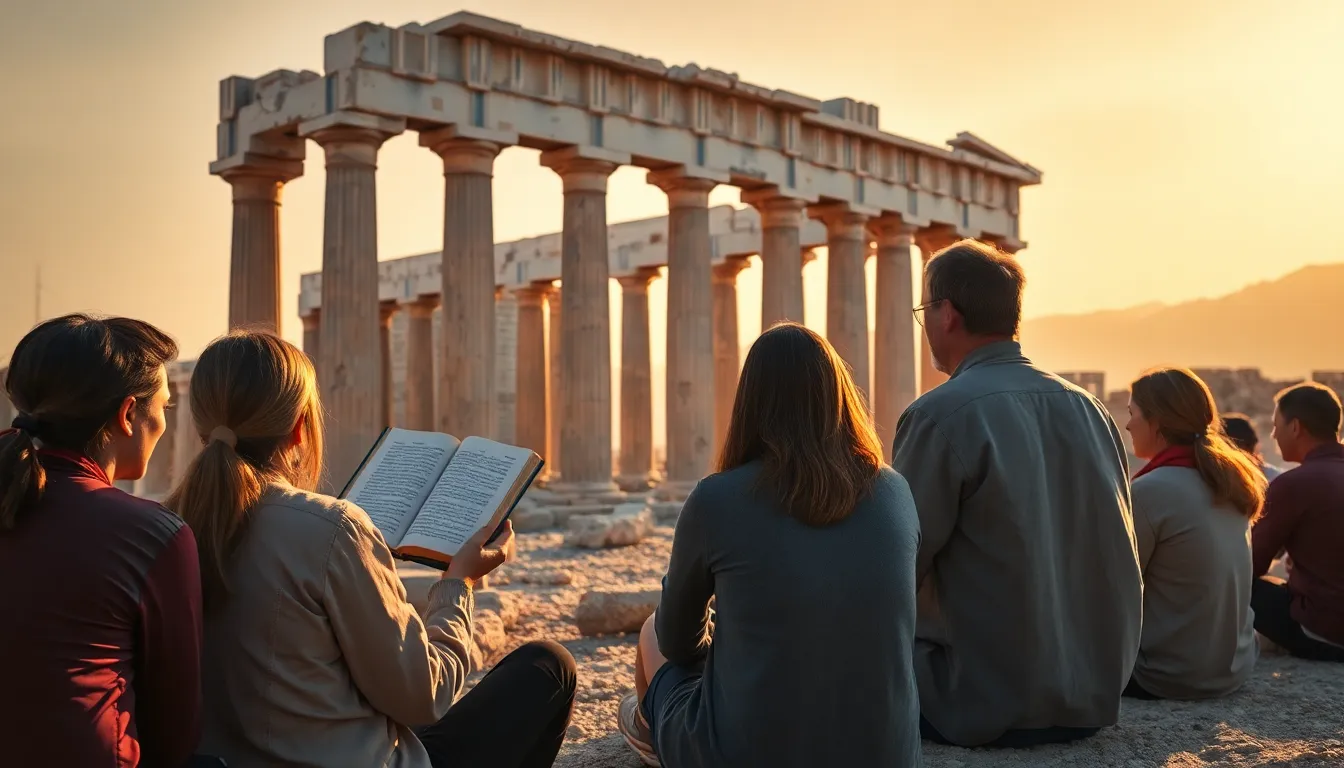
An educator who joined one of our Greece trips told me afterward that her students learned more about Acts in eight days on the ground than in a semester in the classroom, and she did not say it as flattery. She meant it as a problem she wanted to solve back home. Why did the geography unlock the text the way it did? The answer is the whole reason to frame a heritage trip as education rather than tourism. When you read “we sat down and spoke to the women who had gathered there” while sitting at the actual river outside Philippi, the verse stops being words on a page and becomes a place you are standing in. The text moves from your head into your body.
For clergy and educators, Greece is one of the richest teaching environments you can put a group inside, because Paul’s journeys and the Book of Revelation are written into geography you can walk. But the difference between a moving sightseeing trip and a genuine educational journey is the framing you bring to it. Let me show you how to build the teaching in, so your group comes home having learned and not just traveled.
Why Greece Teaches the New Testament So Well
Some biblical journeys are hard to teach on the ground because the sites are uncertain or the landscape has changed beyond recognition. Greece is the opposite. Paul’s second missionary journey runs in a clear line from north to south, the cities are excavated and open, and Acts 16 through 18 reads almost like an itinerary. You can teach the mission in the order it happened.
That sequence is itself a teaching tool. Start at Philippi, the first European church, move through Thessaloniki and Berea, then south to Athens and Corinth, where Paul stayed eighteen months. By the end your group has not just visited sites. They have traced the arc of how the gospel moved into Europe, in order, with a beginning and an end. Our guide to Paul’s footsteps in Greece lays out that full route, and it doubles as a teaching outline.
Build a Reading Plan Tied to the Geography
The core of educational framing is simple: assign the text to the place. Each city on the route has scripture attached to it, and reading that text on location is where the learning happens.
The Passages and Their Places
- Philippi: Acts 16. The conversion of Lydia at the river and the imprisonment of Paul and Silas. Read it at the baptism site.
- Thessaloniki: Acts 17 and First and Second Thessalonians. Paul preached here for three Sabbaths, and two epistles are addressed to this community.
- Berea: Acts 17. The Bereans who “searched the scriptures daily.” A natural place to teach honest inquiry and testing what you hear.
- Athens: Acts 17. The Areopagus sermon to the philosophers, “an unknown god.” Read it on Mars Hill below the Acropolis. We give that scene its own treatment in our guide to the Areopagus in Athens.
- Corinth: Acts 18 and First and Second Corinthians. Paul before Gallio at the bema, and the letters that make sense the moment you see the cosmopolitan city they address.
Assign the reading ahead of the trip and read it again on the ground. The pre-reading gives your group the context. The on-site reading gives them the experience. Together they create real learning rather than passive sightseeing.
Teach the Themes, Not Just the Facts
A guide will give your group the dates, the archaeology, and the history. That is valuable, but it is not the teaching only you can do. Your job as clergy or educator is to draw out the themes the places raise.
Berea teaches discernment, testing what you hear against scripture. Athens teaches engagement with a culture that does not share your assumptions, the way Paul met the philosophers on their own ground. Corinth teaches what it means to build a faithful community inside a divided, distracted, cosmopolitan city, which is why First Corinthians lands so hard when you read it there. Philippi teaches beginnings and the courage of a first step into unknown territory.
Pick the themes that matter to your group and let the sites carry them. A theme taught in the place where it happened is one your people remember for years, not weeks.
Add Revelation With a Patmos Extension
If your teaching extends to the Book of Revelation, Greece gives you a natural addition. The island of Patmos, where John received the Revelation in exile, sits within reach of a Greece itinerary as an extension. Standing at the Cave of the Apocalypse, where tradition holds John received the vision, turns the opening chapters of Revelation from abstract apocalyptic into a real place and a real exile.
A Patmos extension fits a ten to twelve day trip rather than the core eight-day route. For educators teaching through Revelation, or for clergy preaching it, the island gives the text a setting your group can stand inside. It is the same principle as the Pauline cities. The geography unlocks the words.
Structure Reflection and Discussion
Learning sticks when people process it together. Build reflection into the rhythm of the trip, not just the readings and the site visits. An evening discussion after a full day, even a short one, lets your group make sense of what they saw and felt. A few honest questions over dinner do more than any lecture.
Encourage journaling. Ask people to write down one thing each day that struck them. Educators know this, but it bears repeating: the trip becomes education when participants reflect on it, articulate it, and connect it to their own lives. The sites provide the raw material. The reflection turns it into something they keep.
Why Educational Framing Fills the Trip Too
There is a practical bonus to framing the journey as study. The people most likely to commit to a heritage trip are often the ones who want to learn, not just travel. When you present the journey as genuine education, with reading, themes, and reflection, you attract serious participants. We cover the full approach to filling a group in our guide to marketing a Greece heritage trip to your congregation, and the study framing is one of its strongest tools.
It also helps with the practical math. The group leader travels free when you bring fifteen or more participants, with flights, hotels, ground transportation, and site entry covered. The educational framing helps you reach that fifteen, because it gives your most engaged people a reason to come that goes deeper than sightseeing. You can see how the group structure works on our group heritage tours page.
FAQ: Educational Framing for a Greece Trip
What makes a heritage trip educational rather than just travel?
Reading the relevant scripture on the ground where it happened, teaching the themes each place raises, and building in reflection and discussion. Reading Acts 16 at the river in Philippi or the Areopagus sermon on Mars Hill turns the text from words on a page into a place your group stands inside. That is where real learning happens.
Which passages go with which Greek cities?
Acts 16 with Philippi, Acts 17 and the Thessalonian letters with Thessaloniki, Acts 17 with Berea and Athens, and Acts 18 with the Corinthian letters at Corinth. Assign the reading before the trip and read it again on location for the full effect.
Can I include the Book of Revelation?
Yes, with a Patmos extension. The island where John received the Revelation in exile fits a ten to twelve day itinerary. Standing at the Cave of the Apocalypse gives the opening of Revelation a real setting, the same way the Pauline cities ground Acts and the epistles.
Does framing the trip as study help fill the group?
It does. The people most likely to commit are often the ones who want to learn. Presenting the journey as genuine education with reading, themes, and reflection attracts serious participants and helps you reach the fifteen needed for the leader to travel free.
How do I make the learning stick after we get home?
Build reflection into the trip itself. Hold short evening discussions, encourage daily journaling, and connect each theme to your group’s own lives. The sites provide the raw material, but reflection turns it into something participants carry home and keep.
A Greece heritage trip framed as study is one of the most powerful teaching tools a pastor, rabbi, or educator can use, because the geography unlocks the text in a way no classroom can. Build in the reading, the themes, and the reflection, and your group comes home having genuinely learned. See how we structure these journeys on our Greece heritage page, and when you are ready, contact us and we will help you build the teaching in.