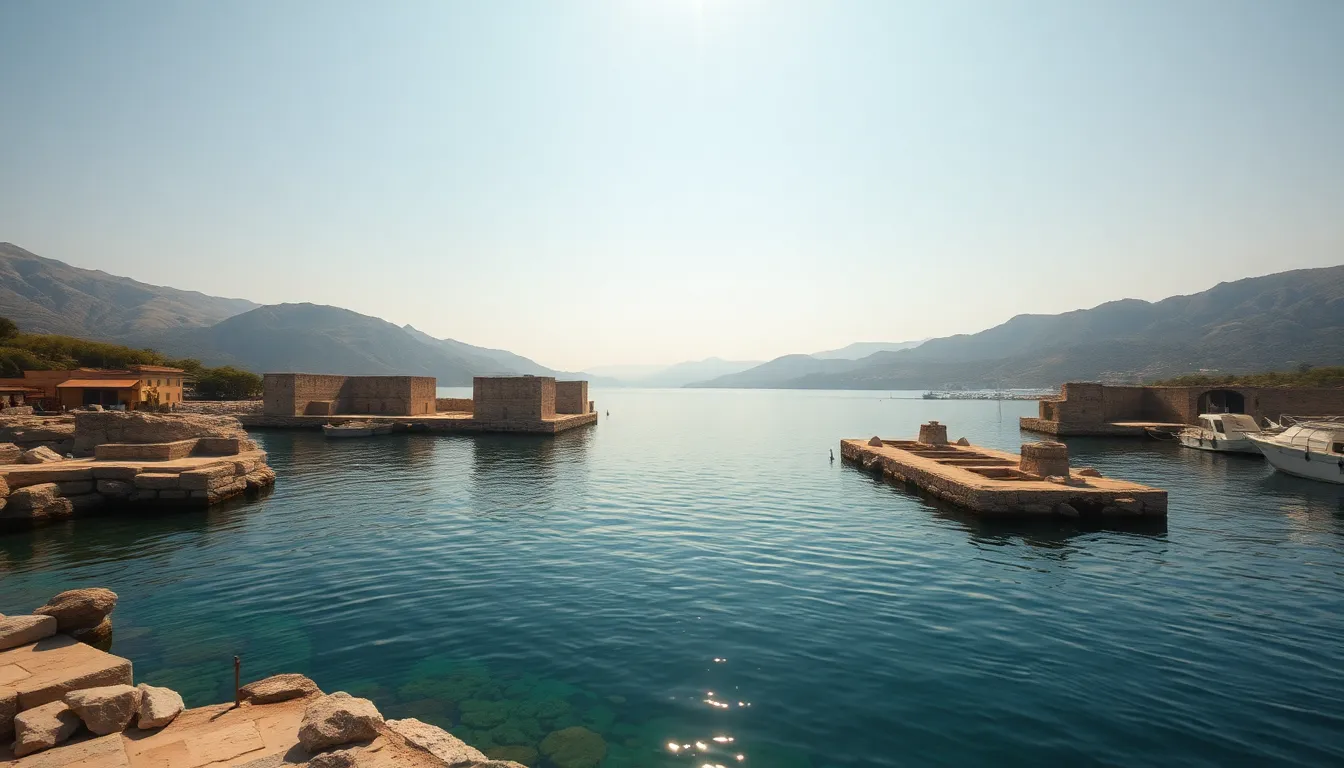
I have a soft spot for Cenchreae, and I will tell you why. Almost no one goes there. The big buses roll into Corinth, do the bema and the temple of Apollo and the museum, and roll out again toward Athens. But a few miles east, on a quiet bay of the Saronic Gulf, sits a place that shows up twice in the New Testament and gets visited by almost nobody. When I bring a group down to that shoreline, with the ancient harbor stones still visible under the shallow water, the whole mood changes. After the scale and crowds of Corinth, Cenchreae feels like a secret. It is one of my favorite stops in all of Greece.
This is a short piece about a small place. But the small place carries more than its size.
Where Cenchreae Sits
Corinth controlled two harbors, one on each side of the narrow isthmus that joins the Greek mainland to the Peloponnese. Lechaion faced west toward Italy. Cenchreae faced east, on the Saronic Gulf, toward the Aegean and Asia Minor. If you were sailing from Corinth toward Ephesus, Syria, or anywhere east, you left from Cenchreae.
That geography is the whole reason the port matters in scripture. Paul was constantly moving between Corinth and the eastern Mediterranean, and Cenchreae was his gateway. Today it is a calm, unspoiled bay. You can still see the remains of the ancient harbor moles, the stone arms that once reached out to shelter the ships, now partly submerged in the clear shallow water. There is no grand monument, no ticket booth crowd. Just a quiet shore where one of the apostle’s most human moments took place.
The Vow Paul Took Here
The first time Cenchreae appears is in Acts 18:18. Paul is wrapping up his long stay in Corinth and preparing to sail east. Luke records the departure with one strange, specific detail: “At Cenchreae he had his hair cut off, for he was keeping a vow.”
That single line opens a window. Paul, the apostle to the Gentiles, the man who argued so fiercely that believers were free from the law, had taken what looks like a Nazirite vow, a Jewish vow of dedication that ended with cutting the hair as an offering. He kept it. Right here, at this harbor, before he boarded the ship.
I love standing a group at the water’s edge and reading that verse, because it complicates the cartoon version of Paul. He was a Jew who treasured his heritage even as he carried the gospel outward. The vow at Cenchreae is a small, vivid sign of a man who held both. It is the kind of detail that makes the New Testament feel like reporting rather than legend. Things this specific and this ordinary do not get invented.
Phoebe, the Deacon of Cenchreae
The second appearance is even more important, and it is the reason I will not let a group skip this place. In Romans 16:1, Paul writes, “I commend to you our sister Phoebe, a servant of the church at Cenchreae.”
Sit with that for a moment. There was a church here. This little working port had its own congregation, distinct from the great Corinthian church up the road. And it had Phoebe.
The word Paul uses for Phoebe is diakonos, deacon or servant, the same word he uses for ministers elsewhere. He calls her a benefactor of many, including himself, and most scholars believe she was the one who physically carried the letter to the Romans from Greece to Rome. Think about what that means. The epistle to the Romans, one of the most influential documents in the history of Christianity, was entrusted to a woman from this overlooked harbor church. She delivered it. Without Phoebe of Cenchreae, the letter does not arrive.
When I tell groups this at the shoreline, you can watch it land, especially with congregations who care about the role of women in the early church. Phoebe is not a footnote. She is the courier of Romans, and her home church was here, on this quiet bay, in a place the buses drive past.
Why a Quiet Site Belongs on Your Itinerary
I understand the temptation to skip Cenchreae. It is not spectacular. There are grander ruins half an hour away. But spectacular is not the only thing a pilgrimage is for, and sometimes it is the opposite of what your group needs.
After the energy of Athens and the scale of Corinth, Cenchreae gives a group a place to exhale. It is small, real, and human. A harbor where a man kept a vow. A church that produced Phoebe. The texture of ordinary early Christian life, the kind that does not make it into the famous photographs. For pastors and educators especially, this stop teaches something the big sites cannot. The early church was not only public sermons and great cities. It was small congregations in working ports, led by faithful people whose names we barely know.
That contrast is exactly why I build it in. Cenchreae rounds out the picture of Paul’s Greece and gives a group a quieter, deeply human note to carry home. It pairs naturally with the full Achaian leg, which I cover in our guide to Paul in Athens, Corinth, and Cenchreae, and it fits into the broader route on our hub for spiritual sites in Greece.
Visiting Cenchreae With a Group
A few practical notes. Cenchreae is an easy add-on from Corinth, only a short drive east, so it costs your itinerary very little time. The shoreline is gentle and accessible, which makes it a welcome stop for mixed-age groups after the uneven ground at the Areopagus and the climb at the Acrocorinth. There is no entrance crowd to manage. I usually plan a short reading and a quiet moment here rather than a long visit, because the power of the place is in its stillness, not in things to see. Bring the Acts and Romans passages, read them at the water, and let the bay do the rest.
FAQ: The Cenchreae Church
What is Cenchreae in the Bible?
Cenchreae was the eastern port of ancient Corinth, on the Saronic Gulf. It appears twice in the New Testament: in Acts 18:18, where Paul cut his hair to complete a vow before sailing east, and in Romans 16:1, where Paul commends Phoebe, a deacon of the church at Cenchreae. It is a quiet, lightly visited site a short drive from the main Corinth ruins.
Who was Phoebe of Cenchreae?
Phoebe was a deacon, or servant, of the church at Cenchreae, commended by Paul in Romans 16. He calls her a benefactor of many, and most scholars believe she carried the letter to the Romans from Greece to Rome. She is one of the most significant women named in Paul’s letters, and her home congregation was the small port church at Cenchreae.
Why did Paul take a vow at Cenchreae?
Acts 18:18 records that Paul had his hair cut at Cenchreae because of a vow he was keeping, most likely a Nazirite-style vow of dedication that ended with cutting the hair. It shows Paul honoring his Jewish heritage even as he carried the gospel to the Gentiles, a small but striking detail about who he was.
Is Cenchreae worth visiting?
Yes, especially for groups who want more than the famous sites. It is small and quiet, with submerged harbor ruins visible in the clear water, and it carries real biblical weight through Paul’s vow and Phoebe’s ministry. After the scale of Athens and Corinth, it offers a contemplative, human stop that many groups remember most.
How do you get to Cenchreae from Corinth?
It is a short drive east of ancient Corinth, on the Saronic Gulf side of the isthmus, easy to add to a Corinth visit on the same day. The shoreline is gentle and accessible, which makes it a comfortable stop for travelers of all ages.
If you want your group to stand at this quiet bay and hear the story of Paul’s vow and Phoebe’s ministry, I would be glad to build Cenchreae into your Greece journey. It is small, it is easy to reach, and it stays with people. You can see how we structure these trips on our Greece heritage page or learn how the group experience works on our group heritage tours page.
Contact us whenever you are ready to start planning.