Most groups come to Greece for the classical world or the apostle Paul, and both are worth the trip. But there is a thread that runs a thousand years past Paul, through the long Byzantine centuries, that most itineraries barely touch. It is the world of the icon and the dome, of monks on cliff tops and frescoed churches in mountain towns, the living Orthodox tradition that kept the faith through empires and occupations. For groups drawn to that, a Pauline itinerary is the wrong tool. They need a Byzantine route, and Greece holds one of the richest in the world.
This itinerary is built for groups, Orthodox congregations, students of church history, and anyone moved by the monastic tradition, who want to trace the Byzantine and Orthodox story across Greece. It runs from the cliff-top monasteries of Meteora to the Byzantine churches of Thessaloniki and down to the ghostly mountain city of Mystras in the Peloponnese. It is a route of frescoes and domes, of monasteries still in use and churches a thousand years old, and it asks a different kind of attention than a classical tour.
Here is how I would shape it.
Day 1: Athens, the Byzantine and Christian Museum
We begin in Athens, but on a Byzantine trip I steer the group past the Acropolis on day one and toward the Byzantine and Christian Museum, one of the finest collections of Orthodox art in the world. Icons, frescoes lifted from ruined churches, liturgical objects, the whole sweep of Byzantine sacred art under one roof. It is the orientation the whole trip needs.
Athens also holds small Byzantine gems hidden among the modern streets, like the eleventh-century church of Panagia Kapnikarea sitting in the middle of a busy shopping street, and the Little Metropolis cathedral. These tucked-away churches set the tone: in Greece, the Byzantine world is not in a museum, it is woven into the living city.
Day 2: Hosios Loukas, a Monastery of Golden Mosaics
We drive toward central Greece and stop at the Monastery of Hosios Loukas, a UNESCO World Heritage Site and one of the masterpieces of middle Byzantine architecture. The mosaics here, gold-ground saints staring out from the curve of the dome, are among the greatest surviving works of Byzantine art. The monastery is still active, and the rhythm of monastic life continues around the visitors.
I give Hosios Loukas unhurried time, because this is where a group starts to understand Byzantine sacred space from the inside. The way the architecture, the light, and the images work together was designed to do something to the worshipper. You feel it standing under that dome.
Days 3 and 4: Meteora, Monasteries in the Sky
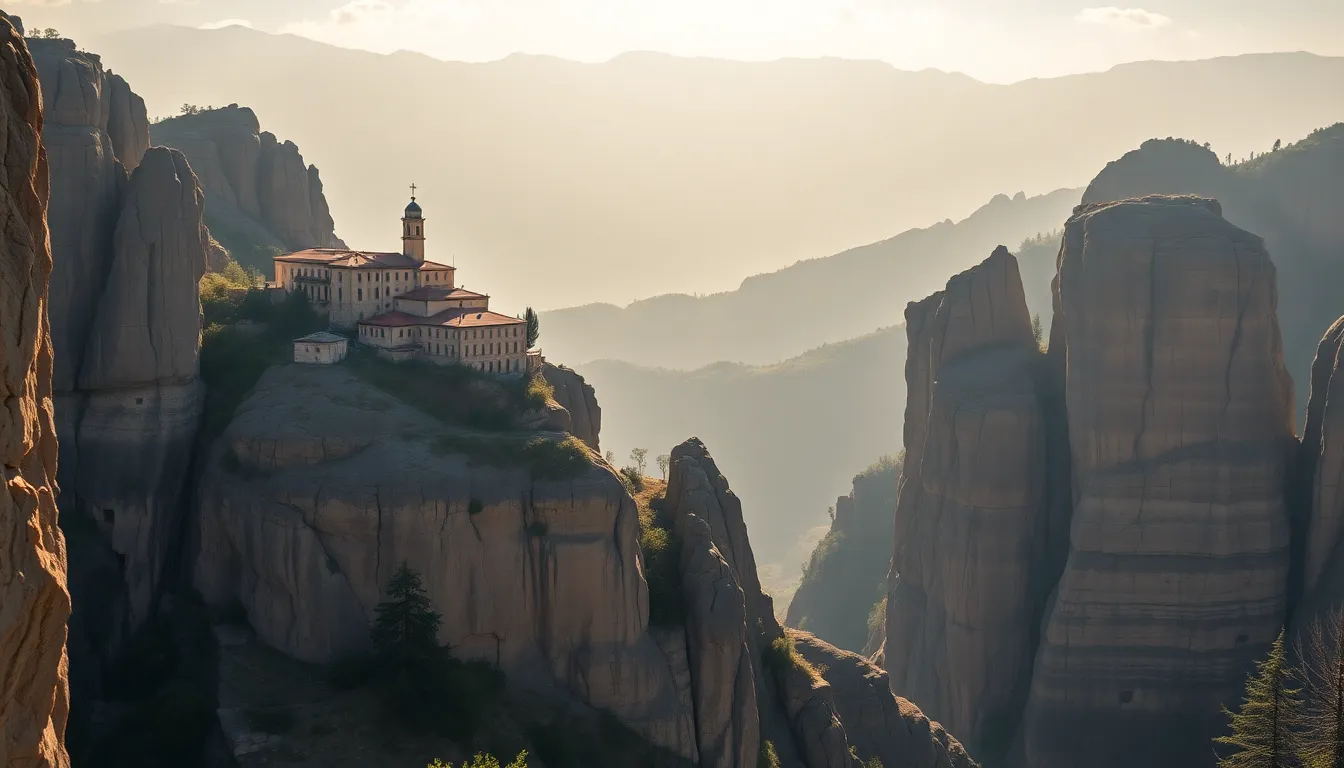
Meteora is the centerpiece, and it is unlike anywhere else on earth. Monasteries built on the summits of sheer rock pillars, hundreds of feet above the plain, where monks once hauled themselves up in nets and baskets because there was no other way. Six monasteries remain active, and a UNESCO World Heritage Site.
I give Meteora two days because one is not enough. We visit several of the monasteries, each with its own frescoed churches, its own community, its own view over the valley. There is real climbing involved, stairs cut into the rock, and a dress code, covered shoulders and knees, with wrap skirts provided for women at the gates. I prepare groups for both. The sunset over the rock pillars on the first evening, watched from a quiet vantage, is one of those moments a group does not forget.
Meteora is where the monastic impulse, the drive to withdraw and pray closer to God, becomes physical and visible. Standing at the foot of those pillars, the group understands the Orthodox monastic tradition in a way no book conveys.
Inside the monastery churches, the frescoes are dense and dark, layered with scenes of saints and martyrs that reward slow looking. I encourage groups to sit, not just pass through, because Byzantine sacred art was made to be read over time, not glanced at. A monk’s church is not a gallery. It is a place where the same images have shaped prayer for five hundred years, and the group feels that when they stop moving and let the space work on them.
Days 5 and 6: Thessaloniki, the Byzantine Capital of the North
Thessaloniki was the second city of the Byzantine Empire, and it wears that history openly. The group spends two days among some of the most important Byzantine churches anywhere: the Rotunda, originally a Roman structure, converted into a church with extraordinary early mosaics. Hagios Demetrios, built over the tomb of the city’s patron saint, with mosaics from the fifth to seventh centuries. Hagia Sophia of Thessaloniki, an eighth-century echo of its great namesake in Constantinople. The collection of Byzantine churches here is a UNESCO World Heritage Site in its own right.
Thessaloniki is also where the Christian and Jewish stories of Greece overlap richly, once known as the Jerusalem of the Balkans, and a thoughtful itinerary can honor both. You can read more about the city’s layers in our 10-day heritage itinerary for Greece. For groups also interested in Paul, Thessaloniki connects naturally to our apostle Paul in Greece guide, since Paul preached and wrote to this very city.
Two days here lets the group move slowly through the churches, attend a liturgy if the schedule allows, and feel the continuity of worship that has never stopped in this city.
Day 7: South Toward the Peloponnese
A travel day carries the group south toward the Peloponnese and the final chapter of the Byzantine story. The drive is long but beautiful, through the mountains and down toward Sparta. I use the bus time for a session on the fall of Constantinople and the last Byzantine century, because the next day’s site, Mystras, is where that ending was written.
Days 8 and 9: Mystras, the Last Light of Byzantium
Mystras is the haunting climax of a Byzantine trip. A whole fortified city climbing a mountainside near ancient Sparta, abandoned and partly ruined, but with its Byzantine churches and palaces still standing, frescoes still glowing on the walls. This was one of the last great centers of Byzantine culture, a place of scholars and theologians in the empire’s final century, and the last Byzantine emperor was crowned here. It is a UNESCO World Heritage Site.
Walking up through Mystras is walking through the twilight of an empire. The churches, the Pantanassa monastery still home to a small community of nuns, the Perivleptos with its remarkable frescoes, the ruined palace of the Despots, hold the group in the strange beauty of a civilization at its end. I give Mystras two days because the site is large and steep, and because a group needs time to sit with what it means to stand in the place where Byzantium made its final stand.
Adapting the Byzantine Route
This route flexes around your group. An Orthodox congregation may want to attend liturgies and time the trip to feast days. A church-history group may want more lecture time and an added stop at Ossios David or the cave churches. Groups with limited mobility should know that Meteora and Mystras both involve serious climbing, and we adapt the pace and the specific monasteries we visit accordingly. We build the route around your group’s focus and ability.
One thing worth knowing as you plan: with Heritage Tours, the group leader travels free when you bring fifteen or more participants.
FAQ: Planning a Byzantine Heritage Trip to Greece
What are the most important Byzantine sites in Greece?
Meteora, the cliff-top monasteries, is the most dramatic. Thessaloniki holds the richest concentration of Byzantine churches, a UNESCO World Heritage collection. Mystras is the great late-Byzantine city near Sparta. Hosios Loukas and the Byzantine and Christian Museum in Athens round out a full route. We build the trip around these anchors.
Is Meteora physically demanding?
Yes. The monasteries sit atop rock pillars and are reached by stairways cut into the stone, some of them long and steep. There is also a dress code, covered shoulders and knees. We prepare groups in advance, choose monasteries to match the group’s mobility, and pace the two Meteora days to avoid exhaustion.
Can we attend Orthodox liturgy during the trip?
Often, yes. Many of the monasteries and churches on this route are active places of worship, and we time visits where possible so the group can attend or observe a liturgy. For Orthodox congregations, we can plan the trip around specific feast days. Tell us what matters to your group and we will build it in.
How is a Byzantine itinerary different from a Pauline one?
A Pauline trip follows Paul’s first-century missionary journey, Philippi, Thessaloniki, Athens, Corinth. A Byzantine trip follows the thousand years after, the monasteries, icons, and frescoes of Orthodox Christianity, through Meteora, Thessaloniki’s churches, and Mystras. Thessaloniki is the one major city both routes share. Many groups combine elements of each.
How many days does a Byzantine route take?
Plan nine to ten days to do Meteora, Thessaloniki, and Mystras justice without rushing, since both Meteora and Mystras deserve two days each. A compressed version covering Meteora and Thessaloniki alone fits in about six days. We shape the length around your group.
If your group is drawn to the world of the icon, the dome, and the monastery, I would love to help you trace it across Greece. This is a quieter, deeper route than the classical tours, and the right group falls in love with it. See our Greece heritage page or learn how the group experience works on our group heritage tours page.
Contact us whenever you are ready to start planning.