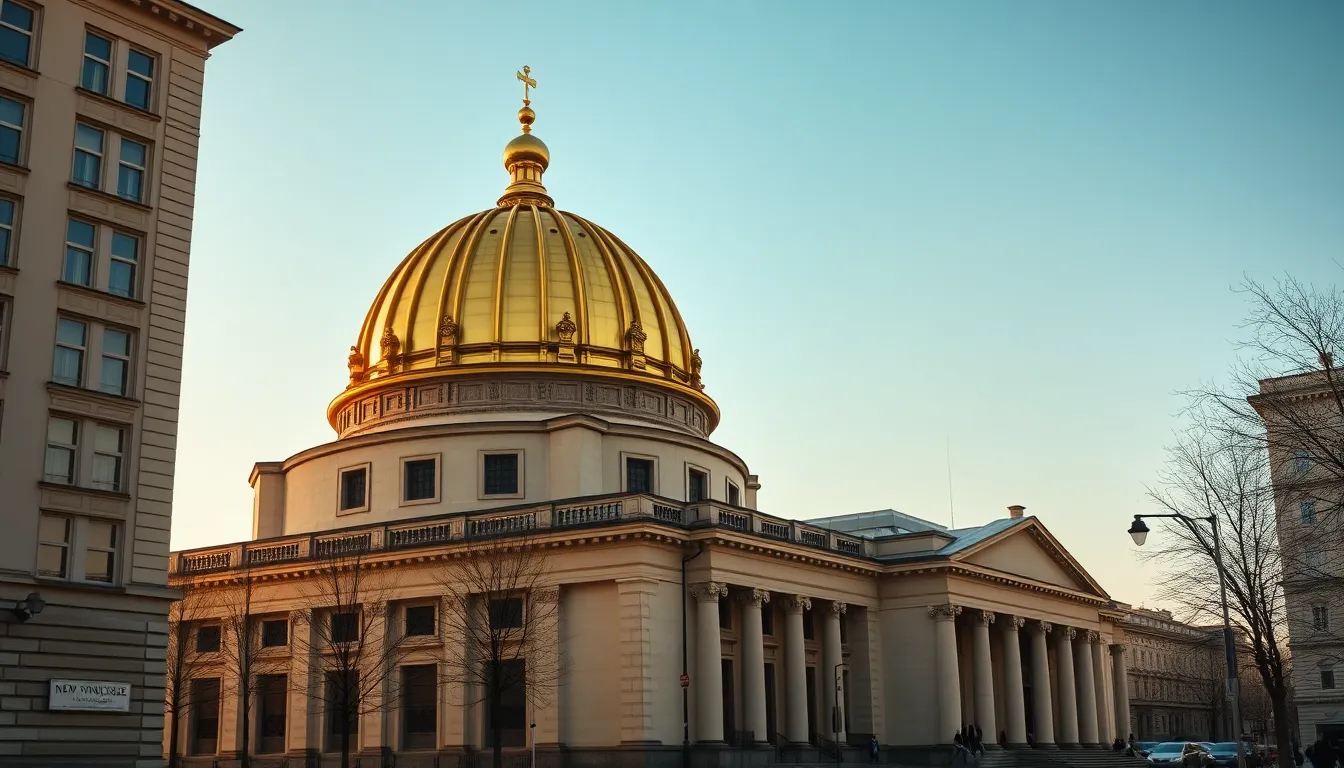
I have watched the same thing happen with group after group. We turn onto Oranienburger Strasse, and the gilded dome of the New Synagogue comes into view above the rooftops, and the conversation stops. People reach for their phones, then put them down. There is something about that dome, the way it catches the light, that asks for a moment of quiet instead of a photograph.
The New Synagogue is the most recognizable symbol of Jewish Berlin, and for good reason. Its story holds the whole century inside it. Grandeur, then fire, then bombing, then a long silence, then careful restoration. For a group trying to understand what was lost and what was salvaged, no single building tells it better.
This is a guide to the New Synagogue and the Centrum Judaicum it now houses, written for rabbis, educators, and group leaders who want to bring their people here with the context the place deserves.
A Statement of Belonging
When the New Synagogue opened in 1866, it was a declaration. Berlin’s Jewish community was growing, confident, and increasingly woven into the life of the city, and this building announced that arrival. It was the largest synagogue in Germany, seating more than three thousand worshipers. The dedication ceremony drew dignitaries from across Prussian society, including Otto von Bismarck.
The architect, Eduard Knoblauch, designed it in a Moorish-revival style, all soaring arches, intricate patterned brickwork, and that gilded central dome. The choice was deliberate. The style looked back to the golden age of Jewish life in medieval Spain, a period of flourishing and contribution, and it set the synagogue apart from the church architecture around it. The building said, in stone and gold, that Jewish Berlin was here to stay and had a heritage to be proud of.
For decades it was exactly that. A center of worship, music, and community. Its organ and choir were famous. Albert Einstein once played violin at a concert held inside. This was the heart of an established, cultured, deeply rooted community.
The Night of November 1938
On the night of November 9 into November 10, 1938, the pogrom now known as Kristallnacht swept across Germany. Synagogues were burned, Jewish shops were smashed, and Jewish men were rounded up and taken to camps. The New Synagogue was targeted that night, and the attackers set fire to it.
What happened next is one of the rare acts of conscience from that night. Wilhelm Krützfeld, the chief of the local police precinct, arrived with his officers, declared the building a protected historic landmark, and ordered the fire brigade to put out the flames. The fire was extinguished. The synagogue was saved that night by the courage of one police officer who refused to look away.
It is a story worth telling your group carefully, and worth telling honestly. It does not soften what Kristallnacht was. Thousands of synagogues across Germany burned to the ground that night, and the violence against Jewish communities was the state-sanctioned signal of what was coming. The survival of this one building, through one man’s defiance, stands as a single point of light against a night of organized cruelty. For the wider story of that night and its sites of remembrance, see our guide to the Kristallnacht sites of November 1938.
Destruction and the Long Silence
The reprieve did not last. The Nazi regime later seized the building for military use, and in November 1943 Allied bombing during the war destroyed the main sanctuary. The great hall that had held three thousand worshipers was gone. In the postwar years the ruined structure stood in East Berlin, behind the Wall, largely neglected. The unsafe remains of the sanctuary were demolished in 1958.
For decades the building was a wound. A fragment of facade, a memory held by a community that had been all but erased from the city. Through the years of division, it waited.
Restoration and the Centrum Judaicum
After German reunification, a careful restoration brought the front of the building back. The work, completed in 1995, rebuilt the facade, the entrance halls, and the unmistakable gilded dome. The restorers made a deliberate choice not to rebuild the destroyed main sanctuary. Instead, the outline of where it once stood is marked, an open space that holds the absence rather than papering over it. That decision is itself a form of remembrance, and it is worth pointing out to your group.
Today the building houses the Centrum Judaicum, a museum and research center documenting the history of the synagogue and of Jewish Berlin. The exhibition includes fragments recovered from the rubble, ritual objects, photographs of the community as it was, and the full account of the building’s destruction and survival. A small active congregation prays in the restored rooms. The gilded dome, once again, is one of the first things you see when you look across the rooftops of Mitte.
Visiting With a Group
The New Synagogue sits in the old Jewish quarter, the Scheunenviertel, within walking distance of the oldest Jewish cemetery in Berlin and the streets where the immigrant community once lived. I always pair the visit with a walk through that neighborhood, so the synagogue stands inside its context rather than alone. You can see how the wider quarter fits together in our guide to Jewish Berlin.
There is airport-style security at the entrance, a quiet reminder that Jewish sites in Europe still require protection. Brief your group on that beforehand so it does not catch anyone off guard. Inside, allow time in the museum and time in the marked outline of the lost sanctuary, which I find people want to stand in for a while. The street outside is lively, with cafes and bookshops, and that contrast between the ordinary present and the weight of the building is part of what makes the visit land.
For a fuller view of how the streets, stones, and memorials of Berlin connect, the Stolpersteine of the city extend the same remembrance down to the level of individual front doors.
How It Fits the Larger Journey
The New Synagogue belongs in the Berlin portion of a wider Germany heritage itinerary, near the end of the arc that runs from medieval roots through destruction to revival. It carries all three movements at once. The grandeur of a flourishing community, the fire of 1938, and the gilded dome rebuilt after reunification. For a group, that compression is powerful. You can see how it fits the whole on our Jewish heritage in Germany hub.
Heritage Tours builds each Berlin itinerary around the readiness and interests of the specific group. You can learn more on our Germany destination page, and our group heritage tours explain how we structure the journey. Group leaders travel free with fifteen or more participants, which keeps a dedicated trip within reach for congregations of any size.
FAQ: The New Synagogue Berlin
Is the New Synagogue in Berlin still used for worship?
The original main sanctuary was destroyed by wartime bombing and was not rebuilt. The restored front of the building houses the Centrum Judaicum museum, and a small active congregation prays in the restored rooms. The largest functioning synagogue in Berlin today is on Rykestrasse.
What style is the New Synagogue built in?
It was built in a Moorish-revival style, with patterned brickwork, soaring arches, and a gilded central dome. The style looked back to the golden age of Jewish life in medieval Spain and set the building apart as a confident statement of Jewish belonging in Berlin.
Did the New Synagogue survive Kristallnacht?
Yes, because of the police officer Wilhelm Krützfeld, who declared it a protected landmark and ordered the fire put out on the night of November 9, 1938. The building survived that night but was later destroyed by Allied bombing in 1943. Thousands of other synagogues across Germany were burned to the ground on Kristallnacht.
What is the Centrum Judaicum?
The Centrum Judaicum is the museum and research center housed in the restored New Synagogue. It documents the history of the building and of Jewish Berlin, with recovered fragments, ritual objects, photographs, and the full account of the synagogue’s destruction and survival.
Where is the New Synagogue located?
It stands on Oranienburger Strasse in the Mitte district, in the heart of Berlin’s old Jewish quarter, the Scheunenviertel. It is within walking distance of the oldest Jewish cemetery in the city and other key sites, which makes it a natural anchor for a walking tour of Jewish Berlin.
If you would like to bring your community to stand beneath that gilded dome and understand everything it has survived, I would be glad to help you plan it. Contact us whenever you are ready to begin the conversation.