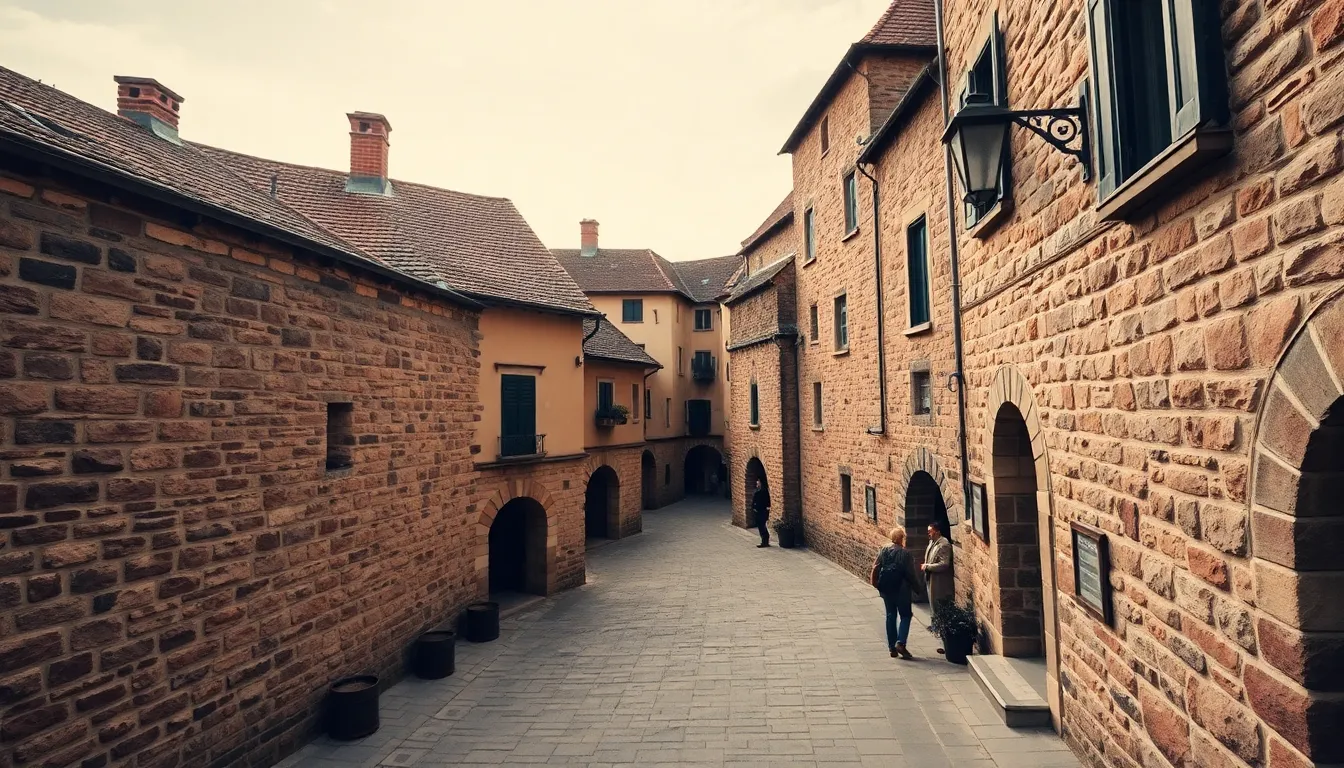
The first time I brought a group to Worms, a rabbi in the group stopped in the doorway of the Rashi Synagogue and would not move. He stood there for a long moment, and then he said something I have never forgotten. “This is where we come from. Not Poland. Not New York. Here.”
He was right. Most of the congregants I travel with trace their families through Eastern Europe, through Poland and Lithuania and Russia. But the tradition itself, the prayers, the customs, the legal rulings that shape how an observant Jew lives, did not start in those places. It started here, along a stretch of the Rhine River, more than a thousand years ago. The word for it is Ashkenaz.
If you are a rabbi or an educator thinking about bringing your community to Germany, this is the chapter of the story that often gets skipped. People know the Holocaust sites. Fewer know that the Rhineland is where European Jewry was born. Let me walk you through it.
What “Ashkenaz” Actually Means
Ashkenaz is the medieval Hebrew name for the German lands, specifically the region along the Rhine. Over time the word came to describe an entire branch of the Jewish people: Ashkenazi Jews, as distinct from the Sephardi Jews of Spain and the Mediterranean.
When we say a custom is Ashkenazi, when we follow Ashkenazi liturgy, when we eat the foods and sing the melodies of that tradition, we are pointing back to this region. The communities that took root here between the tenth and thirteenth centuries built the legal and spiritual foundation that the rest of Ashkenazi history is built on.
That is why standing in the Rhineland matters for a group. You are not visiting an interesting historical footnote. You are visiting the source.
The ShUM Cities: Speyer, Worms, and Mainz
Three cities along the Rhine formed the heart of medieval Ashkenaz. Together they are called the ShUM cities, from a Hebrew acronym built on their medieval names: Shpira for Speyer, Warmaisa for Worms, and Magenza for Mainz.
These were not three separate communities that happened to be near each other. They functioned as a connected network. Their rabbis met, corresponded, and issued shared rulings known as the Takkanot ShUM, regulations that governed Jewish communal life across the region and influenced Jewish law far beyond it. For a few centuries, the decisions made in these three towns shaped how Jews across Europe lived.
In 2021, UNESCO recognized the ShUM sites as a World Heritage location. What strikes most groups is how quiet they remain. These are some of the most significant sites in all of Jewish history, and you will often have them nearly to yourselves.
Worms and the Footsteps of Rashi
Worms is where I always begin. The Jewish community here dates to at least the tenth century, among the oldest in Europe.
The Rashi Synagogue, first built in 1034, is named for Rabbi Shlomo Yitzchaki, the commentator every Jewish student knows simply as Rashi. He studied in Worms as a young man. For a congregation that opens a Chumash and reads Rashi’s commentary every week, standing in the building where he learned is hard to put into words. The current structure has been rebuilt more than once, including after the Nazis destroyed it on Kristallnacht, but it stands on the original foundations, in the original place.
Next to the synagogue is the Rashi Chapel and the old yeshiva space. A short walk away is the Heiliger Sand, the Holy Sand, the oldest surviving Jewish cemetery in Europe. Some of the tombstones date to the eleventh century. The names carved into them belong to scholars and ordinary families who lived full Jewish lives here when most of Europe was still in the early Middle Ages.
Speyer and the Medieval Mikveh
Speyer holds one of the treasures of the whole region: a mikveh built around 1128, descending deep underground to reach groundwater. It is among the best-preserved medieval ritual baths in Europe.
When your group walks down those worn stone steps, you are standing in the exact space where Jewish daily and spiritual life met for centuries. A mikveh is not a museum object. It is one of the most intimate parts of Jewish observance, and to see it built with this kind of care nine hundred years ago tells you everything about how rooted this community was.
Speyer also preserves the remains of its medieval synagogue and the Judenhof, the Jewish courtyard that was the center of community life.
Mainz and the Rabbinic Mind of Ashkenaz
Mainz produced some of the founding scholars of Ashkenazi Judaism, including Rabbeinu Gershom, known as the Light of the Exile, whose rulings still shape Jewish practice today. His ban on polygamy and his protections in Jewish law came out of this city.
Much of medieval Mainz was lost, but the Jewish story is preserved in its cemetery, with stones reaching back centuries, and in a museum that traces a thousand years of Jewish Mainz. For an educator, Mainz is where the intellectual weight of Ashkenaz becomes concrete.
The Crusades and the Resilience of These Communities
I do not let a group leave the Rhineland without understanding what happened here in 1096. As the First Crusade moved through, mobs attacked the Jewish communities of Worms, Speyer, and Mainz. Many Jews were killed. Many chose death rather than forced conversion, an act recorded in the memorial literature of Ashkenaz as Kiddush Hashem, the sanctification of God’s name.
This is heavy ground. It belongs to the same soil where Rashi studied and where the mikveh was built. I tell groups about it plainly, because the resilience of these communities, who rebuilt again and again, is part of what makes the Rhineland so powerful to stand in. The Yizkor memorial books we still read trace their roots to the martyrs of these very cities.
Building a Medieval Ashkenaz Itinerary
The three ShUM cities sit close together along the Rhine, which makes them a natural opening sequence for a Germany heritage trip. Many groups spend two to three days here before moving on to Frankfurt and the Holocaust memorial landscape, ending in Berlin’s living Jewish community. You can read how the full arc fits together on our Jewish heritage in Germany guide.
A few things I have learned. Give Worms a full half day at minimum. Build in time for your rabbi or educator to teach on site, in the synagogue and at the cemetery, because these places ask for learning, not just looking. And pair the medieval chapter with the modern one. After the Rhineland, the Jewish heritage of Bavaria and the living community of Berlin show how the story continues.
If kashrut and Shabbat are part of your planning, our guide to keeping kosher and Shabbat in Germany covers the practical side across the country.
Heritage Tours builds each medieval Ashkenaz itinerary around the specific learning goals of the group. Group leaders travel free with fifteen or more participants, which keeps a dedicated heritage trip within reach for a congregation or a school.
You can learn more on our Germany destination page or see how we structure group heritage tours.
FAQ: Medieval Ashkenaz Heritage
What does Ashkenaz mean?
Ashkenaz is the medieval Hebrew name for the German lands along the Rhine River. Over time it came to describe an entire branch of the Jewish people, the Ashkenazi Jews, whose prayers, customs, and legal traditions took shape in this region between the tenth and thirteenth centuries. When we follow Ashkenazi liturgy or custom today, we are pointing back to medieval Germany.
What are the ShUM cities?
ShUM is a Hebrew acronym for Speyer (Shpira), Worms (Warmaisa), and Mainz (Magenza), three Rhine Valley cities that formed the connected heart of medieval Ashkenaz. Their rabbis issued shared rulings, the Takkanot ShUM, that shaped Jewish law across Europe. UNESCO recognized the sites as World Heritage in 2021.
Why is Worms important in Jewish history?
Worms holds one of the oldest Jewish communities in Europe, dating to at least the tenth century. Rashi, the commentator studied in nearly every yeshiva and Jewish home, learned there as a young man. The city preserves the Rashi Synagogue, built on its original 1034 foundations, and the Heiliger Sand, the oldest surviving Jewish cemetery in Europe.
Is the medieval Ashkenaz region appropriate for a synagogue or school group?
Yes. The ShUM cities are among the most meaningful and least crowded Jewish heritage sites in Europe. They reward groups that come to learn. A rabbi or educator can teach on site, in the synagogue where Rashi studied and at cemeteries with eleventh-century stones, which makes the region especially strong for congregations and Jewish schools.
How much time should a group spend in the Rhineland?
Most groups spend two to three days across Speyer, Worms, and Mainz, often pairing them with Frankfurt before continuing to Berlin. Worms deserves at least a full half day on its own. The sites are close together, which makes a focused medieval Ashkenaz sequence very manageable.
If the roots of Ashkenaz are something you want your community to stand in, I would be glad to help you plan it. This is the chapter most trips skip, and it is often the one people remember most.
Contact us whenever you are ready to start the conversation.