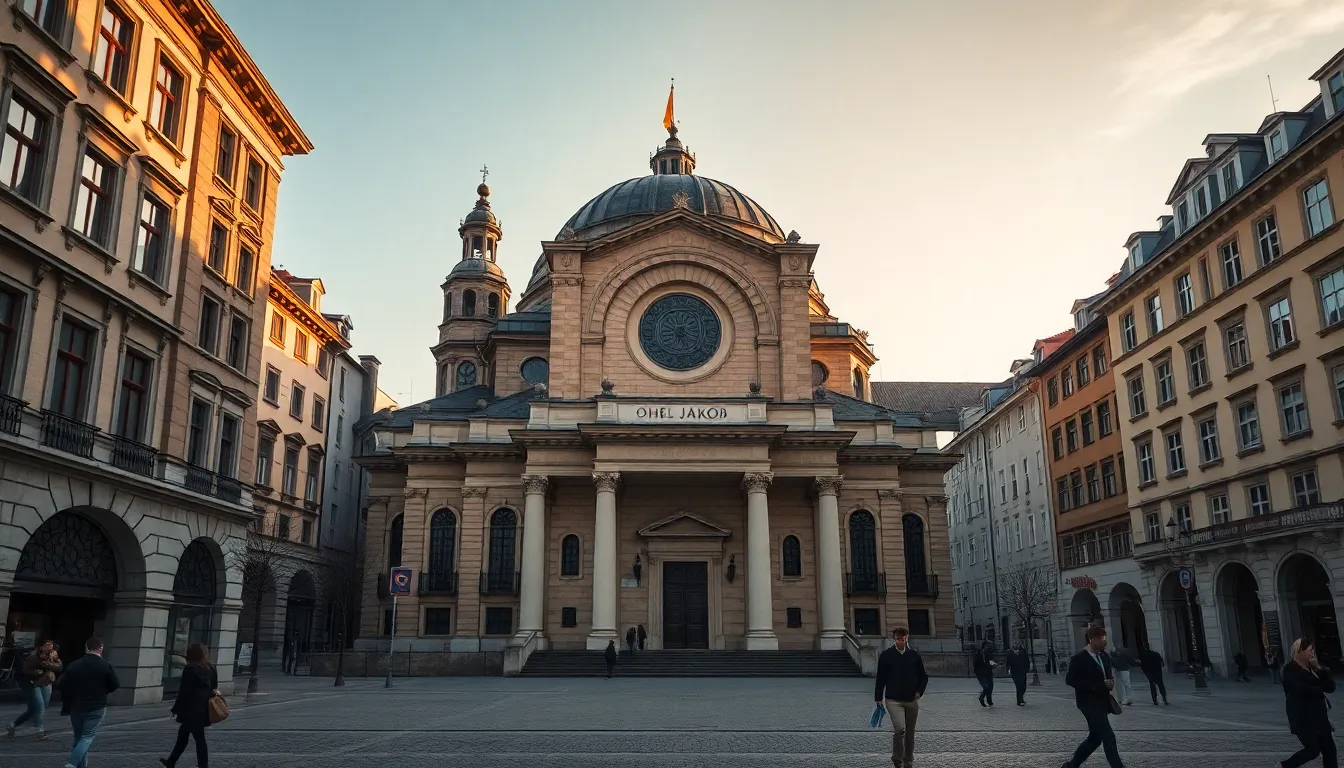
When people think of Jewish Germany, they think of the Rhineland and they think of Berlin. Bavaria gets left off the map. That is a mistake, and I tell every group I bring south the same thing: some of the deepest and most surprising Jewish history in the country is right here, and almost no tour groups come looking for it.
Bavaria holds a striking range. Munich, with one of the most beautiful new Jewish centers in Europe. Fuerth, a town once so important that it was called the Bavarian Jerusalem. And scattered across the countryside, small village communities, the Landjuden, the rural Jews, whose synagogues and cemeteries still stand in places most travelers drive right past.
If you are a rabbi or an educator who wants to give your group something beyond the standard route, Bavaria is where I would point you. Let me walk you through it.
Munich: A Modern Jewish Heart at Jakobsplatz
Munich’s Jewish story is old, but its most powerful expression today is new. In 2006, the community opened a complex at St.-Jakobs-Platz that has become one of the landmark Jewish sites in Europe.
At its center is the Ohel Jakob synagogue, a striking modern building of stone and glass. The solid stone base evokes the Western Wall and the wilderness Tabernacle, while the glass and metal structure above it lets light pour in. Next to it stands the Jewish community center and the Jewish Museum Munich, which tells the city’s Jewish story across the centuries.
For a group, Jakobsplatz works on two levels. It is a place of real beauty and a place to daven with a living community. And it is a statement. This confident, central, unhidden Jewish complex sits in the heart of Munich, a city bound up with the early rise of the Nazi movement. To stand there is to see Jewish life asserting its place again, in the open. The community center includes kosher dining, which makes Munich a comfortable base, as our guide to kosher and Shabbat in Germany explains.
Munich and the Weight of Dachau
I do not separate Munich from Dachau, and I prepare groups for that. The Dachau concentration camp memorial sits just outside the city. It was among the first camps the Nazi regime established, and it became a model for the system that followed.
A visit to Dachau is not tourism, and I never frame it that way. It is an act of witness and remembrance. I brief groups carefully before we go, build in silence and time to process afterward, and never schedule anything light against it on the same day. Standing at Jakobsplatz and standing at Dachau in the same trip holds the full truth of Bavaria together: the destruction, and the Jewish life that continues in spite of it.
Fuerth: The Bavarian Jerusalem
Fuerth surprises every group I bring there. Today it is a quiet town beside Nuremberg. But for centuries it was one of the most important Jewish centers in all of Germany, so significant that it earned the name the Bavarian Jerusalem.
From the sixteenth century onward, while many German cities restricted or expelled their Jews, Fuerth allowed Jewish life to flourish. It became a center of Torah learning with one of the most respected yeshivas in Europe. It had a Hebrew printing press, a Jewish hospital, an orphanage, and at its height a Jewish community that made up a large share of the town. Scholars and rabbis from across Europe knew Fuerth’s name.
The Jewish Museum Franconia in Fuerth preserves this story in a historic Jewish house, including a rare surviving sukkah and a mikveh. Walking the old streets with a knowledgeable guide, your group can recover a world that most history books skip entirely: a German town where, for generations, Jewish life was not merely tolerated but central. For an educator, Fuerth reframes the standard narrative. Not every chapter of German Jewish history was restriction and tragedy. Some of it was flourishing on a scale people do not expect.
The Rural Communities: Bavaria’s Landjuden
Here is the part of Bavaria that almost no tour ever reaches, and the part I find most moving. Across the Bavarian and Franconian countryside, Jews did not only live in cities. They lived in villages, in small communities scattered among farming towns, for centuries. They are called the Landjuden, the country Jews.
These were not grand congregations. They were modest village communities, often a handful of families, who built small synagogues, kept kosher butchers, maintained mikvehs, and buried their dead in cemeteries shared between several villages. Many of these communities reached back to the medieval and early modern periods, when Jews expelled from cities found refuge under local rural lords.
A number of these village synagogues and cemeteries survive. Some have been restored as memorials and small museums. To stand in a tiny rural synagogue, or in a country Jewish cemetery with worn stones among the fields, is to encounter a layer of German Jewish life that the famous sites cannot show you. This was Jewish existence at its most everyday, woven into the rhythm of the countryside.
I do not bring every group to the rural communities, because they take time and a willingness to go slowly. But for a group that wants depth over checklist, a day among the Landjuden sites is often the day people remember most. For an educator, it is a chance to teach about how the vast majority of Jews actually lived, not in the great centers but in small, rooted communities.
Building a Bavaria Heritage Itinerary
Bavaria works beautifully as a distinct segment of a Germany trip, or as the heart of a focused Bavarian Jewish journey. Munich serves as the base, with Jakobsplatz, the Jewish Museum Munich, and the act of witness at Dachau. From there, Fuerth and neighboring Nuremberg open the Franconian story, and the surrounding countryside holds the Landjuden sites for groups with the time to seek them out.
Most full Germany itineraries pair Bavaria with the Rhineland’s medieval Ashkenaz heritage and with Berlin’s memorial landscape and living community. The complete arc, roots, destruction, and revival, is laid out in our Jewish heritage in Germany guide.
Heritage Tours builds each Bavaria itinerary around what the group wants to encounter, with the pacing that Dachau and the rural sites require. Group leaders travel free with fifteen or more participants, which keeps a focused Bavarian heritage trip within reach for a congregation or a school.
You can learn more on our Germany destination page or see how we structure group heritage tours.
FAQ: Jewish Heritage of Bavaria
What is the Ohel Jakob synagogue in Munich?
Ohel Jakob is Munich’s main synagogue, opened in 2006 at St.-Jakobs-Platz as part of a Jewish complex that also includes the community center and the Jewish Museum Munich. Its stone base evokes the Western Wall and the wilderness Tabernacle, with a glass structure above. The complex stands confidently in central Munich and includes kosher dining, which makes the city a comfortable base for a heritage group.
Why was Fuerth called the Bavarian Jerusalem?
From the sixteenth century onward, Fuerth allowed Jewish life to flourish while many German cities restricted or expelled their Jews. It became a leading center of Torah learning with a renowned yeshiva, a Hebrew printing press, a Jewish hospital, and a large community. Its importance earned it the name the Bavarian Jerusalem. The Jewish Museum Franconia preserves the story, including a rare surviving sukkah and a mikveh.
Who were the Landjuden?
The Landjuden, or country Jews, were the rural Jewish communities scattered across the Bavarian and Franconian countryside for centuries. They lived in small villages, often a few families each, building modest synagogues, keeping kosher butchers and mikvehs, and sharing cemeteries between villages. Several of these synagogues and cemeteries survive, some restored as memorials, and they reveal how most German Jews actually lived, outside the great cities.
How should a group approach Dachau?
The Dachau memorial just outside Munich is a place of witness and remembrance, never tourism. Groups should be briefed carefully beforehand, given silence and time to process afterward, and never scheduled against anything light on the same day. Visiting Dachau and the living Jewish community at Jakobsplatz in the same trip holds the full truth of Bavaria together: the destruction, and the Jewish life that continues.
Is Bavaria worth a dedicated heritage segment?
Yes, especially for groups that want depth beyond the standard Rhineland-and-Berlin route. Bavaria offers Munich’s beautiful modern Jewish center, the surprising flourishing of Fuerth, and the rarely visited rural Landjuden communities. It reframes German Jewish history to include real chapters of flourishing, not only restriction and tragedy, which makes it especially rich for educators and engaged congregations.
If you want to take your community somewhere most heritage groups never go, Bavaria is my answer. The combination of Munich, Fuerth, and the country communities tells a fuller story than the famous route alone. I would be glad to help you build it.
Contact us whenever you are ready to start the conversation.