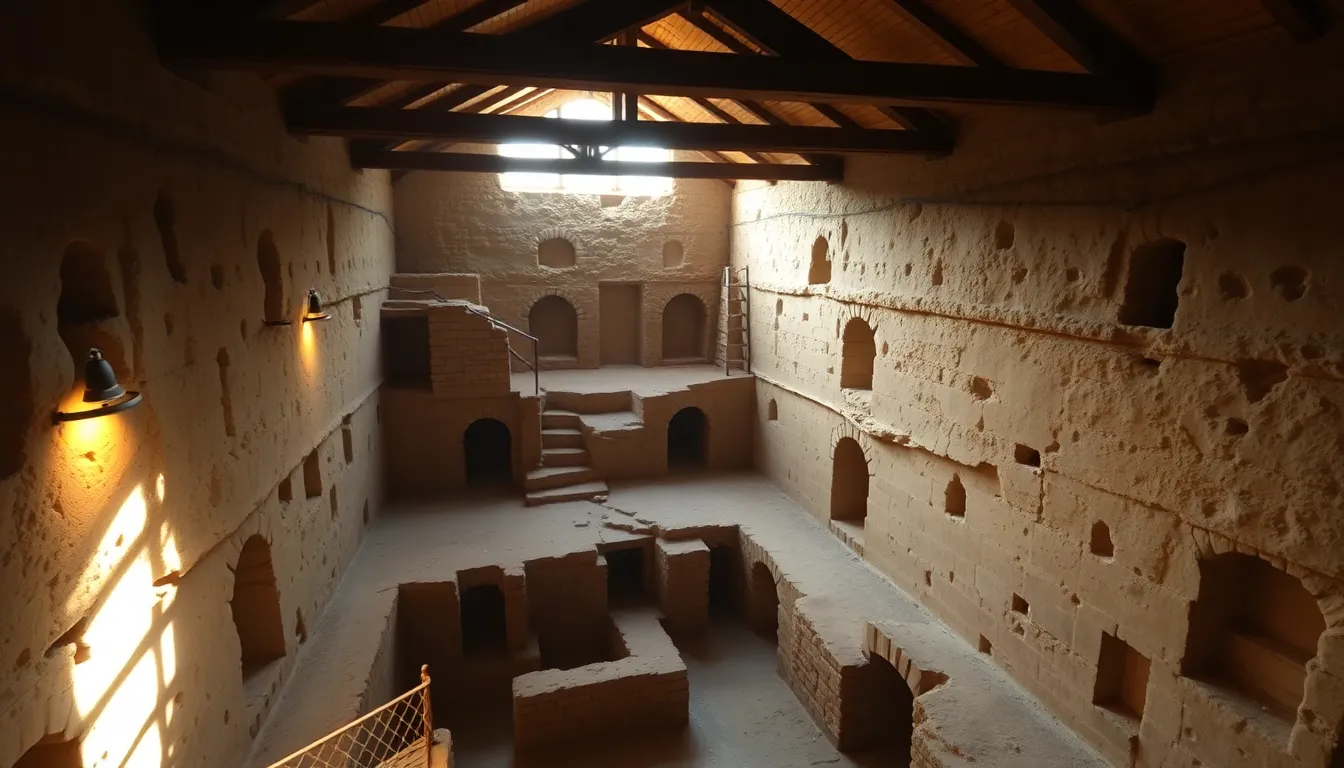
There is a moment I wait for whenever I bring a group into the Museum Judengasse in Frankfurt. We descend a level, and there in front of us are the excavated stone foundations of the medieval ghetto, the actual footprint of homes and a ritual bath, set into the floor of the museum. People go quiet. They had been picturing a “Jewish street” as a tourist phrase. Then they see how narrow it was, how packed, and they understand that thousands of people built a complete world inside that confinement. The scale of it does the teaching.
Frankfurt holds one of the most important and most difficult Jewish stories in Germany. For more than three centuries, the city’s entire Jewish population was confined by law to a single narrow street. And out of that street came one of the most influential families in modern history. The two facts belong together, and a group that holds them both leaves with a real understanding of the Jewish experience of perseverance under restriction.
This is a guide to Jewish Frankfurt for rabbis, educators, and group leaders who want to bring their people into that story with the depth it deserves.
The Judengasse: Three Centuries on One Street
In 1462, the city authorities of Frankfurt ordered the Jewish community out of the city center and into a single, walled-off lane on the eastern edge of town. This was the Judengasse, the “Jews’ alley.” For the next 350 years, until the restrictions were dissolved in the early nineteenth century, this was the only place in Frankfurt where Jews were permitted to live.
The street was perhaps a quarter of a mile long and extremely narrow. At its peak in the eighteenth century, more than three thousand people lived crowded into it, in tall houses pressed wall to wall, with families stacked floor by floor. The gates were locked at night, on Sundays, and on Christian holidays. Movement in and out was restricted. The community could not expand the boundaries, so it could only build upward and inward, densifying year after year.
It would be easy to tell this as a story only of hardship, and the hardship was real. But that is not the whole of it. Inside those walls the community built a complete civic and religious world. Synagogues, a hospital, a ritual bath, schools, charitable societies, a community council, and a flourishing intellectual and commercial life. The Judengasse produced rabbis and scholars whose influence reached far beyond Frankfurt. The resilience of that community, building richness inside confinement, is the heart of what this site teaches.
The Museum Judengasse
The Museum Judengasse, opened on the site in 1992, is built around the excavated foundations of the medieval street. When construction of an administrative building uncovered the remains in the 1980s, a public campaign fought to preserve them, and the museum was the result. That fight is itself part of the story, a reminder that remembrance in Germany has often had to be insisted upon.
Inside, you walk among the stone outlines of real houses, named for the families who lived in them, and the foundations of two ritual baths, the mikvaot that served the community. The exhibition reconstructs daily life on the street: how families lived in the cramped houses, how the community governed itself, how it kept its religious life intact under restriction. For an educator, it is one of the clearest windows in Germany into medieval and early modern Jewish life as it was actually lived.
Plan for at least an hour and a half here, more if your group reads deeply. The foundations reward slow attention.
The Old Jewish Cemetery and the Börneplatz Memorial
Beside the museum lies the old Jewish cemetery of Frankfurt, in use from the thirteenth century until 1828. It is one of the oldest in Germany, and many of the community’s great figures are buried here.
The wall surrounding the cemetery carries one of the most affecting memorials I know. The Börneplatz memorial, completed in 1996, sets into the wall a small metal block for each of the more than eleven thousand Frankfurt Jews who were murdered in the Holocaust. Each block bears a name, a birth year, and, where known, the date and place of death. Visitors place small stones on the blocks in the Jewish tradition of remembrance, and the wall is lined with them.
Walking the length of that wall, reading name after name set into the stone, is a slow and necessary act. I encourage groups to find a name, to stop at it, to read it aloud if they wish. The memorial returns the murdered from a number to a person, one block at a time. This same impulse, to mark each individual life, runs through the Stolpersteine set into pavements across Germany.
The Rothschild Origins
Here is where the Judengasse story turns outward to the world. In the eighteenth century, a young man named Mayer Amschel Rothschild was born and raised on this street, in a house known as “zum grünen Schild,” the Green Shield, from which the family took its name. He began as a dealer in coins and goods, working within the constraints placed on Jewish merchants, and built a financial business of remarkable reach.
He sent his five sons to establish banking houses across Europe: Frankfurt, London, Paris, Vienna, and Naples. Within a generation, a family that had begun in a locked and crowded ghetto street had become one of the most influential financial dynasties in the world. The distance between the confinement of the Judengasse and the reach of the Rothschild houses is one of the most striking arcs in Jewish history.
I am careful in how I tell this with a group. The Rothschild story has long been a target for antisemitic conspiracy, and part of telling it well is telling it truthfully. This was a family that rose through skill, discipline, and family coordination, working against legal restrictions that limited where Jews could live and what they could do. Told honestly, it is a story of perseverance and ingenuity under conditions designed to hold a community down.
How Frankfurt Fits the Larger Journey
Frankfurt belongs in the early part of a Germany heritage itinerary, in the chapter of medieval roots and confinement, alongside the ShUM cities of the Rhine Valley and before the memorial sites and the revival of Berlin. It pairs naturally with a visit to nearby Worms, Speyer, and Mainz. You can see how the whole arc fits together on our Jewish heritage in Germany hub, and Frankfurt also holds the birthplace and remembrance trail of Anne Frank, which many groups include in the same days.
Heritage Tours builds each itinerary around the interests and readiness of the specific group. You can learn more on our Germany destination page, and our group heritage tours explain how the journey is structured. Group leaders travel free with fifteen or more participants, which keeps a dedicated heritage trip reachable for congregations of any size.
FAQ: Jewish Frankfurt and the Judengasse
What was the Judengasse in Frankfurt?
The Judengasse was a single narrow, walled street where the entire Jewish community of Frankfurt was required by law to live from 1462 until the early nineteenth century. At its peak more than three thousand people lived crowded into it. Inside the confinement the community built a complete religious and civic world.
Can you visit the Judengasse today?
Yes. The Museum Judengasse, opened in 1992, is built around the excavated stone foundations of the medieval street, including the outlines of houses and two ritual baths. Visitors walk among the real foundations and learn how the community lived under restriction.
What is the connection between Frankfurt and the Rothschild family?
Mayer Amschel Rothschild, founder of the banking dynasty, was born and raised in the Judengasse in a house called the Green Shield, from which the family name comes. From that confined ghetto street, his five sons established banking houses across Europe, making the family one of the most influential financial dynasties in the world.
What is the Börneplatz memorial?
The Börneplatz memorial lines the wall of the old Jewish cemetery with a small metal block for each of the more than eleven thousand Frankfurt Jews murdered in the Holocaust. Each block carries a name and dates. Visitors place small stones on them in remembrance, and reading the wall name by name is one of the most moving acts of the visit.
How does Frankfurt fit into a wider Germany heritage trip?
Frankfurt belongs in the medieval and early modern chapter of the journey, alongside the ShUM cities of Worms, Speyer, and Mainz in the Rhine Valley. It pairs naturally with those sites before a group travels on to the memorial landscape and the revival of Berlin.
If the Judengasse and the Rothschild story are part of what you want your community to understand, I would be glad to help you build it into a meaningful itinerary. Contact us whenever you are ready to start planning.