Most people meet Anne Frank in a book. They read her diary in a classroom, often as teenagers, and they carry the voice of that young girl with them for the rest of their lives. What many of them do not know is that her story did not begin in Amsterdam. It began in Frankfurt, in the city where she was born, in a Jewish family that had lived in Germany for generations.
When I bring a group to Frankfurt, the Anne Frank trail asks for a different kind of care than any other part of the journey. This is not a site. It is the remembrance of a child whose life was taken, and of a family, and of the millions she has come to represent. We walk it slowly, we speak softly, and we let the weight of it sit with us. What follows is a guide for rabbis, educators, and group leaders who want to honor her memory with the gravity it requires.
Anne Frank’s Frankfurt
Annelies Marie Frank was born in Frankfurt on June 12, 1929. Her family was rooted in the city. The Franks had lived in Frankfurt for generations, part of the established Jewish community that had contributed to the life of the city for centuries. Her father, Otto Frank, had served in the German army in the First World War. This was their home.
The family lived in the western part of the city. Anne spent the first years of her childhood there, an ordinary little girl in an ordinary German neighborhood, before the rise of the Nazi regime made ordinary life impossible for Jewish families. In 1933, as the persecution began, Otto Frank moved his family to Amsterdam in search of safety. Anne was four years old when she left the city of her birth.
To stand in Frankfurt and understand that this is where her life began changes how a group hears the rest of the story. She was not an abstraction. She was a German Jewish child, born in this city, whose family was driven out by a state that had decided they did not belong. The trail in Frankfurt restores the beginning that the diary, written in hiding far away, could not tell.
The Path of Remembrance in the City
Frankfurt remembers Anne Frank in quiet, deliberate ways, and I keep our visits in that register. There are no spectacles here, and there should not be.
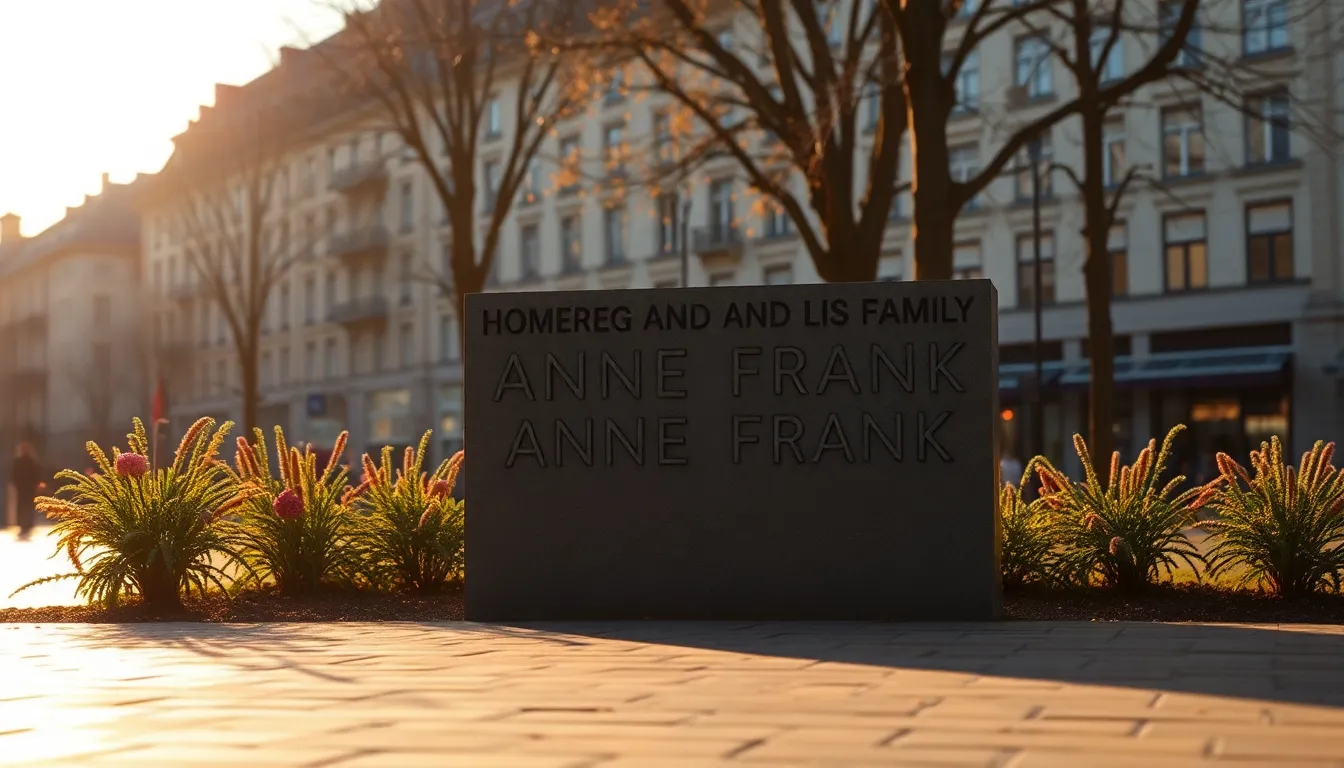
The family’s former homes in the city are marked. Memorial plaques honor the place where Anne was born and where the family lived in her early childhood. A school in the city bears her name, as do streets and public spaces, carrying her memory into the daily life of the place she came from. These are not tourist stops. They are markers of belonging and of loss, and we treat them as such.
For groups that wish to go deeper, the city’s Jewish Museum and the Museum Judengasse set the Frank family within the longer story of Jewish Frankfurt: the centuries of community, the confinement of the medieval Judengasse, the flourishing, and the destruction. Anne Frank’s family was one thread in that long cloth. Seeing her story inside the fuller history of the city’s Jewish life keeps it from standing alone and gives a group the context to understand what was lost when families like hers were forced out.
Stolpersteine and the Naming of Each Life
Across Frankfurt, as across Germany, small brass cobblestones are set into the pavement in front of the homes from which Jewish residents were taken. These are the Stolpersteine, the “stumbling stones,” each one bearing the name of a person, the year they were born, and the fate that befell them. They are placed at the threshold of the last home a person freely chose.
These stones embody the principle that matters most on the Anne Frank trail: that remembrance happens one name at a time. Anne Frank has become a symbol for the one and a half million Jewish children murdered in the Holocaust. But she was also one girl, with one name, one birthday, one family. The Stolpersteine hold that truth in brass, refusing to let the murdered dissolve into a number. When a group bends to read a single stone outside a single door, they are doing the work that her diary has always asked of its readers. For the fuller story of these memorials, see our guide to reading Germany’s stumbling stones.
From Frankfurt to Bergen-Belsen
The Anne Frank trail does not end in Frankfurt. It is bound, finally, to a place far to the north. After years in hiding in Amsterdam, the family was discovered and deported. Anne and her sister Margot were sent to the Bergen-Belsen concentration camp in Lower Saxony, where both died in early 1945, within weeks of the camp’s liberation. Anne was fifteen years old.
I tell groups about this connection plainly, without drama, because the facts carry their own weight. The camp itself was burned by British liberators to halt a typhus epidemic, so what remains at Bergen-Belsen is a landscape: gentle grass-covered hills that are, in truth, mass graves. There is a single memorial stone for Anne and Margot Frank among them. The quietness of that place is almost unbearable, and it is exactly right.
For a group that has walked the Frankfurt trail, the beginning of her life, a visit to Bergen-Belsen, where it ended, closes a circle that no classroom reading ever could. If your itinerary allows for it, the two together form one of the most profound sequences in a Germany heritage journey. We approach Bergen-Belsen as the place of remembrance it is, with full preparation, time for silence, and time afterward to process what we have seen.
How We Walk This Trail With a Group
A few things matter on this part of the journey, and I want to be clear about them.
Brief your group before each site, so that no one is caught unprepared by the emotion of it. Build silence into the itinerary, not as a gap but as a part of the visit. Hold time afterward for people to speak, or to not speak. Younger participants, in particular, often carry Anne Frank close to their hearts, and they may need space to feel what the visit brings up. There is no rushing this. There should be no photographs taken lightly, no tourism language, no hurry to the next thing.
This is remembrance. We come to these places to honor a life, to bear witness, and to carry the memory forward. That posture, more than any fact in a guidebook, is what a group should leave with.
Building the Anne Frank Trail Into Your Journey
The Anne Frank trail fits within the Frankfurt portion of a wider Germany heritage itinerary, in the early chapters of community and destruction, and it connects forward to Bergen-Belsen in the north. You can see how the full arc fits together on our Jewish heritage in Germany hub. Many groups pair the trail with the Judengasse and the broader story of Jewish Frankfurt.
Heritage Tours builds each itinerary around the readiness and the heart of the specific group, with particular care given to the sites of remembrance. You can learn more on our Germany destination page, and our group heritage tours explain how we structure these journeys. Group leaders travel free with fifteen or more participants, which keeps a meaningful trip within reach for a congregation or a school group of any size.
FAQ: The Anne Frank Heritage Trail
Was Anne Frank born in Frankfurt?
Yes. Anne Frank was born in Frankfurt on June 12, 1929, into a Jewish family that had lived in the city for generations. The family moved to Amsterdam in 1933, when Anne was four years old, as the Nazi persecution of Jews began. Frankfurt is the city of her birth and early childhood.
What can you see of Anne Frank’s story in Frankfurt?
Frankfurt marks the family’s former homes with memorial plaques, and a school, streets, and public spaces bear her name. The city’s Jewish Museum and the Museum Judengasse place her family within the longer history of Jewish Frankfurt. These are quiet markers of remembrance, not tourist attractions.
Where did Anne Frank die?
Anne Frank and her sister Margot were deported to the Bergen-Belsen concentration camp in Lower Saxony, where both died in early 1945, only weeks before the camp’s liberation. Anne was fifteen. A single memorial stone for the sisters stands among the grass-covered mass graves at the site today.
How should a group prepare to visit these sites of remembrance?
Prepare your group with a briefing before each site, build silence into the itinerary, and hold time afterward for reflection. These are memorial sites, and we approach them with reverence, not tourism. Younger participants in particular may need space to process what the visit brings up.
Can the Anne Frank trail be combined with a visit to Bergen-Belsen?
Yes, and for many groups the two together are deeply meaningful: Frankfurt, where her life began, and Bergen-Belsen, where it ended. We arrange both with full preparation and the gravity they require, as part of a wider Germany heritage journey.
If you wish to bring your community along this path of remembrance, with the care it asks of us, I would be honored to help you plan it. Contact us whenever you are ready to begin.