England’s Jewish Story: Arrival, Expulsion, and Return
Most people, including many Jewish travelers, do not know that England was the first European country to formally expel its entire Jewish population. In 1290, Edward I signed the Edict of Expulsion, and every Jew in England was forced to leave. They had been part of English life for over two centuries. They had built communities, financed cathedrals, served the crown. And then, in a single decree, they were gone.
For 366 years, there were essentially no Jews in England.
The return came quietly, in 1656, when Oliver Cromwell permitted a small group of Sephardic Jews to settle in London. It was not a grand act of welcome. It was a practical calculation. But from that small opening, Jewish life in England rebuilt itself, and Bevis Marks Synagogue, opened in 1701, became its most enduring symbol.
This arc, arrival, destruction, long absence, and cautious return, is the spine of Jewish heritage travel in England. It is a story that deserves to be walked, not just read. And for the rabbi leading a group, this is a journey that will change how your congregation understands the Jewish story in Europe.
For the broader view of England’s heritage, including Christian sites, see our full England guide.
York and Clifford’s Tower: Confronting the 1190 Massacre
There is no gentle way to introduce Clifford’s Tower. In March 1190, the Jewish community of York, approximately 150 men, women, and children, took refuge in the royal castle on this mound. A mob surrounded them. Faced with forced conversion or death, most chose to die. Some set fire to the castle. Others were killed when they emerged.
This is one of the most significant acts of anti-Jewish violence in medieval Europe, and it happened here, on this small hill in the center of York.
Visiting Clifford’s Tower with a group is not like visiting any other heritage site. It requires preparation, both for yourself and for your participants. I always recommend that leaders give their group a few minutes of silence before offering any historical explanation. Let the weight of the place settle. The information matters, but the stillness matters more.
English Heritage manages the site, and there is now a memorial and interpretive display. But the experience of standing on the mound, looking down at the city that turned on its Jewish neighbors, is something no display can fully convey. This is sacred ground in the truest sense.
Medieval Jewish England: Lincoln, Oxford, and the World Before 1290
Before the expulsion, Jewish communities existed across England, concentrated in cities where royal protection and commercial opportunity overlapped. Lincoln and Oxford were two of the most significant.
In Lincoln, the Jewish quarter centered around Jew’s Court, near the base of Lincoln Cathedral. Aaron of Lincoln, a 12th-century Jewish financier whose wealth rivaled the king’s own treasury, lived here. His house still stands. It is one of the oldest domestic buildings in England, and it is a direct, physical connection to a period when Jewish life was woven into the fabric of English society.
Oxford had its own Jewish community, centered around what is now St. Aldates. The Bodleian Library at Oxford University holds Hebrew manuscripts that survived the expulsion, legal documents, religious texts, and community records that are among the few surviving artifacts of English Jewish life before 1290.
These sites are not well known, even among Jewish heritage travelers. Most groups visit London and perhaps York. But Lincoln and Oxford tell the story of what Jewish life looked like when it was thriving, before everything was taken away. That context makes the expulsion story not just a political event, but a human one.
Read about these and other lesser-known sites in our hidden heritage guide.
The 366 Years of Absence: What Changed Under Cromwell
The period between 1290 and 1656 is not empty history. It is an absence that shaped England and shaped European Jewish life. When England expelled its Jews, other countries followed. France expelled its Jewish population in 1306. Spain followed in 1492. The pattern that began in England rippled across Europe for two centuries.
Cromwell’s decision to readmit Jews in 1656 was not driven by moral conviction. It was a political and economic calculation during a period of upheaval. But it opened a door that had been closed for nearly four centuries. The small Sephardic community that settled in London, many of them descendants of Jews expelled from Spain and Portugal, built something remarkable from that narrow opening.
Understanding this gap, the 366 years when there were no Jewish communities in England, is essential for any Jewish heritage group. The sites you visit in London exist because of the return. The sites you visit in York and Lincoln exist despite the expulsion. Both sides of that equation matter.
London’s East End: Bevis Marks, Whitechapel, and the Immigrant Story
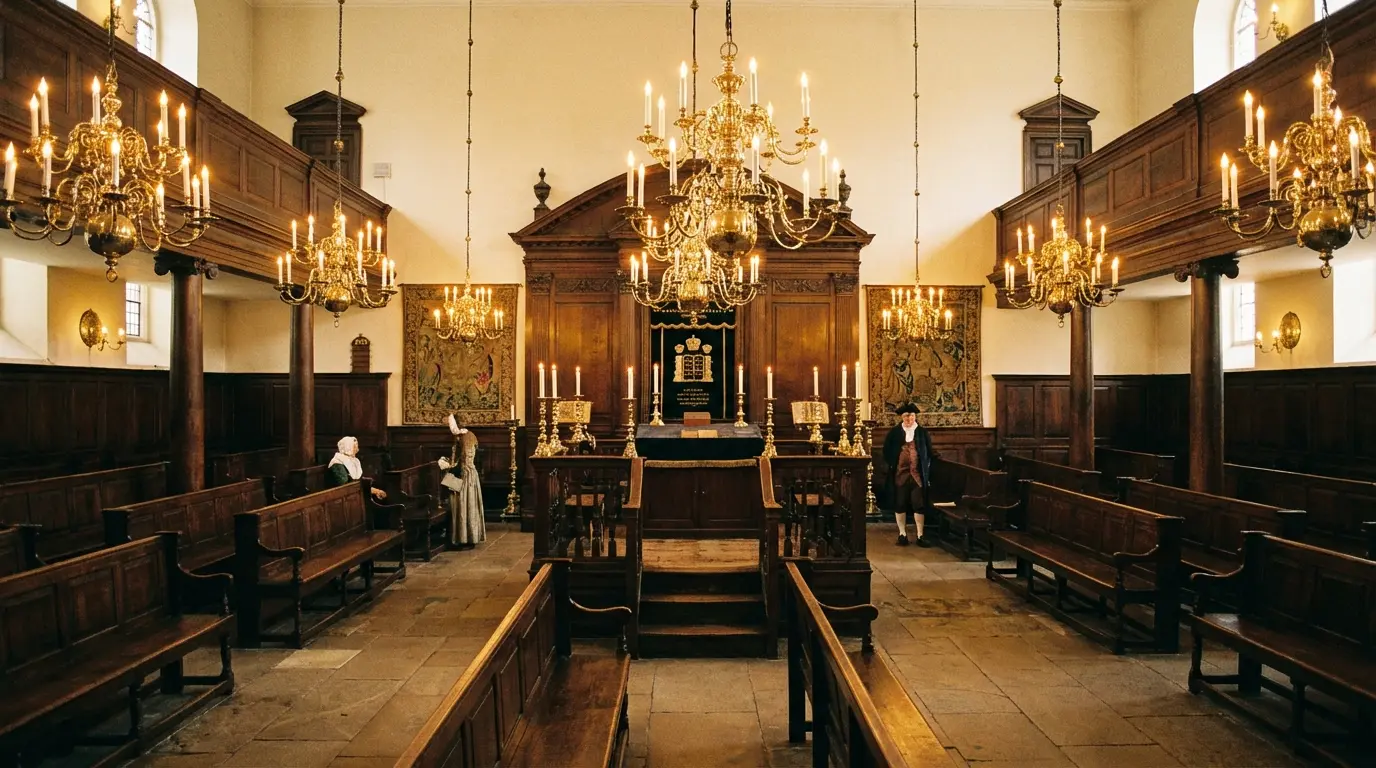
Bevis Marks Synagogue, in the City of London, was built in 1701 by the Sephardic community that Cromwell had permitted to return. It has been in continuous use since its construction. Nothing has been altered. The benches, the layout, the light, all original. When you enter, you are in the same space where Jews worshipped over 300 years ago. That kind of continuity is almost unheard of.
A few miles east, Whitechapel and Spitalfields tell the later chapter of the story. In the late 19th and early 20th centuries, waves of Ashkenazi Jews fleeing pogroms in Eastern Europe settled in London’s East End. The buildings, the street names, the old synagogues now converted to other uses, all trace the path of a community that arrived with nothing and built a new life.
Walking from Bevis Marks to Whitechapel with a group is not just a tour of buildings. It is a tour of the Jewish story in England across three centuries, from the Sephardic return to the Ashkenazi immigration. For a rabbi, this walk offers more teaching moments per block than almost any Jewish heritage site in Europe.
Planning a Jewish Heritage Tour to England With Your Group
A Jewish heritage trip to England can focus on London alone, covering Bevis Marks, the East End, the Jewish Museum, and the Holocaust Memorial. But the deeper itinerary moves north, to Lincoln, to Oxford, and to York. A 7 to 10 day trip allows the full arc of the story to unfold.
Heritage Tours brings Jewish groups to England with full awareness of the historical weight of these sites. Clifford’s Tower is not a photo stop. Lincoln’s Jew’s Court is not a quick walk-by. These places require time, context, and a guide who understands what the group is encountering.
Group leaders travel free when they bring 15 or more participants. Heritage Tours manages the advance bookings, the ground transportation, and the site coordination. Your role as the rabbi is to lead your community through the experience, not to manage the schedule.
See our group leader planning guide and our 10-day England heritage itinerary for a day-by-day route.
FAQ: Jewish Heritage Travel in England
Why were Jews expelled from England in 1290 and when were they allowed to return? Edward I issued the Edict of Expulsion in 1290, making England the first European country to formally expel its entire Jewish population. The reasons were a combination of religious hostility, financial exploitation (the crown had taxed Jewish communities heavily), and political convenience. Jews were not readmitted until 1656, when Oliver Cromwell permitted a small Sephardic community to settle in London. The gap lasted 366 years.
What is Bevis Marks Synagogue and how old is it? Bevis Marks is a Sephardic synagogue in the City of London, built in 1701. It has been in continuous use since its construction, with no alterations to its original interior. It is the oldest synagogue in the United Kingdom and one of the oldest in Europe. Visiting with a group requires advance booking, which Heritage Tours arranges as part of any London-based Jewish heritage itinerary.
What happened at Clifford’s Tower in York and is it appropriate to visit? In March 1190, approximately 150 Jews took refuge in the royal castle at Clifford’s Tower. Surrounded by a hostile mob, most chose death over forced conversion. It is one of the most significant acts of anti-Jewish violence in medieval Europe. Visiting is appropriate and important, but it requires sensitivity. Heritage Tours prepares group leaders with guidance on how to approach the site with their community.
What was Jewish life like in medieval England before the expulsion? Jewish communities in England were concentrated in cities like London, Lincoln, York, Oxford, and Norwich. They were primarily engaged in finance, as many other occupations were restricted. Figures like Aaron of Lincoln amassed enormous wealth that funded royal projects. Jewish communities were under royal protection but also subject to heavy taxation and periodic violence. The period from roughly 1070 to 1290 saw both prosperity and persecution, ending in total expulsion.
Where is London’s historic Jewish quarter and what can you visit today? London’s early Jewish community was centered around what is now Old Jewry, near the Bank of England. After the 1656 return, Jewish life rebuilt around the City of London (Bevis Marks area) and later the East End (Whitechapel, Spitalfields). Today you can visit Bevis Marks Synagogue, the Jewish Museum in Camden, and walk the East End to see the layers of Ashkenazi immigration. The old synagogues in the East End have largely been converted, but the streets and buildings still tell the story.
If you are a rabbi considering England for your community, this is a heritage journey worth taking. We would be glad to talk with you about what it could look like. Explore Heritage Tours’ England programs.