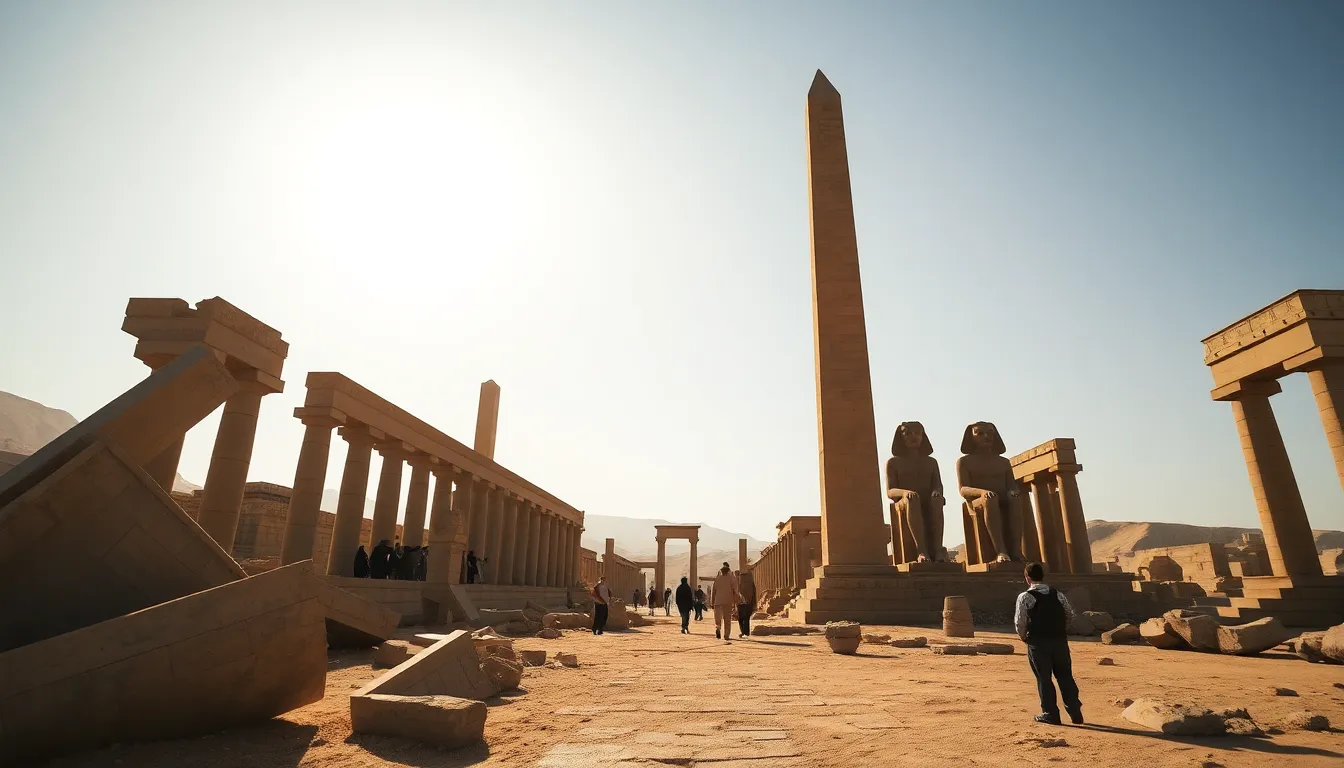
The first time I brought a group to Tanis, a rabbi in the party stopped at the edge of the ruin field, looked out over the toppled obelisks and the broken giants lying in the grass, and said quietly, “This is Zoan.” He had read the name in the Psalms his whole life, recited it at the Seder table, and never imagined he would stand in it. That is the gift of Tanis. It is a city the Bible names, sitting half-forgotten in the green Delta, far from the tour-bus circuit, where a faith group can have one of the most direct encounters with Scripture available anywhere in Egypt.
Tanis does not get the crowds of Giza or the polish of Luxor. It is a vast, raw field of fallen monuments out in the northern Delta. But for a group walking the biblical story, it is among the most rewarding stops in the country. This guide orients a faith group to Tanis: the city the Bible calls Zoan, the wonders done in its fields, and what survives for you to stand among today.
Why Tanis Matters to Faith Travelers
Tanis sits in the northeastern Nile Delta, the same biblical region as the land of Goshen where the Israelites settled. For a stretch of ancient Egyptian history, after the great age of the southern capitals, Tanis became the seat of royal power in the north. Its kings built temples here and filled them with obelisks, statues, and sacred lakes. They also buried their dead here, and in the twentieth century archaeologists uncovered royal tombs at Tanis with gold treasures that rival the more famous finds of Tutankhamun, though they remain far less known to the public.
What makes Tanis matter to a faith group is the biblical name. The Hebrew Bible calls this city Zoan, and it names it more than once. That direct scriptural connection, set in the very region of the Exodus narrative, is what lifts Tanis from an impressive ruin into heritage ground.
Zoan in the Bible
The name Zoan appears several times in Scripture. The Psalms recall the wonders God did “in the field of Zoan,” placing the signs of the Exodus in this part of the Delta. The book of Numbers preserves an old note that the city of Zoan was built seven years after Hebron in Canaan, an ancient marker of its antiquity. The prophets Isaiah and Ezekiel name Zoan in their oracles concerning Egypt, speaking of its princes and its fate.
When I read these passages to a group standing inside the ruins, the effect is immediate. The “field of Zoan” the Psalmist sang about is the field they are standing in. The princes of Zoan the prophets named once ruled from the broken temples around them. For a faith traveler, few places in Egypt offer this kind of direct, named encounter with the biblical text. Tanis is one of them.
Tanis and the World of the Exodus
There is a further connection that gives Tanis added weight for an Exodus-minded group. Much of the stone at Tanis was not quarried fresh. It was carried here from the older Delta capital of Pi-Ramesses, the grand city of Ramesses II that lay a short distance to the south. When that city declined and the Nile branch beside it silted up, its monuments were dismantled and hauled to Tanis to build the new capital. This is why the obelisks and colossi at Tanis are carved with the names of the Ramesside pharaohs.
That matters because Pi-Ramesses is closely tied to the store-city of Rameses the Bible says the Israelites built. So when you stand at Tanis among stones bearing the names of those pharaohs, you may well be looking at the very blocks the biblical narrative connects to Israelite labor, relocated north to a new capital. I am always careful to frame this honestly: the stones were moved, and the picture is layered. But the connection is real, and it makes the walk through Tanis a walk through the physical world of the Exodus.
What Survives at Tanis Today
Tanis is one of the largest archaeological sites in the Delta, and what survives is a field of fallen giants. Here is how I orient a group to what they are seeing.
The Field of Fallen Obelisks and Colossi
The first impression of Tanis is scale and ruin together. Across the temple precinct lie toppled obelisks of red granite, the shattered remains of colossal royal statues, and the foundations of great temples to the gods of the Delta. Some of the fallen figures are enormous, their faces and shoulders half-buried in the earth. Unlike the upright, reconstructed temples of the south, Tanis is left much as it fell, and that rawness is part of its power. You walk among the wreckage of a capital, and the sense of a fallen city, exactly as the prophets foretold for the cities of Egypt, is palpable.
The Temple Precincts and Sacred Lake
The heart of Tanis was its great temple complex, dedicated chiefly to the Delta gods. The enclosure walls, the gateways, and the bases of the temples can still be traced across the site, along with the remains of a sacred lake. Walking the precinct, a group gets a sense of how an Egyptian temple city was organized: the processional approaches, the sanctuaries, the water at the heart of the cult. It is a quieter, more contemplative kind of visit than the crowded southern temples, and that quiet serves a faith group well.
The Royal Tombs
One of the most remarkable discoveries at Tanis came in the twentieth century, when archaeologists found intact royal tombs within the temple enclosure, holding silver coffins, gold masks, and rich burial goods. The find was made on the eve of a world war and never received the public attention that the treasures of Tutankhamun did, which is part of why Tanis remains so little known. For a group, the story of these hidden royal burials adds a sense of discovery to the site, a reminder that even a forgotten ruin in the Delta held the wealth of kings.
Reading Tanis as a Heritage Group
What I want a group to carry away from Tanis is the meeting of three things: the biblical name, the relocated stones of the Exodus pharaohs, and the field of ruin foretold by the prophets. Tanis is Zoan, named in the Psalms and the prophets. Its monuments came from the city the Bible links to Israelite labor. And it lies fallen and quiet, a once-great capital reduced to broken giants in the grass.
That is why I treat Tanis as a destination in its own right, not a quick photo stop. We read the relevant passages on site. We walk the temple precinct slowly. We let the silence of a fallen capital do its work. For a faith group, Tanis is where the Delta heritage trail reaches one of its clearest biblical anchors. It pairs naturally with the wider biblical north covered in our Nile Delta heritage guide, and with the Exodus geography of the Red Sea coast where the liberation story turns.
Practical Orientation for Visiting Tanis
A few honest practicalities, because Tanis is more remote than most Egypt sites and a group leader should plan accordingly.
Tanis sits in the northeastern Delta, a longer drive from Cairo than most heritage day trips, generally a couple of hours each way through agricultural country. Because of that distance, I treat Tanis as the better part of a dedicated day rather than something to squeeze in alongside other sites. The drive itself, through the green farming heart of the Delta, is part of the experience and helps a group feel the landscape of Goshen.
This is open archaeological country with little shade and minimal tourist infrastructure. The ground is uneven, scattered with stone and grass, and there are no crowds and few facilities. Closed shoes, sun protection, and water are essential, and a knowledgeable guide is what turns the site from a confusing field of rubble into a readable, moving heritage encounter. Our team handles the long drive, the timing, and the site orientation so your group can focus on the meaning.
Timing matters at an exposed Delta site. Spring, fall, and winter are far kinder than the summer heat, and our season-by-season guide to visiting Egypt walks through the windows in detail. I steer Tanis visits toward the cooler, clearer months whenever a group has the flexibility.
For group leaders: with 15 or more participants, the group leader travels free. Tanis is exactly the kind of off-the-circuit biblical site that makes a heritage itinerary feel personal and deep rather than packaged, and it rewards the group willing to make the drive.
FAQ: Tanis (Zoan) Heritage Travel
Is Tanis mentioned in the Bible?
Yes. The Bible calls Tanis by the name Zoan and names it several times. The Psalms recall the wonders God did “in the field of Zoan,” placing the Exodus signs in this part of the Delta. The book of Numbers notes that Zoan was built seven years after Hebron, and the prophets Isaiah and Ezekiel name its princes in their oracles concerning Egypt. This direct scriptural connection is what makes Tanis significant for faith groups.
Where is Tanis located?
Tanis sits in the northeastern Nile Delta, in the same broad region the Bible calls Goshen, where the Israelites settled. It lies a couple of hours by road from Cairo, through the agricultural heart of the Delta. Because of that distance, we treat Tanis as a dedicated day trip rather than a quick stop alongside other sites.
What can you see at Tanis today?
Tanis is a vast field of fallen monuments: toppled red granite obelisks, the shattered remains of colossal royal statues, and the traced foundations of great temples and a sacred lake. Unlike the reconstructed temples of southern Egypt, Tanis is left much as it fell, which gives it a raw, contemplative power. The site also yielded intact royal tombs with gold and silver treasures in the twentieth century.
Is Tanis connected to the Exodus?
Indirectly but meaningfully. Much of the stone at Tanis was carried here from the older capital of Pi-Ramesses, the city of Ramesses II that is closely tied to the store-city of Rameses the Bible says the Israelites built. So the obelisks and colossi at Tanis bear the names of the Ramesside pharaohs and may include blocks linked to the Exodus narrative, relocated north when the new capital was built.
Is Tanis worth the trip for a faith group?
For a group focused on the biblical story, yes. Tanis is one of the few sites in Egypt that the Bible names directly, set in the region of the Exodus, built from stones tied to the pharaohs of that era, and left fallen as the prophets foretold for Egypt’s cities. It is remote and lacks tourist polish, which is part of why it feels like a genuine discovery rather than a packaged stop.
Tanis is Zoan, the city of the Psalms and the prophets, lying quiet and immense in the green Delta. For the group willing to make the drive, it offers one of the most direct meetings with Scripture that Egypt has to give.
You can see how Tanis fits a complete heritage journey on our Egypt heritage destination page, or read our Nile Delta heritage guide to place it within the wider biblical north. When you are ready to start planning, reach out through our contact page and I will help you build the itinerary around your community.