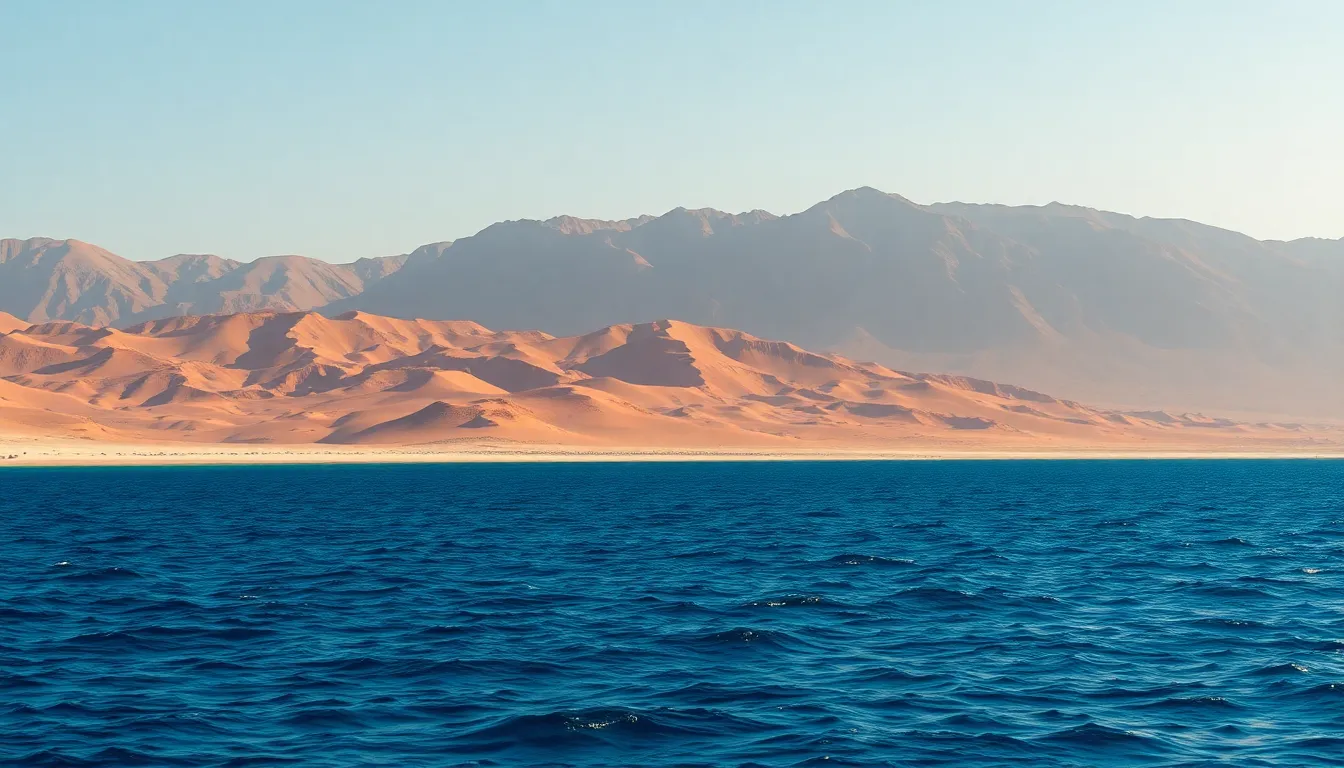
I have stood at the edge of the Red Sea with more groups than I can count, and I have stopped trying to predict how people will react. Some go silent. Some pray. Once, a pastor I was traveling with simply walked to the water, knelt, and stayed there long enough that the whole group fell quiet around him. The Red Sea does that. Whatever you believe about the mechanics of the crossing, standing at the shore where the story says God made a way through the water is one of the most powerful moments a faith group can have in Egypt.
But the Red Sea coast is more than the crossing tradition. The eastern desert that runs down to this shore holds the oldest Christian monasteries in the world, communities of monks who have prayed in the same desert caves for sixteen centuries. This guide orients a faith group to the whole coast: the crossing, the monasteries, and the practical realities of bringing a congregation to this corner of Egypt.
Why the Red Sea Coast Matters for Faith Groups
The Red Sea coast carries two distinct heritage layers, and a good itinerary honors both.
The first is the Exodus. The crossing of the sea is the climax of the liberation narrative, the moment the Israelites pass from slavery to freedom, the event the Passover Seder retells every year. The Red Sea is where the story turns. For a Jewish or Christian group walking the Exodus trail, reaching the water is the emotional summit of the journey.
The second layer is the birth of Christian monasticism. The mountainous desert between the Nile and the Red Sea is where the earliest monks withdrew to seek God in solitude in the centuries after Christ. From these Egyptian deserts the entire monastic tradition spread to the rest of the Christian world. When a group visits the monasteries of the Eastern Desert, they are not visiting a museum. They are visiting living communities at the source of a tradition that shaped monasteries from Ireland to New England.
The Crossing Tradition
Let me be direct, because honesty serves a group better than tidy certainty. The exact location of the Red Sea crossing is a matter of long scholarly debate. The Hebrew name of the body of water, Yam Suph, is often translated “Sea of Reeds,” and proposals for the crossing point range across the Gulf of Suez, the marshy lake region of the eastern Delta, and the Gulf of Aqaba far to the east. There is no signpost, and I do not pretend there is one.
What I tell my groups is this. The water is real. The shore is real. The story is real to your community. You do not need archaeological certainty to stand at the Red Sea and feel the weight of the moment the Israelites stood at the same kind of water, with the desert behind them and freedom ahead. I have led groups to the shore of the Gulf of Suez and watched grown men and women weep at the recognition of where they were standing. The power of the place does not depend on settling the scholarly argument.
How I Frame the Crossing for a Group
I frame it the way I frame Sinai and Giza, with accurate history held alongside living faith. I explain the geography and the debate honestly. Then I let the place do its work. We read the relevant passage at the shore. We give people time and quiet. Often a rabbi or pastor leads a prayer or a song, and it is rarely brief, because the moment asks for more than a few minutes. This is the place where the story says deliverance came at the last possible instant. Standing there, that truth lands in the body in a way no sermon back home can match.
The Desert Monasteries
The Eastern Desert, the rugged country between the Nile and the Red Sea, holds two of the most important monasteries in Christian history. For a Christian group, and for any traveler curious about the roots of the faith, these are among the most moving stops in Egypt.
The Monastery of Saint Anthony
The Monastery of Saint Anthony, set against the cliffs of the Eastern Desert not far inland from the Red Sea coast, is generally regarded as the oldest Christian monastery in the world. Saint Anthony, often called the father of monasticism, withdrew into this desert in the late third and early fourth centuries to live as a hermit. Others followed, drawn by his example, and the community that gathered around him became the model for monastic life everywhere. Above the monastery, you can climb to the cave where Anthony lived in solitude, looking out over the desert that formed him.
The monastery is still a working community of Coptic monks. The ancient church holds vivid wall paintings, and the whole compound, with its walls, gardens, and springs, feels like a fortress of prayer in the wilderness. For a group, the visit is a direct encounter with the place where the choice to leave everything for God first took organized form.
The Monastery of Saint Paul
Not far away, deeper in the same desert toward the coast, lies the Monastery of Saint Paul, built around the cave where Saint Paul the Hermit is said to have lived for decades in even greater solitude than Anthony. The two monasteries are traditionally visited together, and their stories are intertwined in Coptic tradition. Saint Paul’s is smaller and more remote, and that remoteness is exactly the point. This is what the earliest Christians meant by withdrawing to the desert to find God.
Saint Catherine’s and the Sinai Connection
A group focused on monasteries should know that the most famous desert monastery of all, Saint Catherine’s at the foot of Mount Sinai, sits across the Gulf of Suez in the Sinai Peninsula rather than on the Red Sea mainland coast. It is the oldest continuously inhabited Christian monastery in the world and the launching point for the pre-dawn ascent of Mount Sinai. Many heritage itineraries combine the Red Sea coast with a Sinai crossing to reach Saint Catherine’s, tying the monastic tradition and the Exodus geography together. I plan that link carefully for groups whose focus calls for it.
The Coastal Sites and the Wider Red Sea Region
Beyond the crossing and the monasteries, the Red Sea coast has a character worth understanding before a group arrives.
The coast is also Egypt’s resort region. Towns like Hurghada on the mainland and Sharm el-Sheikh in the Sinai are built around the warm water, the coral reefs, and year-round sun. For a heritage group, this matters in a practical way: the coast offers comfortable, well-serviced hotels that can anchor a journey to the monasteries and the crossing sites, and it gives a group a place to rest after the demands of desert travel. I have built itineraries where a day of rest by the sea, after the Mount Sinai ascent, becomes its own quiet gift to a tired but moved group.
The reefs of the northern Red Sea are among the finest in the world, and some groups add a day of snorkeling or a glass-bottom boat trip. I never push this, but for families and mixed-age congregations it can be a welcome lighter day woven into a heavy itinerary. The Red Sea has been a route of trade and travel since antiquity, and even a relaxed day on the water connects a group to the ancient life of this shore.
Practical Orientation for the Red Sea Coast
A few honest practicalities for a group leader weighing this region.
Distances here are real. The monasteries of Saint Anthony and Saint Paul sit in remote desert, reached by long drives from Cairo or from the coastal towns. The crossing sites on the Gulf of Suez, the coastal resorts, and a Sinai crossing to Saint Catherine’s are all separated by significant travel. This is country where good ground arrangements are not a luxury. Our team handles the routing, the timing, and the long desert drives so your group arrives ready rather than worn out.
Dress for the desert and for working monasteries. The monasteries are active religious communities with modest dress expectations: covered shoulders and knees for everyone, and a head covering for women in some churches. The desert is hot and exposed by day and can be cool at night, so layers matter. Sun protection and water are essential.
Timing matters here as much as anywhere in Egypt. The coast stays warm year-round, but the desert and the Sinai are far more comfortable outside the peak summer heat. Our season-by-season guide to visiting Egypt walks through the windows in detail, and I usually steer Red Sea and Sinai itineraries toward spring, fall, or winter.
For group leaders: with 15 or more participants, the group leader travels free. The Red Sea coast, with its crossing tradition and its ancient monasteries, is one of the most emotionally resonant parts of an Egypt heritage journey, and it costs little to build in.
FAQ: Red Sea Coast Heritage Travel
Where did the Red Sea crossing happen?
The exact location is debated by scholars. The Hebrew term Yam Suph is often translated “Sea of Reeds,” and proposed crossing points range across the Gulf of Suez, the lake region of the eastern Delta, and the Gulf of Aqaba. There is no marked site. We bring groups to the shore of the Red Sea and frame the crossing honestly, letting the place carry the weight of the story without claiming a certainty the evidence does not provide.
What monasteries can you visit on the Red Sea coast?
The two great monasteries of the Eastern Desert are Saint Anthony’s, generally regarded as the oldest Christian monastery in the world, and Saint Paul’s, built around the cave of Saint Paul the Hermit. Both are still working Coptic communities and are traditionally visited together. Saint Catherine’s, at the foot of Mount Sinai, sits across the gulf in the Sinai Peninsula and is often combined with the coast on a Sinai-focused itinerary.
Is the Red Sea coast just a resort area?
It is both. Towns like Hurghada and Sharm el-Sheikh are resort destinations built around the reefs and warm water, but the same region holds the crossing tradition and the desert monasteries. For a heritage group, the resorts provide comfortable hotels to anchor the journey and a welcome place to rest, while the monasteries and the shore provide the spiritual heart of the visit.
How do you reach the desert monasteries?
The monasteries of Saint Anthony and Saint Paul lie in remote desert, reached by long drives from Cairo or from the Red Sea coastal towns. The roads are good but the distances are real, which is why solid ground arrangements matter. We handle the routing and timing so a group arrives rested rather than worn down by the desert travel.
Can you combine the Red Sea coast with Mount Sinai?
Yes, and many heritage groups do. A Sinai crossing links the Red Sea region to Saint Catherine’s Monastery and the pre-dawn ascent of Mount Sinai, tying the monastic tradition and the Exodus geography together in one journey. We plan this connection carefully, since it involves significant travel and the timing of the mountain ascent.
The Red Sea coast holds two of the deepest currents in the biblical story: the moment of deliverance at the water and the birth of the monastic life in the desert. For a faith group, reaching this shore is often the part of Egypt that stays with people longest.
You can see how the Red Sea fits a complete heritage journey on our Egypt heritage destination page, or read our Nile Delta heritage guide to trace the Exodus from its beginning in Goshen to its turning at the sea. When you are ready, reach out through our contact page and we will build the itinerary around your community.