The first time I brought a group down the desert road toward the Red Sea, a pastor sitting near the front asked me why we were driving so far past Saint Anthony’s to reach a second monastery. He had read about Saint Anthony. He had not heard of Saint Paul. By the time we left the monastery of Saint Paul the Anchorite that afternoon, he told me it was the part of the trip he would carry home. That happens here more than you might expect.
Saint Paul’s lives in the shadow of its famous neighbor, and that is part of what makes it worth the drive. Where Saint Anthony’s draws the crowds and the church history footnotes, Saint Paul’s holds a quieter, older claim. This is the cave where the man the Coptic church calls the first hermit lived alone for ninety years. If your group cares about the roots of Christian monasticism, you cannot understand the story from one monastery. You need both. Let me walk you through the one most itineraries skip.
Who Was Saint Paul the Anchorite
Paul of Thebes, called Paul the First Hermit or Paul the Anchorite, was born around the year 228 in the Thebaid of Upper Egypt. According to the account written by Saint Jerome in the fourth century, Paul fled into the Eastern Desert during the persecution of the emperor Decius, around the year 250. He was a young man, educated and wealthy, escaping both the danger of arrest and a relative who wanted to betray him for his inheritance.
He found a cave near a spring and a date palm, and he stayed. Not for a season. For the rest of his life. Jerome writes that Paul lived in that cave for ninety years, fed, the tradition says, by a raven that brought him half a loaf of bread each day. He prayed, he fasted, and he saw almost no one.
The Meeting with Saint Anthony
The reason we know Paul’s story at all is the meeting that closes it. When Paul was an old man of around 113, Saint Anthony, already famous as a holy man, was told in a vision that there was a hermit deeper in the desert holier than himself. Anthony set out to find him. The two old men met, talked through the night, and shared a meal. When Anthony returned a short time later, Paul had died. Anthony buried him, the tradition says, with the help of two lions that dug the grave.
I tell groups this story before we arrive, because it changes how you stand in the place. This is not an abstract saint. This is the man who reminded even Anthony, the father of monasticism, that someone had gone further into the silence first.
The Monastery in the Eastern Desert
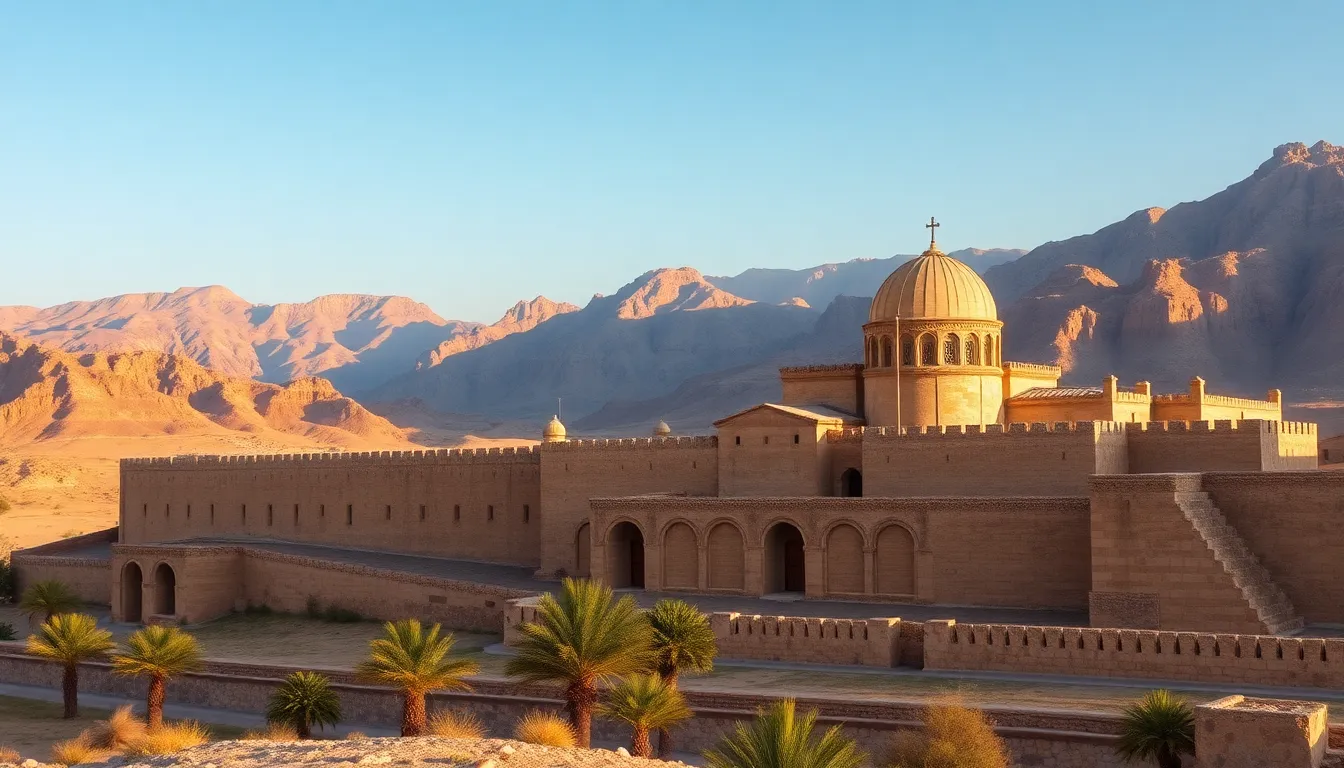
The Monastery of Saint Paul, known in Arabic as Deir Anba Bula, sits in the Eastern Desert of Egypt, tucked against the cliffs of the Galala plateau, about a two-hour drive inland from the Red Sea resort town of Hurghada and roughly the same distance from Saint Anthony’s over the mountains. The setting is stark. Tan rock, hard light, and then suddenly these fortified walls rising out of the desert floor.
The monastery grew up around Paul’s cave. Monks settled at the site to guard and venerate it, and over the centuries they built the walls, the towers, and the churches you see today. Like most desert monasteries in Egypt, Saint Paul’s has known cycles of flourishing, abandonment, and revival. Bedouin raids emptied it more than once. It was repopulated, restored, and it remains an active, inhabited Coptic Orthodox monastery today, home to a community of monks who keep the same rhythm of prayer that has marked this ground for more than fifteen centuries.
The Cave Church of Saint Paul
The heart of the monastery, and the reason your group is here, is the Cave Church built into and around the cave where Paul lived. You descend into it. The space is low, dark, and close, lit by hanging lamps, the walls and ceiling covered in old paintings of saints, Christ, and the Virgin. The relics of Saint Paul are kept here.
I always slow a group down at this point. The cave church asks for it. You are standing in the actual hollow in the rock where a man spent ninety years in prayer. The air is cool and still. People stop talking on their own, the way they do at Sinai. I have watched Protestant pastors who came in skeptical of relic veneration grow quiet here, not because their theology changed, but because the sheer endurance of the place reached past the argument.
The Churches, Walls, and Spring
Above and around the cave, the monastery holds several churches, a keep that monks could retreat into during raids, ancient olive presses, a mill, and the spring that, by tradition, sustained Paul and still flows. The walls enclose a small dense world of stone stairways and chapels. A guide from the monastery, or your own, can walk your group through the layers.
The spring matters to the story. In a desert this absolute, water is the difference between a place a man can survive and a place he cannot. That Paul found this spring, this palm, this cave, is part of why tradition reads his refuge as providence rather than luck.
Pairing Saint Paul’s with Saint Anthony’s
If you take only one piece of practical advice from me, take this: do not visit Saint Paul’s alone, and do not visit Saint Anthony’s alone. Visit both, in the same stretch of your itinerary, and let your group hold them together.
Saint Anthony’s, the Monastery of Saint Anthony, is the larger and more developed of the two, and it preserves the cave where Anthony himself withdrew high in the cliffs above. Together, the two monasteries give your group the founding pair of Christian monasticism in one landscape: Paul the first hermit, and Anthony the father of monks who organized the movement that followed. The desert between them is the same desert both men crossed.
The drive over the mountain road that connects the two is part of the experience. It is empty, severe country, and it tells you in your body what these men chose when they walked into it. For groups exploring the broader story, our guide to spiritual sites in Egypt sets these desert monasteries in the full context of the country’s Christian heritage, and the related cave churches of Mokattam show how the same impulse to carve worship into rock continued into modern Cairo.
Practical Notes for Group Leaders
A few things I have learned bringing groups here over the years.
The monastery is remote. Build it into a day that already takes you toward the Red Sea coast rather than treating it as a quick add-on from Cairo. Roads are good but distances are long.
Dress is modest and required. This is a working monastery. Shoulders and knees covered for everyone, men and women. I tell groups before we leave the hotel so no one is caught out at the gate.
Visiting hours follow the monastic calendar. During certain fasts, particularly the long Lenten fast and the fast before Christmas, access can be limited and the monks are in retreat. We confirm the schedule in advance every time, because the Coptic fasting calendar is genuinely different from the Western one.
The monks welcome reverent visitors warmly, but this is their home and their place of prayer, not a museum. I ask groups to keep voices low, to ask before photographing monks, and to remember that the silence here is the point, not an inconvenience.
If your group includes members who struggle with tight or dark spaces, give them a heads-up about the cave church before they descend. Most people find it moving. A few find it close. Knowing in advance helps.
Why This Site Belongs on a Christian Heritage Itinerary
There are flashier stops in Egypt. The pyramids, Abu Simbel, the Cairo museum. Saint Paul’s is not competing with those, and it does not need to. What it offers is something most itineraries never touch: the actual ground where the Christian impulse toward solitude, simplicity, and total devotion to God first took root in the desert.
For pastors leading congregations that feel scattered and overstretched, the witness of a man who gave ninety years to prayer in a cave lands in a particular way. For educators teaching church history, this is the chapter made physical. For anyone in your group hungry for silence in a loud life, the desert outside these walls preaches without a word.
You can see how we fit the Eastern Desert monasteries into a fuller journey on our Egypt heritage destination page, and learn how the group leader experience works through our group heritage tours, where group leaders travel free with fifteen or more participants.
FAQ: Visiting Saint Paul Monastery in Egypt
Where is the Monastery of Saint Paul located?
It sits in Egypt’s Eastern Desert, against the Galala plateau cliffs, roughly two hours inland from Hurghada on the Red Sea coast and about the same distance from Saint Anthony’s Monastery over the mountain road. Most groups reach it as part of a journey that already takes them toward the Red Sea, rather than as a day trip from Cairo.
What is the difference between Saint Paul’s and Saint Anthony’s monasteries?
Both are ancient Coptic monasteries in the same desert, and the two saints are linked by the famous account of their meeting. Saint Paul is venerated as the first Christian hermit, who lived alone in his cave for ninety years. Saint Anthony is honored as the father of organized monasticism. Saint Anthony’s is larger and more visited. We recommend seeing both together, since the story only makes full sense as a pair.
Can my group enter the cave where Saint Paul lived?
Yes. The Cave Church is built into and around Paul’s cave, and your group descends into it. It holds his relics and is covered in old paintings of saints and biblical scenes. The space is low, dark, and quiet. It is the spiritual heart of the visit, and we give groups time there rather than rushing through.
What should we wear to visit the monastery?
Modest dress is required for everyone. Shoulders and knees covered, for both men and women. This is an active monastery and a place of prayer, not a tourist site, so we ask groups to come prepared before arriving at the gate.
Is the monastery open year-round?
It is an active monastery, so access follows the Coptic monastic calendar. During major fasts, particularly Lent and the fast before Coptic Christmas, the monks may be in retreat and visiting can be restricted. Because the Coptic fasting calendar differs from the Western one, we confirm the schedule in advance for every group.
If your community is drawn to the desert roots of the faith and you want to walk the ground where Christian monasticism began, I would be glad to help you build a journey that does it justice. The Eastern Desert monasteries reward groups who come slowly and with reverence. When you are ready to talk it through, reach out to our team.