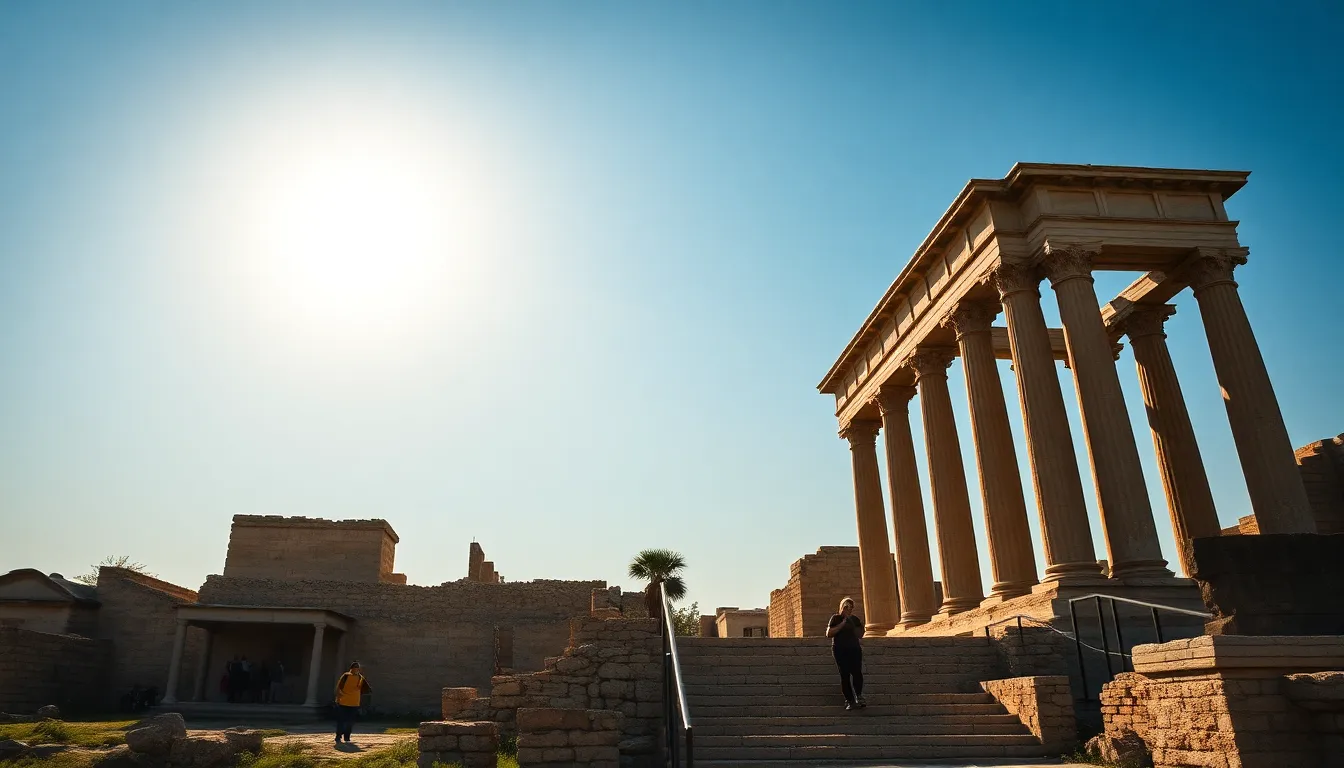
I will tell you when Pompey’s Pillar stops being a tall column in a guidebook and starts being something a group remembers. It is the moment you explain what used to stand around it. The pillar is impressive on its own, a single shaft of red granite reaching almost thirty meters into the Alexandrian sky. But it is the last thing standing on a hilltop that once held one of the most important temples and libraries of the ancient world. When a group understands that, they stop looking at the column and start looking at the empty ground around it, and the empty ground is where the story is.
Alexandria does not give itself up easily. Most of its ancient grandeur is gone, under the modern city or under the harbor. Pompey’s Pillar is one of the few monuments left standing in place, and that makes it the right anchor for telling a group what this city once was.
What Pompey’s Pillar Actually Is
Let me clear up the name first, because the name is a mistake that stuck. The column has nothing to do with the Roman general Pompey. Medieval travelers assumed it marked his tomb, and the wrong name has clung to it ever since. The Greek inscription on its base tells the real story: it was raised around 298 to 302 CE in honor of the Roman emperor Diocletian, almost certainly by the people of Alexandria in gratitude after a difficult siege and famine.
The column is a single piece of red Aswan granite, polished, rising about twenty-six and a half meters and standing close to thirty meters with its base and capital. For seventeen centuries it has held its place while the city around it was rebuilt over and over. It is the tallest ancient monument of its kind still standing in its original spot, and on a clear day you can see it from a good distance across the rooftops.
But the column is not why the hilltop matters. The hilltop matters because of what it held.
The Serapeum: The Real Heart of the Site
The pillar stands on the site of the Serapeum, the great temple of the god Serapis. Serapis was a deity invented under the early Ptolemaic kings to unite their Greek and Egyptian subjects under one shared cult, a god with an Egyptian heart and a Greek face. His temple in Alexandria was among the grandest in the ancient world, a vast complex of colonnades, courts, and underground galleries.
It was also a center of learning. The Serapeum is widely believed to have housed a major part, sometimes called the “daughter library,” of the famous Library of Alexandria after the main library declined. This was a place where the scholarship of the ancient Mediterranean was kept and copied and argued over. For anyone who cares about the transmission of texts, including the sacred texts of Judaism and Christianity, that detail matters enormously. I will come back to it.
In 391 CE the Serapeum was destroyed, torn down during the conflicts between the city’s pagan and Christian communities under the emperor Theodosius. What you walk among today are the foundations, the cisterns, a pair of granite sphinxes, the underground passages, and the one great column left standing. It is a ruin. But it is a ruin with a name worth knowing, and when a group walks the foundations with the story in their ears, the absence becomes its own kind of presence.
Why It Matters on a Faith Heritage Journey
Alexandria is a city of the deepest importance to both Jewish and Christian heritage, and Pompey’s Pillar is the gateway to telling that larger story on the ground.
The City of the Septuagint
Alexandria was home to the largest and most influential Jewish community of the ancient diaspora. It was here, according to tradition, that seventy Jewish scholars translated the Hebrew Scriptures into Greek in the third and second centuries BCE, producing the Septuagint. That translation is one of the most consequential events in the history of the Bible. It is the version of Scripture the early church read and quoted. When a New Testament writer cites the Old Testament, more often than not he is quoting the Septuagint. So the Greek Bible that shaped early Christianity was born in this city. Standing at the Serapeum, in the company of the library tradition that made such scholarship possible, gives a group a tangible footing for that history.
A Cradle of Early Christianity
Alexandria was also one of the great centers of the early church. Tradition holds that Mark the Evangelist brought the Gospel here and founded the Christian community of Egypt, which grew into the Coptic Orthodox Church that survives to this day. The Catechetical School of Alexandria, where thinkers like Clement and Origen taught, was among the most important centers of early Christian scholarship anywhere. For Christian groups, the city is not a side trip. It is one of the roots of the faith.
The Serapeum site, with its library connection and its place at the heart of ancient intellectual Alexandria, is where I begin that conversation with a group, because it makes the abstract concrete.
How Groups Visit the Site
Pompey’s Pillar and the Serapeum sit on a hill in the Karmous district of Alexandria, and the site is open, compact, and easy to walk. It is not a place that takes a whole morning. I usually plan forty-five minutes to an hour here, which is enough to walk the column, descend into the underground galleries where the sphinxes and a Nilometer survive, and stand on the foundations while I lay out the history of the temple and the library.
What I have learned to do is to treat this stop as the explanatory hub for the whole Alexandria day. You stand at the one surviving ancient monument and you point: there was the temple, there was the library, out there was the great harbor and the lost lighthouse, over there the catacombs. From this hill the vanished city can be reassembled in a group’s imagination, and that is worth more than the column itself.
Practical Notes for Group Leaders
- Time it as a short, high-impact stop. Forty-five minutes to an hour is right. The power of the site is in the storytelling, not in the square footage.
- The footing is uneven and there are stairs down to the underground galleries. For groups with less mobile members, the column and the upper terrace can be enjoyed without the descent.
- There is little shade on the open hilltop, so hats, water, and a morning or late-afternoon visit make a real difference in the warmer months.
- Pair it deliberately. This site works best alongside the Bibliotheca Alexandrina, the catacombs of Kom el-Shoqafa, and the Roman amphitheater, all of which are close by and tell parts of the same story.
This kind of sequencing, where each stop builds on the last instead of feeling like a checklist, is what my team handles when we build an Alexandria day. You can see how the broader Egypt itinerary comes together on our Egypt heritage destination page.
Where It Fits in the Trip
A proper Alexandria day moves naturally from the ancient to the modern. Pompey’s Pillar and the Serapeum give you the ancient grandeur and the library origin story. From there, the modern Bibliotheca Alexandrina picks the thread back up, a deliberate revival of the ancient library on the same shoreline. For groups going deeper into the country’s lesser-known sacred ground, our guide to hidden heritage sites in Egypt covers the Jewish and Coptic sites most tours miss. And if you are still weighing when to come, the season-by-season guide will help, since Alexandria’s coastal weather differs from Cairo and the south.
Pompey’s Pillar is a column. But it is a column standing guard over the memory of a city that gave the world the Greek Bible and a cradle of the early church. Tell a group that, and they will never see it as just a column again.
FAQ: Pompey’s Pillar and Ancient Alexandria
Is Pompey’s Pillar actually connected to Pompey?
No. The name is a medieval mistake. Travelers assumed the column marked the tomb of the Roman general Pompey, and the wrong name stuck. The Greek inscription on its base shows it was raised around 298 to 302 CE in honor of the emperor Diocletian, most likely by the people of Alexandria after a siege and famine.
What is the Serapeum and why does it matter?
The Serapeum was the great temple of the god Serapis, which once stood on the hill where Pompey’s Pillar now stands. It was among the grandest temples of the ancient world and is widely believed to have housed a major part of the Library of Alexandria. That library connection is why the site matters to faith travelers: this was a center of the scholarship that preserved and copied ancient texts, including the work that shaped the Greek Bible.
Why is Alexandria important to Jewish and Christian heritage?
Alexandria was home to the largest Jewish community of the ancient diaspora, and tradition holds that it was here that the Hebrew Scriptures were translated into Greek as the Septuagint, the version the early church read and quoted. It was also one of the great centers of early Christianity, with the Coptic Church tracing its founding to Mark the Evangelist. Pompey’s Pillar and the Serapeum are the anchor for telling that larger story on the ground.
How long do groups spend at Pompey’s Pillar?
Plan about forty-five minutes to an hour. That is enough to walk the column, descend into the underground galleries with the sphinxes, and hear the history of the temple and the library. The power of the visit is in the storytelling, so a knowledgeable guide turns a short stop into a meaningful one.
What else should we see in Alexandria on the same day?
Pompey’s Pillar pairs naturally with the catacombs of Kom el-Shoqafa, the Roman amphitheater, and the modern Bibliotheca Alexandrina, all close by. A common flow is the ancient sites in the morning, then the modern library in the afternoon, which deliberately revives the ancient one. Together they let a group trace Alexandria from its lost grandeur to its present.
If Alexandria belongs in the journey you are planning for your community, I would love to help you shape the day so each stop builds on the last. With fifteen or more participants, the group leader travels free, and my team handles every arrangement on the ground. Contact us whenever you are ready to begin the conversation.