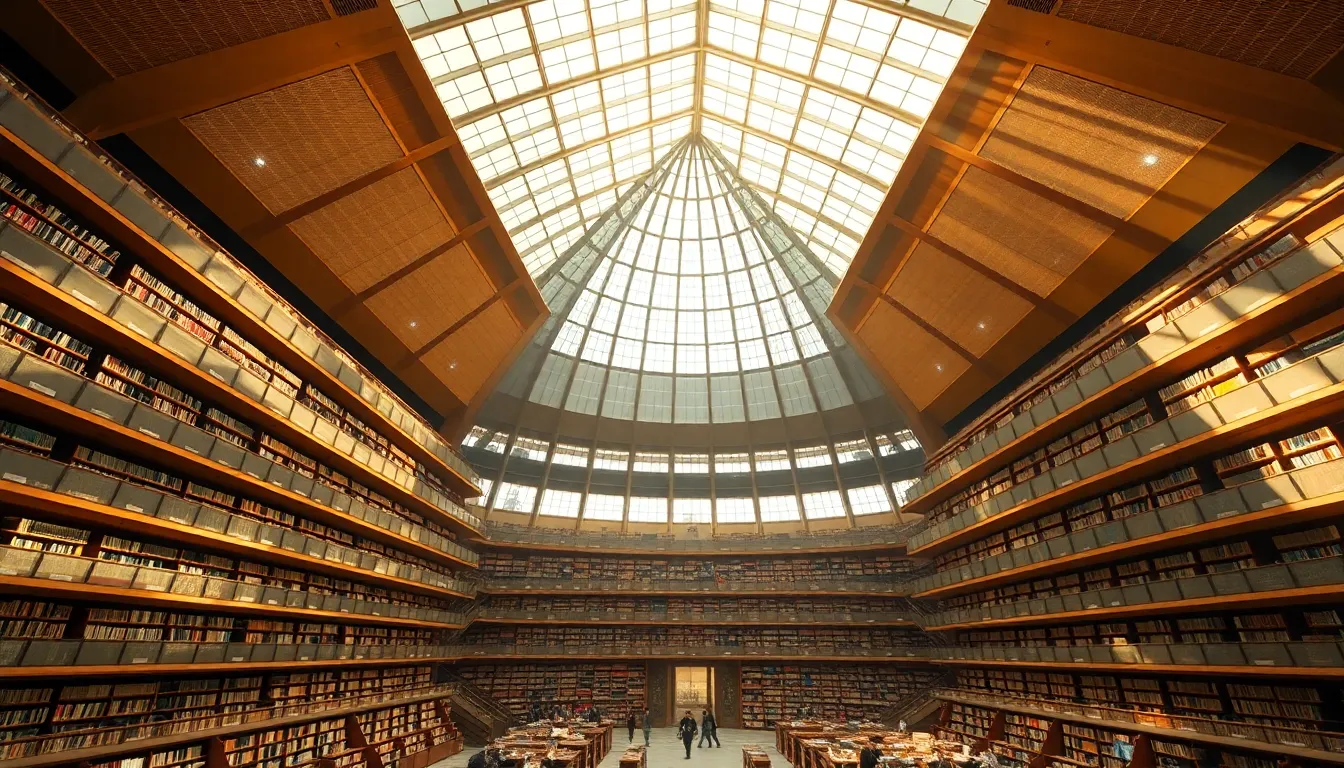
I had a rabbi on one of my Alexandria groups who stood in the great reading room of the Bibliotheca Alexandrina, looked up at that sweeping tiered space full of light, and said something I have never forgotten. He said, “This is where the Bible learned to speak Greek.” He meant it almost literally. Alexandria is the city where the Hebrew Scriptures were first translated into Greek, in the shadow of the greatest library the ancient world ever built. And here we were, standing in the modern resurrection of that library, on the same shoreline. For a group that cares about how sacred texts traveled through history, there are few stops in Egypt that land like this one.
The Bibliotheca Alexandrina is a modern building. But it is a modern building built deliberately to answer an ancient loss, and that is exactly why it belongs on a heritage itinerary.
The Ancient Library: What Was Lost
The original Library of Alexandria was founded under the early Ptolemaic kings in the third century BCE, probably under Ptolemy I and his successor Ptolemy II. It was part of a larger institution called the Mouseion, a kind of research academy dedicated to the Muses, and its ambition was staggering: to collect a copy of every book in the known world.
The methods were aggressive. Ships docking at Alexandria reportedly had their scrolls confiscated, copied, and the copies returned while the originals were kept. Agents were sent across the Mediterranean to buy texts. At its height the library is said to have held hundreds of thousands of scrolls, though the ancient numbers are debated. What is not debated is that Alexandria became the intellectual capital of the ancient world. The scholars who worked here measured the circumference of the earth, edited the texts of Homer, advanced mathematics and astronomy and medicine, and preserved the literature of Greece for the centuries that followed.
The library’s decline was gradual, not a single dramatic fire as the popular story has it. It suffered through the Roman conquest, civil conflict, and the destruction of the Serapeum and its “daughter library” in 391 CE. By late antiquity the institution was gone, and with it an incalculable amount of human knowledge. The loss became a kind of permanent wound in the memory of Western civilization, a symbol of what it means to lose what cannot be replaced.
The Septuagint Connection
For faith travelers, the ancient library has a specific and powerful significance. Alexandria held the largest Jewish community of the ancient diaspora, and it was here, according to tradition, that seventy or seventy-two Jewish scholars translated the Hebrew Scriptures into Greek in the third and second centuries BCE. That translation is the Septuagint.
This is not a footnote. The Septuagint was the Bible of the Greek-speaking Jewish world, and it became the Scripture the early church read, quoted, and spread. When the writers of the New Testament cite the Hebrew Scriptures, they are usually quoting the Septuagint. So the very intellectual culture that produced the Library of Alexandria, the scholarship, the scribes, the appetite for collecting and translating texts, is the culture that gave the world the first translation of the Bible. Standing in Alexandria, with the memory of that library in front of you, makes the journey of Scripture from Hebrew into Greek into the languages of the world feel like something that happened in a place, not just in the abstract.
The Modern Revival: The Bibliotheca Alexandrina
In 2002, after years of planning and international support, Egypt opened the Bibliotheca Alexandrina on the Mediterranean shore, near where the ancient library is believed to have stood. It was conceived as a deliberate act of memory and revival: not a museum of the old library, but a living, working library and cultural center meant to reclaim Alexandria’s role as a place of learning.
The building itself is striking. Its great reading room slopes down in eleven cascading terraces beneath an enormous tilted glass and aluminum roof, designed to evoke a rising sun. The outer wall is a vast cylinder of grey granite carved with characters from scripts all over the world and across history, a stone declaration that this is a home for the writing of all humanity. Inside, alongside the main reading room, there are several specialized museums, galleries, a planetarium, and rare manuscript and rare book collections.
For a group, the contrast is the whole experience. You spend the morning among the ancient ruins, the column on the hill where the Serapeum once held part of the old library, and then you come here, to the answer the modern world gave to that ancient loss. The wound and the response, in one day.
How Groups Visit the Bibliotheca
The Bibliotheca Alexandrina is on the Corniche, the seafront boulevard, on the east side of the old harbor. It is a working institution with regular opening hours, and groups visit with tickets. I plan around an hour and a half to two hours here, which gives time for the main reading room, one or two of the smaller museums, and a quiet moment to take in the scale.
I have found this stop works best as a teaching moment rather than a rushed walk-through. The reading room invites stillness. I gather the group on one of the terraces, lay out the story of the ancient library and the Septuagint, and let them sit with it. After days of ruins, standing inside a thriving library that consciously carries the ancient one’s mission forward gives a group a sense of continuity that is genuinely moving.
Practical Notes for Group Leaders
- It is a quiet, working library, so groups keep their voices low and follow the staff’s guidance. I brief everyone before we enter.
- Plan ninety minutes to two hours. Enough for the reading room and a museum or two without rushing. The building rewards a slower pace.
- It pairs best in the afternoon, after a morning among the ancient sites, so the contrast between loss and revival lands in sequence.
- Check current hours and any special exhibitions ahead of time, since opening days and times shift around Egyptian holidays. My team confirms this so a group never arrives to a closed door.
This kind of confirmation and sequencing is what we handle for you when we build an Alexandria day. You can see how it fits the wider trip on our Egypt heritage destination page.
Where It Fits in the Trip
The Bibliotheca is the second half of the story that begins at the ancient sites. It pairs directly with Pompey’s Pillar and the Serapeum, where part of the ancient library once stood, so a group experiences the loss and the revival as one continuous arc. For congregations going deeper into Egypt’s Jewish and Coptic heritage, our guide to hidden heritage sites in Egypt reaches the sites most tours skip. And since Alexandria’s coastal climate differs from Cairo and the south, the season-by-season guide is worth a read before you set dates.
The Bibliotheca Alexandrina is not ancient, and I am always clear about that with a group. What it is, is the modern world’s answer to one of history’s great losses, standing on the shore of the city that gave the Bible its first translation. For a faith community that understands what it means to carry a text faithfully across the centuries, that is a stop with real depth.
FAQ: The Bibliotheca Alexandrina and the Ancient Library
What happened to the original Library of Alexandria?
The original library declined gradually over centuries rather than burning down in a single event, as the popular story claims. It suffered through the Roman conquest, civil conflict, and the destruction of the Serapeum and its associated library in 391 CE. By late antiquity the institution was gone, taking with it an enormous amount of ancient knowledge. The loss became a lasting symbol of what it means to lose what cannot be replaced.
Why is Alexandria important to the history of the Bible?
Alexandria held the largest Jewish community of the ancient diaspora, and it was here that the Hebrew Scriptures were first translated into Greek, producing the Septuagint, in the third and second centuries BCE. The Septuagint became the Bible the early church read and quoted, so the New Testament writers usually cite it. The scholarly culture that built the Library of Alexandria is the same culture that gave the world the first translation of Scripture.
Is the Bibliotheca Alexandrina the same as the ancient library?
No. The Bibliotheca Alexandrina is a modern library and cultural center that opened in 2002, near where the ancient library is believed to have stood. It was built as a deliberate revival of the ancient library’s mission, not as a museum of it. Its dramatic terraced reading room under a great tilted roof has made it a landmark, and it houses working collections, museums, and a planetarium.
How long do groups spend at the Bibliotheca Alexandrina?
Plan about ninety minutes to two hours. That allows time for the main reading room, one or two of the smaller museums, and a quiet teaching moment about the ancient library and the Septuagint. The building rewards a slower pace, so I avoid rushing groups through it.
How does the Bibliotheca fit with the rest of an Alexandria day?
It works best in the afternoon, after a morning among the ancient ruins such as Pompey’s Pillar and the Serapeum. That order lets a group experience the loss of the ancient library and then the modern revival in sequence, which is the heart of what makes the visit meaningful. Together with the catacombs and the Roman amphitheater, it makes a full and coherent day.
If Alexandria belongs in the journey you are planning for your community, I would love to help you build a day where the ancient and the modern speak to each other. With fifteen or more participants, the group leader travels free, and my team handles every arrangement on the ground. Contact us whenever you are ready to begin.