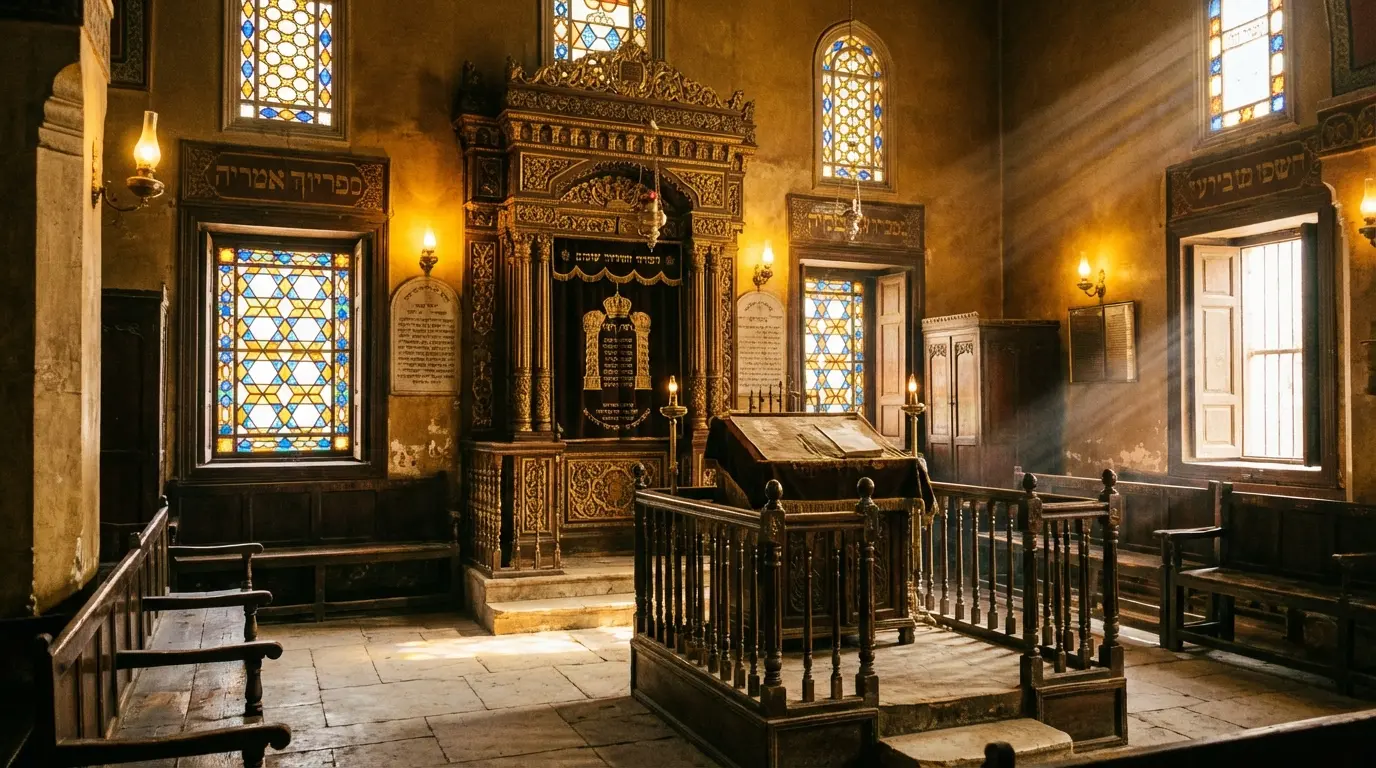
Every group leader I know has had the same conversation with their congregation. Someone has already been to Egypt. They have seen the pyramids, they have floated past Luxor on a Nile cruise, they have visited Ben Ezra Synagogue. And they come back asking the same question: “Is there more?”
There is so much more. The Egypt that most tour groups visit is the surface. Beneath it is a layer of sacred sites that have moved people to tears, prompted prayers that lasted an hour, sparked conversations that continued for years after the trip ended. These are the places my team brings groups when the standard itinerary is not enough. And honestly, sometimes these are the places I build the entire trip around.
Why the Standard Egypt Tour Misses So Much
The standard Egypt itinerary was designed for general tourism. The pyramids at Giza, the Egyptian Museum, a Nile cruise with stops at Luxor and Aswan, maybe a day in Old Cairo. It is a good itinerary if you want to see Egypt’s ancient monuments. But if you are a rabbi bringing your congregation to understand the Exodus, or a pastor whose church wants to walk the path of the Holy Family, the standard itinerary leaves out the most important ground.
Part of the reason these sites get missed is access. Some of them require local relationships to visit properly, not just a ticket purchase. Part of it is knowledge. The significance of a place like Tell el-Dab’a, or the Jewish Cemetery of Bassatine, is not obvious if you do not know what you are looking at. And part of it is simply that tour operators build what sells to the largest audience, and the largest audience is not a faith group from a synagogue in New Jersey or a church in Georgia.
That is our audience. So these are the sites we know.
The Land of Goshen: Where the Israelites Actually Lived
I want to start here because this is, to me, the most underappreciated place in all of Egypt for Jewish and Christian travelers.
The land of Goshen is not a metaphor. The Hebrew Bible describes it as a specific region in the northeastern Nile Delta, the fertile grazing land that Pharaoh gave to Jacob’s family when they arrived in Egypt in the time of Joseph. This is where the Israelites lived for generations, where they worked as laborers, where they multiplied, and where God heard their cry. When a Jewish family sits at the Passover Seder and says “we were slaves in Egypt,” this is the specific soil they are talking about.
Most tour groups never come here. It is not on the standard route. There are no world-famous monuments. What there is, instead, is a profound sense of place, and one of the most exciting archaeological sites in the entire Middle East.
Tell el-Dab’a (Ancient Avaris): The Possible Site of Ramesses
Tell el-Dab’a, in the Sharqia Governorate of the northeastern Delta, is the site of ancient Avaris, the capital of the Hyksos, a Semitic people who ruled northern Egypt for roughly a century and a half during the Second Intermediate Period. Since the 1960s, Austrian archaeologist Manfred Bietak and his team have been excavating here, and what they have found is extraordinary.
The material culture at Tell el-Dab’a is distinctly non-Egyptian. The burial practices, the pottery, the animal bones in the archaeological record, all point to a Semitic population that maintained its own cultural identity even while living in Egypt. Some scholars identify Avaris as the biblical city of Ramesses, one of the two store cities the Bible says the Israelites built. The debate among archaeologists is ongoing and fascinating.
What I can tell you is what I have watched happen when a Jewish group stands at Tell el-Dab’a. They go quiet in a particular way. Not the polite quiet of someone listening to a lecture. A deeper quiet. The kind that comes when a story you have carried your whole life suddenly has ground under it.
What the Archaeology Is Still Uncovering
One of the things I love about this site is that it is still being actively excavated. Every season brings new findings. When I bring a group here, I am not showing them a closed story. I am showing them an open one. The archaeology is still catching up to what faith has always held. There is something beautiful in that for people of faith.
If you want to understand more before bringing your group, read about the work of the Austrian Archaeological Institute at Tell el-Dab’a. It is some of the most significant biblical archaeology happening anywhere in the world right now.
Wadi Natrun: The Desert Monasteries That Shaped Christian Monasticism
About 110 kilometers northwest of Cairo, in a desert depression between the Nile Delta and the Libyan border, there is a valley called Wadi Natrun. It does not look like much from the main road. But Wadi Natrun is, quite literally, where Christian monasticism was born.
In the fourth century, Egyptian Christian hermits began retreating to this desert to pray and to fast and to wrestle with God in the silence of the wilderness. The most famous of them, Saint Macarius the Great, established a community here around 330 CE. By the end of the fourth century, thousands of monks had come to the Natrun desert. The Rule of Saint Basil, which became the foundation of Eastern Christian monastic practice, was shaped by what Basil observed here when he visited. The later Western traditions, including the Rule of Saint Benedict, grew from those roots.
When a Christian pastor brings their congregation to Wadi Natrun, they are not visiting a monument to ancient practice. They are visiting a living tradition. The monasteries here are still active. Monks still pray the ancient hours, still keep silence, still welcome pilgrims with the generous hospitality that has been characteristic of Coptic monks for seventeen centuries.
Saint Catherine’s Monastery in the Sinai gets most of the international attention, and it deserves it. But the Wadi Natrun monasteries are more accessible, more intimate, and, I would argue, more deeply moving for Christian groups because the community here is so alive.
Monastery of Saint Macarius the Great
Deir Abu Maqar, the Monastery of Saint Macarius the Great, is the oldest of the Wadi Natrun monasteries and one of the oldest continuously inhabited monastic communities on earth. It has been in continuous occupation since the fourth century, with only brief interruptions when Bedouin raids forced the monks to flee.
The monastery holds relics venerated by the Coptic Orthodox Church, and its ancient church includes architectural elements that are as old as the institution itself. But what moves people most, in my experience, is not the antiquity. It is the monks themselves. They are welcoming, serene, and willing to talk. A Coptic monk explaining his faith to a visiting pastor, or to a rabbi curious about the desert tradition, is one of the most profound interfaith encounters I have ever witnessed.
Monastery of the Syrians (Deir el-Suriani)
Deir el-Suriani, the Monastery of the Syrians, is named for the Syrian monks who purchased it in the eighth century and brought their extraordinary library with them. The library of Deir el-Suriani was one of the great scholarly treasures of the medieval world. In the nineteenth century, many of its most significant manuscripts were acquired by the British Museum, where they remain. But the monastery itself still stands, still active, still beautiful, with an interior decorated with paintings and stucco relief work that dates to the seventh century.
For Christian groups, both of these monasteries offer something rare: a direct, living connection to the world of the early church. Not a reconstruction. Not a museum. The thing itself, still functioning, fifteen hundred years on.
The Jewish Cemetery of Bassatine: One of the World’s Oldest
This is one of the sites I approach with the most care, because it deserves the most care.
The Bassatine Cemetery, on the southeastern edge of Cairo, is one of the oldest Jewish cemeteries in existence. Some of its graves date to the ninth century. The cemetery served the Jewish community of Cairo for over a thousand years and contains the graves of scholars, merchants, communal leaders, and ordinary families, the full span of a community’s life, recorded in stone.
By the late twentieth century, the cemetery was in a state of serious disrepair. The community that maintained it was almost entirely gone. Restoration efforts, led by the Association Internationale pour la Sauvegarde du Patrimoine Juif en Egypte and supported by the Egyptian government, have preserved significant portions of the site.
Walking through Bassatine is an act of witness. There is almost no other English-language writing about this place. You will not find it in most guidebooks. But for a Jewish group, it is one of the most powerful sites in Egypt, precisely because it is so unknown, and because the people buried here deserve to be remembered. We are, as a tradition, a people who do not forget our dead. Going to Bassatine is an act of that faithfulness.
The Other Synagogues of Cairo: Sha’ar Hashamayim and the Adly Street Synagogue
Everyone who visits Cairo’s Jewish heritage knows about Ben Ezra Synagogue. Fewer know about Sha’ar Hashamayim, the grand Sephardic synagogue on Adly Street in downtown Cairo.
Built in 1905, Sha’ar Hashamayim was designed to serve Cairo’s prosperous Jewish community at the height of its influence in Egyptian society. The building is extraordinary: a large, elegantly appointed synagogue in a North African and European hybrid style, capable of seating hundreds of worshippers. At its peak, the Jewish community of Cairo was deeply integrated into the professional and commercial life of the city. Doctors, lawyers, financiers, artists. A community that was genuinely at home here.
The synagogue is now maintained by the Egyptian government and can be visited with advance arrangement. Standing inside Sha’ar Hashamayim, you are standing inside the life of a community that no longer exists in this place. It is beautiful, and it is melancholy, and it is important. For Jewish groups doing a heritage tour focused on the full arc of Jewish presence in Egypt, including this synagogue alongside Ben Ezra tells a more complete story.
If you want to understand the depth of Jewish heritage in Egypt beyond the Exodus narrative, our full Egypt heritage travel guide covers the broader context.
The Church of the Holy Virgin at Musturud (Holy Family Site)
About twelve kilometers north of Cairo, in a neighborhood called Musturud, there is a church built over a spring where Coptic tradition holds that the Holy Family stopped and rested during their flight to Egypt. The Church of the Holy Virgin at Musturud is not on the standard tour itinerary. It is a working Coptic parish church in an ordinary Cairo suburb, not a grand basilica.
That is precisely why I find it so affecting.
When you visit the famous Coptic sites in Old Cairo, you are visiting places that have been pilgrimage destinations for centuries, places adapted to receive visitors and present their significance. Musturud is just a church, in a neighborhood, where people come to pray. The spring is still there. The church is simple and warm and alive. For Christian groups tracing the Holy Family route, stopping at Musturud, as one of many points on that path rather than the single famous stop, gives the journey a texture and a humanity that the famous sites alone cannot provide.
Tell el-Amarna: The Heretic Pharaoh and His Monotheist Revolution
Around 1346 BCE, the pharaoh Akhenaten did something that had never been done in three thousand years of Egyptian civilization. He abolished the traditional Egyptian pantheon, closed the temples of the gods, moved the capital to a new city he built from scratch on the desert plain, and declared that there was only one god: Aten, the solar disk.
The city he built was called Akhetaten. Today it is called Tell el-Amarna. It was occupied for only about twenty years before Akhenaten’s successors abandoned it, tore down his monuments, erased his name from the records, and tried to restore the old order. The city was never reoccupied. Its remains have been preserved under the desert sand for three thousand years.
For faith travelers, Tell el-Amarna raises one of the most tantalizing questions in biblical archaeology. Did Akhenaten’s monotheistic revolution have any connection to the Israelite concept of monotheism? Scholars debate this endlessly. What is not debatable is that standing at Tell el-Amarna, a city built by a pharaoh who believed in one God, somewhere in the same century the Exodus narrative takes place, creates an intellectual and spiritual encounter that is unlike anything else in Egypt.
Tell el-Amarna requires a dedicated day trip and a willingness to travel into Upper Egypt. But for groups with a scholarly or theologically curious character, it is worth building into the itinerary.
Saint Catherine’s Monastery: The World’s Oldest Continuously Inhabited Monastery
I know I said the Wadi Natrun monasteries deserve more attention than they get. That is true. But I would be doing you a disservice if I did not also say this: Saint Catherine’s Monastery is, for both Jewish and Christian travelers, one of the most extraordinary places on earth.
Built in the sixth century by order of the Emperor Justinian, on the site where tradition holds that Moses encountered the burning bush, at the foot of the mountain where God gave the Law, Saint Catherine’s has been in continuous habitation for fifteen centuries. It contains one of the world’s great libraries, with manuscripts second in significance only to the Vatican Library. The Codex Sinaiticus, one of the oldest and most complete manuscripts of the Christian Bible, was discovered here. The icon collection within the monastery walls includes pieces dating to the sixth and seventh centuries, predating the Byzantine iconoclasm that destroyed most early Christian imagery elsewhere.
The monastery is a UNESCO World Heritage Site and receives a significant number of visitors. But visiting it with a faith group that has been properly prepared for what they are about to see is a completely different experience from visiting it as a tourist. The climb to the summit at dawn, the silence at the top, the view from the mountain of Moses. These are not things I can describe in a way that does them justice.
How to Weave These Sites Into a Faith Group Itinerary
None of the sites I have described are on the standard Egypt tour itinerary. Some require advance arrangements. Some require local relationships that make access possible. Some require a guide who can provide the spiritual and historical context that transforms a visit from sightseeing to encounter.
This is what Heritage Tours does. Our team knows these sites deeply. We have local operators in Egypt with the relationships needed to access places that general tour groups cannot. And we build custom itineraries, so if your congregation is primarily interested in the Exodus narrative, we build around Goshen and Sinai. If your church wants to trace the Holy Family, we build around that path. If you want the hidden Jewish heritage of Cairo, we build a Jewish Cairo itinerary that most tour operators do not even know exists.
With fifteen or more participants, the group leader travels free. We handle all the on-the-ground arrangements. Your role is to be the spiritual guide for your community. Our role is to put you in the right places, with the right context, at the right time.
For more context on Egypt’s full range of heritage sites, read our Egypt heritage travel guide.
If you are considering a faith heritage journey that goes beyond the standard stops, we would love to talk about what that could look like for your community. The sites in this guide have changed people. I have watched it happen. I would be glad to help you bring your congregation to that same experience.
FAQ: Hidden Heritage Sites in Egypt
What are the most underrated historical sites in Egypt for faith travelers?
The most underrated sites for faith travelers include the Land of Goshen and Tell el-Dab’a in the northeastern Nile Delta, the Wadi Natrun desert monasteries, the Jewish Cemetery of Bassatine, Sha’ar Hashamayim Synagogue in downtown Cairo, and Tell el-Amarna in Upper Egypt. Each of these offers a depth of spiritual and historical encounter that the standard itinerary completely misses.
Where did the Israelites actually live in ancient Egypt?
The Israelites are described in the Hebrew Bible as living in the land of Goshen, in the northeastern Nile Delta region. The specific area corresponds to the modern Sharqia Governorate. The archaeological site of Tell el-Dab’a, believed by many scholars to be the biblical city of Ramesses, sits in this region and has yielded evidence of a significant Semitic population in the period associated with the Exodus narrative.
What is the Land of Goshen and can you visit it?
Yes, you can visit it, and we bring groups there regularly. The land of Goshen is the northeastern Nile Delta region where the Bible says Jacob’s family settled and where the Israelites lived for generations before the Exodus. The archaeological site of Tell el-Dab’a, within this region, is actively excavated and accessible. A Heritage Tours guide can provide the context that transforms this visit from a field trip into a genuine encounter with the biblical narrative.
Are there Jewish heritage sites in Egypt beyond Ben Ezra Synagogue?
Yes, and they are significant. Sha’ar Hashamayim on Adly Street in downtown Cairo is a grand Sephardic synagogue from 1905, a window into a prosperous and integrated Jewish community that has largely vanished. The Jewish Cemetery of Bassatine is one of the world’s oldest Jewish cemeteries, with graves dating to the ninth century. The former Jewish quarter of Haret el-Yahud in Old Cairo preserves the physical memory of a community that once numbered 80,000 in this city. A Heritage Tours Jewish Cairo itinerary covers all of these with the depth they deserve.
What is Wadi Natrun and why do Christian pilgrims visit it?
Wadi Natrun is a desert depression northwest of Cairo where Christian monasticism was effectively born in the fourth century. The hermits and monastic communities that established themselves in this wilderness shaped the entire subsequent tradition of Christian monasticism, from the Eastern Orthodox traditions to the Western Benedictine rule. Four ancient Coptic monasteries are still active in Wadi Natrun today, including the Monastery of Saint Macarius the Great, founded around 330 CE. For Christian pilgrims, visiting Wadi Natrun is visiting the living origin point of a spiritual tradition that shaped the global church.