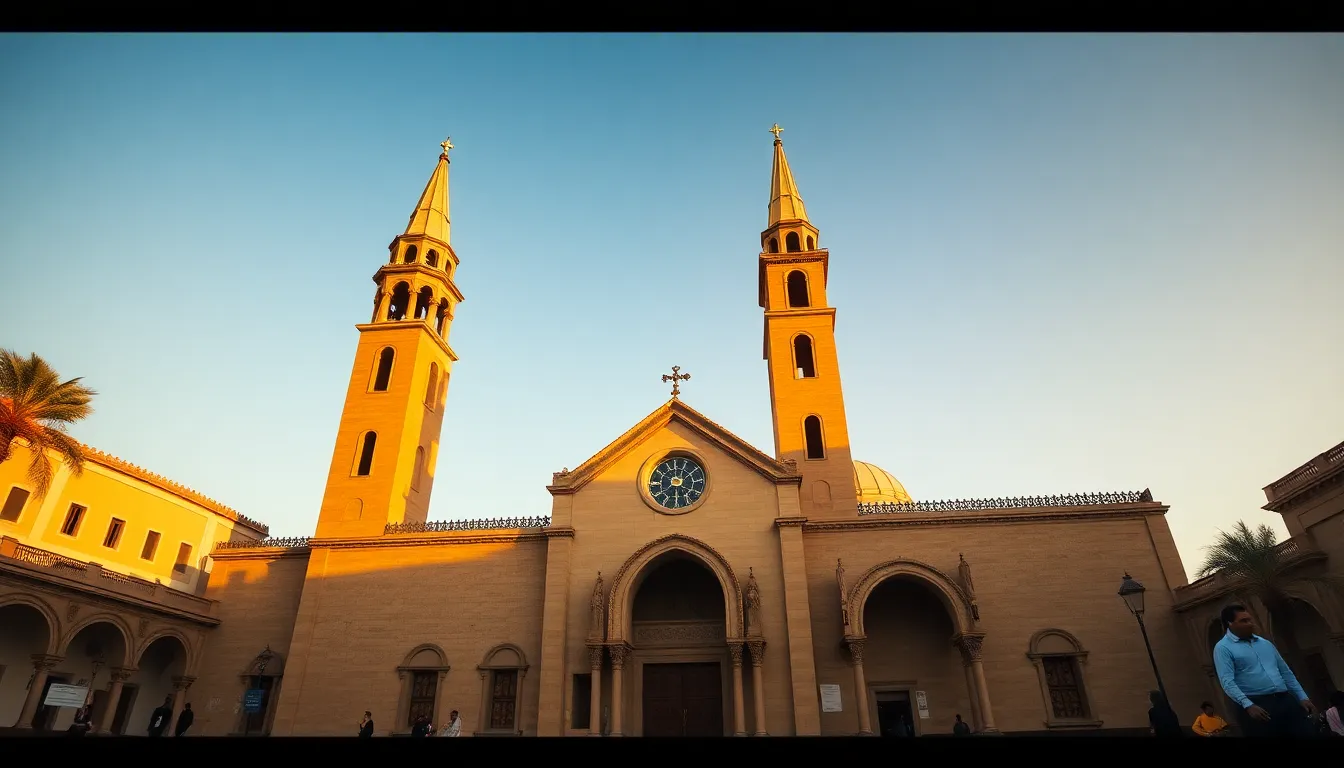
The stairs are what people remember first. You climb a long flight of stone steps up from the lane, between two narrow walls, and you have no idea what is waiting at the top. Then you step through into the courtyard and the facade of the Hanging Church rises in front of you, twin bell towers, an arched entrance, mosaics catching the light. I have brought hundreds of groups up those stairs, and the pause at the top is always the same. People go quiet and just look.
The Hanging Church is one of the oldest churches in Egypt and one of the most beloved in all of Coptic Christianity. For a heritage group, it is often the moment when the depth of the Egyptian church stops being an idea and becomes something you can stand inside. This is my guide to what it is, why it matters, and what your group will actually experience there.
Why It Is Called the Hanging Church
The name is literal. The Arabic Al-Muallaqa means “the suspended” or “the hanging.” The church was built across the top of a gatehouse of the old Roman fortress of Babylon, so its nave sits above the passage below rather than on solid ground. In parts of the church there is a section of glass set into the floor, and groups love to gather around it, looking down to see the Roman structure the building rests on.
That single fact tells the whole story of Coptic Cairo in miniature. The early Christians did not arrive on empty land. They built their faith on top of, and inside, the Roman world that had ruled and persecuted them. Standing in a church that hangs over a Roman gate, a group feels that layering of history in their feet.
How Old Is It, Really
I get asked this constantly, and I give groups an honest answer. The exact founding date is debated, but parts of the structure go back to at least the third century, with major construction and rebuilding through the medieval period. For a long stretch it served as the seat of the Coptic Pope, the head of the Coptic Orthodox Church, after the patriarchate moved to Cairo. So this was not just an old church. It was, for centuries, one of the most important churches in Egyptian Christianity, the place where Coptic popes were enthroned.
When I tell a group that this building was already ancient and central to the church before most of the cathedrals of Europe were even imagined, it reorders their sense of where Christianity comes from.
What to See Inside
The Ark-Shaped Ceiling
Look up first. The wooden roof of the nave is built in the shape of an inverted ark, a deliberate reference to Noah and to the church as a vessel of salvation. The old timbers are worth a long look. I tell groups to spend a minute just with the ceiling before anything else, because it sets the meaning of the whole space.
The Marble Pulpit on Thirteen Columns
The pulpit, or ambon, is one of the treasures of the church. It rests on thirteen slender marble columns. The Coptic guides will explain the symbolism: the columns represent Christ and his twelve apostles. One column is darker than the rest, traditionally said to stand for Judas. Small details like this give a group something concrete to hold, and they stay with people long after the trip.
The Sanctuary Screens and Icons
Inlaid screens of cedar, ebony, and ivory separate the sanctuary from the nave, in the pattern the Coptic church has used for over a thousand years. Behind and around them hang Coptic icons, including a revered image of the Virgin Mary. Coptic iconography has its own style, frontal, large-eyed, deeply symbolic, and seeing it in its home setting rather than a museum case is part of what makes the visit matter.
What Groups Actually Experience Here
This is the part I most want pastors and priests to understand. The Hanging Church is not a ruin you observe from a rope line. It is a living, working church with a regular Coptic Orthodox congregation. Services are still held here. The faithful still come to pray before the icons.
That changes everything about a group’s visit. Where the schedule allows, I arrange for groups to be present during a Coptic service, or to gather in the nave for a short devotional of their own. The Coptic liturgy is one of the oldest continuous forms of Christian worship in the world, sung in a way close to what the early church would have known. Hearing it in this space is something many pastors tell me afterward they will never forget.
When we hold a group’s own devotional, the church lends itself naturally to it. A reading. A prayer. A few minutes of silence under the ark-shaped roof. I have watched groups sing a hymn quietly in that nave and seen people moved to tears by the simple weight of where they were standing. The Hanging Church sits at the heart of the wider Coptic Cairo quarter, so a devotional here pairs well with the cave below Abu Serga and the rest of the spiritual sites of Egypt.
Practical Things to Know Before You Go
A few details I always cover with a group so the visit goes smoothly.
Modest dress is expected. Shoulders and knees covered, for everyone. Women may want to bring a light scarf. The church is reached by those long stairs, which is part of its character but worth noting for anyone with mobility concerns, and we plan around that when needed. Photography is generally allowed in the church but never during services, and we always follow the lead of the clergy. The interior can be dim, which suits the atmosphere but is worth knowing for older eyes.
I also prepare groups on timing. Mornings, especially Fridays and Sundays when services are held, are alive with worshipers, which is powerful to witness but means we plan our own quiet time carefully around the community’s schedule. We coordinate all of this in advance so your group’s visit feels prepared rather than improvised.
How It Fits a Heritage Itinerary
The Hanging Church almost never stands alone. It anchors a morning in Coptic Cairo, where it sits within a few minutes’ walk of Abu Serga and its cave of the Holy Family, the Church of Saint Barbara, the Ben Ezra Synagogue, and the Coptic Museum. For many of the Christian groups I lead, the Hanging Church is the place we choose for the group’s main devotional in the quarter, and the rest of the morning flows out from there.
It also connects naturally to the broader Holy Family flight trail, since the Coptic sites of Cairo are part of that same ancient memory. You can see how the church fits the full destination on our Egypt heritage destination page, and how the group leader experience works on our group heritage tours page.
FAQ: The Hanging Church of Cairo
Why is it called the Hanging Church?
Because it was built across the top of a gatehouse of the old Roman fortress of Babylon, so its nave hangs suspended above the passage below rather than resting on the ground. The Arabic name Al-Muallaqa means “the suspended.” In one part of the church, a glass panel in the floor lets visitors look down at the Roman structure underneath.
How old is the Hanging Church?
Parts of the structure date to at least the third century, with significant rebuilding through the medieval period. It is among the oldest churches in Egypt. For centuries it served as the seat of the Coptic Pope after the patriarchate moved to Cairo, which made it one of the most important churches in Egyptian Christianity.
Is the Hanging Church still an active church?
Yes. It holds regular Coptic Orthodox services and serves a living congregation. It is a heritage site for visitors, but it has never stopped being a working church. We can often arrange for groups to attend a Coptic service or to hold a private devotional in the nave outside of service hours.
Can our group hold a service or devotional inside?
In most cases, yes, with advance coordination. The nave lends itself beautifully to a reading, a prayer, or a few minutes of silence under the ark-shaped ceiling. We arrange the timing around the church’s own service schedule and always defer to the clergy who care for the building.
What should we wear and know before visiting?
Modest dress with shoulders and knees covered for everyone, and a light scarf is useful for women. The church is reached by a long flight of stairs, which we plan around for anyone with mobility concerns. Photography is usually fine except during services. The interior is dim and atmospheric. We brief every group on all of this before arrival.
The Hanging Church has a way of making a congregation realize how old and how deep their faith really runs. They climb those stairs as tourists and come down as something closer to pilgrims. I would be glad to help you build a morning in Coptic Cairo with the Hanging Church at its center. When you are ready, reach out to our team and we will start with what your group most hopes to experience.