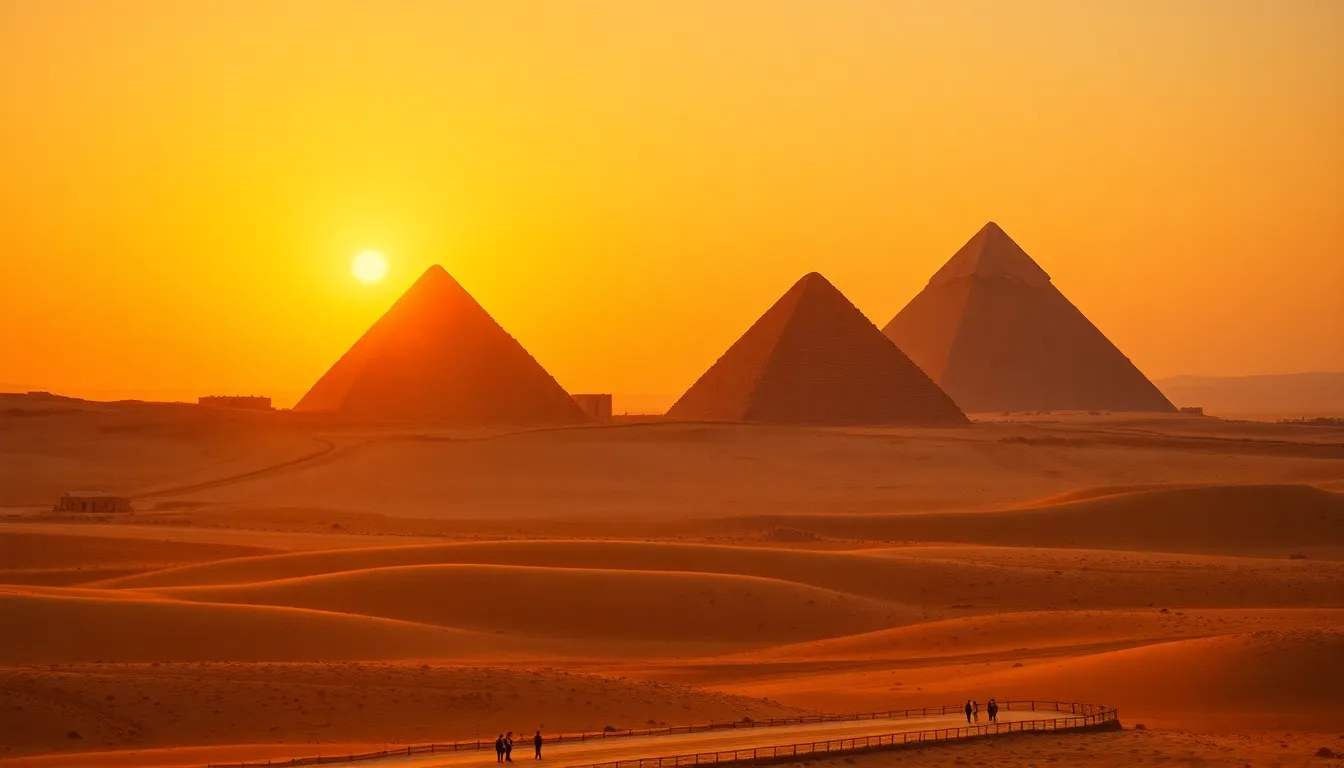
Every group I have ever brought to Egypt sees the pyramids. It is the one stop nobody skips. But here is what I have learned in two decades of leading faith travelers: most people arrive at Giza expecting a postcard and leave with something they did not anticipate. They came to check a box, to take the photo on the camel, to say they stood at one of the wonders of the world. And then they stand at the base of the Great Pyramid, look up, and feel the scale of an empire that the Bible says enslaved their ancestors. That is a different experience than tourism. That is heritage.
The pyramids are not a biblical site. No prophet stood here, no scripture was written here, and the pyramids were already ancient when Abraham was born. But for a faith group, Giza is essential, because it shows you the power that the Exodus story stood against. This guide is how I frame the pyramids for pastors, rabbis, and educators, so the visit means more than a photo.
Why the Pyramids Matter for a Faith Heritage Trip
Let me start with the honest framing I give every group. The pyramids of Giza were built roughly during the Old Kingdom, centuries before the events the Bible describes. By the time the Israelites were in Egypt, the pyramids were already among the oldest structures in the world. Moses, if he grew up in the Egyptian court as the Bible says, would have looked at the pyramids the way we look at a cathedral built a thousand years ago. They were the inheritance of a civilization that thought of itself as eternal.
That is exactly why Giza belongs on a heritage itinerary. The Exodus is the story of a small, enslaved people walking out of the most powerful empire on earth. You cannot feel the weight of that story until you see the empire. The pyramids are the empire made visible. They are the proof of what Egypt could build, what it could command, what it believed about its own permanence. When you understand that, the courage of the Exodus narrative changes from a children’s story into something that takes your breath away.
The World Moses Knew
When I stand a group in front of the Great Pyramid, I ask them to imagine the world this represents. A state that could organize tens of thousands of workers, feed them, house them, and direct them toward a single monument for decades. A bureaucracy, a priesthood, a divine king who was believed to be a god in human form. This was the most advanced and powerful civilization of its age, and it had been powerful for a very long time before the Israelites arrived.
The Bible’s claim is audacious precisely against this backdrop. It says the God of a band of slaves was greater than the gods of this empire. It says Pharaoh, who was worshipped as divine, was brought low. When you have seen the scale of pharaonic power at Giza, the plagues and the Passover and the Red Sea read differently. The story is not God against a village chief. It is God against the superpower of the ancient world. Giza is where a group feels that.
Why I Do Not Call Giza a Biblical Site
I am careful with my groups about this, and I think the honesty matters. The pyramids are not the store-cities the Israelites built. The Bible places the Israelite labor in the Delta, at cities like Pi-Ramesses, not at the pyramids of Giza, which were already a thousand years old by then. You will sometimes hear guides claim the Israelites built the pyramids. That is not what the Bible says, and it is not what the evidence shows. I want my groups to leave Egypt with accurate history, not a comfortable legend.
So I frame Giza as context, not as a biblical site itself. It is the backdrop against which the biblical drama unfolds. That framing is more honest, and in my experience it is also more powerful. The truth of what Egypt was makes the Exodus more remarkable, not less.
What You Actually See at Giza
The Giza plateau holds three major pyramids, several smaller ones, the Great Sphinx, and a field of tombs and temples. Here is how I orient a group.
The Three Great Pyramids
The largest is the Great Pyramid, built for the pharaoh Khufu, and for thousands of years it was the tallest structure made by human hands. Beside it stand the pyramid of Khafre, which looks taller because it sits on higher ground and still keeps a cap of its original outer casing near the top, and the smaller pyramid of Menkaure. Together they form the silhouette everyone knows. Standing at the base, the scale is hard to absorb. The individual blocks are taller than a person. The precision of the construction, achieved without iron tools or the wheel as we use it, is genuinely staggering.
You can go inside the Great Pyramid, climbing a steep, low passage to the burial chamber at the heart of the structure. It is hot, close, and not for everyone, but for those who do it, standing in the empty chamber at the center of the largest pyramid is a quiet, strange moment. I always tell groups it is optional and physically demanding, so people can choose well.
The Great Sphinx
Below the pyramids sits the Sphinx, the great lion-bodied figure with a human face, carved from the living rock of the plateau. It has watched over Giza for the better part of five thousand years. The Sphinx is smaller in person than people expect from photographs, but the face, worn by millennia of wind and sand, has a presence that holds a group. This is one of the oldest monumental sculptures on earth, and it was already ancient mystery to the Egyptians of Moses’ day.
Reading the Plateau as a Heritage Group
What I want a group to take from Giza is not just the monuments but the meaning. This plateau is a statement about death, eternity, and the divine kingship of Pharaoh. The pyramids were tombs designed to launch a god-king into the afterlife. The whole landscape is built around the idea that Pharaoh was eternal and divine. Hold that thought next to the Exodus, where this same office of Pharaoh is humbled by the God of slaves, and you have the theological collision at the center of the biblical story. Reading Giza this way turns a sightseeing stop into a heritage encounter.
Connecting Giza to the Rest of Your Egypt Journey
Giza is the start, not the whole. To understand the Egypt of the Bible, a group needs to connect the pyramids to the wider landscape. Just south of Giza lies the older necropolis of Saqqara and the ruins of ancient Memphis, the first capital of a united Egypt, where the step pyramid pioneered the form that Giza perfected. Seeing Saqqara and Memphis alongside Giza gives a group the full arc of pharaonic power, and our Memphis and Saqqara heritage guide covers that pairing in depth.
North of Cairo, in the green Delta, is where the biblical labor narrative actually unfolds, at Goshen and the store-cities. Our Nile Delta heritage guide connects the empire you see at Giza to the land where the Israelites lived and worked. The pyramids show you the power. The Delta shows you the bondage. Putting them together is what makes Egypt a heritage journey rather than a sightseeing list.
In Cairo itself, the Grand Egyptian Museum near the plateau and the older Egyptian Museum hold the treasures of this civilization, including the world of Tutankhamun. For a faith group, the museums are where the abstract idea of pharaonic Egypt becomes concrete: the jewelry, the writing, the gods, the daily objects of the world Moses knew. I frame the museum visit the same way I frame Giza, as the world the Bible’s story pushed against.
Practical Orientation for Visiting Giza
A few honest practicalities, because Giza can overwhelm a group that arrives unprepared.
The plateau is open desert. It is hot, exposed, and there is little shade. Bring sun protection, water, and closed shoes for uneven ground. The pyramids sit at the very edge of Cairo’s sprawl, so the contrast between the modern city and the ancient plateau is sudden and striking.
Giza draws crowds and vendors. The camel and horse touts can be persistent, and this is one of the most touristed places on earth. This is exactly where having your own guide and ground arrangements changes the experience. Our team handles the entry, the timing, and the pacing, and keeps the group together and unbothered so the focus stays on the encounter rather than the hustle. We can also time the visit to avoid the worst of the crowds, often earlier in the day.
Plan a half day for the plateau itself, more if your group wants to go inside a pyramid or combine Giza with the museum. Giza pairs naturally with Saqqara and Memphis for a full day of pharaonic heritage. For timing across the year, our season-by-season guide helps you choose the right window, since the open desert is far kinder in spring, fall, and winter than in summer.
A practical note for those organizing a trip: with 15 or more participants, the group leader travels free. Bringing your congregation to stand at Giza, framed properly, is one of the experiences they will talk about for years.
FAQ: Giza Pyramids for Heritage Travelers
Did the Israelites build the pyramids?
No. The pyramids of Giza were built during the Old Kingdom, roughly a thousand years before the events the Bible describes, so they were already ancient by the time of the Israelite sojourn. The Bible places the Israelite labor in the Delta, building store-cities like Pi-Ramesses, not the pyramids. We frame Giza as the backdrop of pharaonic power that the Exodus stood against, not as a site the Israelites built.
Are the pyramids a biblical site?
Not directly. No biblical event is recorded at Giza, and the pyramids predate the patriarchs. We include Giza on heritage itineraries because it shows the scale and power of the empire central to the Exodus story. Seeing what Egypt could build makes the courage of the Exodus narrative far more vivid. It is essential context rather than a scriptural location.
Why should a faith group visit the pyramids?
Because the pyramids are the empire made visible. The Exodus is the story of enslaved people walking out of the most powerful civilization of the ancient world, and you cannot feel the weight of that until you see what that civilization built. Giza turns the abstract idea of pharaonic Egypt into a physical reality, which deepens every other site on the journey.
Can you go inside the Great Pyramid?
Yes, though it is optional and physically demanding. Entering involves climbing a steep, low, hot passage to the burial chamber at the center. It is a memorable experience for those who choose it, but it is not for everyone, particularly anyone with claustrophobia or mobility concerns. We always present it as a choice so each traveler can decide well.
How much time should a group spend at Giza?
Plan at least a half day for the plateau itself, and a full day if you want to go inside a pyramid or combine Giza with the Egyptian Museum. Giza also pairs naturally with Saqqara and Memphis to the south for a complete day of pharaonic heritage. We handle the timing to avoid the heaviest crowds and keep the group moving comfortably.
The pyramids are the one thing everyone expects from Egypt, and yet they surprise nearly every group I bring, because most people have never been given a reason to see them as anything more than a photo stop. Framed as the empire the Exodus stood against, Giza becomes one of the most meaningful mornings of the whole trip.
You can see how Giza fits a complete heritage journey on our Egypt heritage destination page, or learn how we structure group travel on our group heritage tours page. When you are ready, reach out through our contact page and we will start building your itinerary.