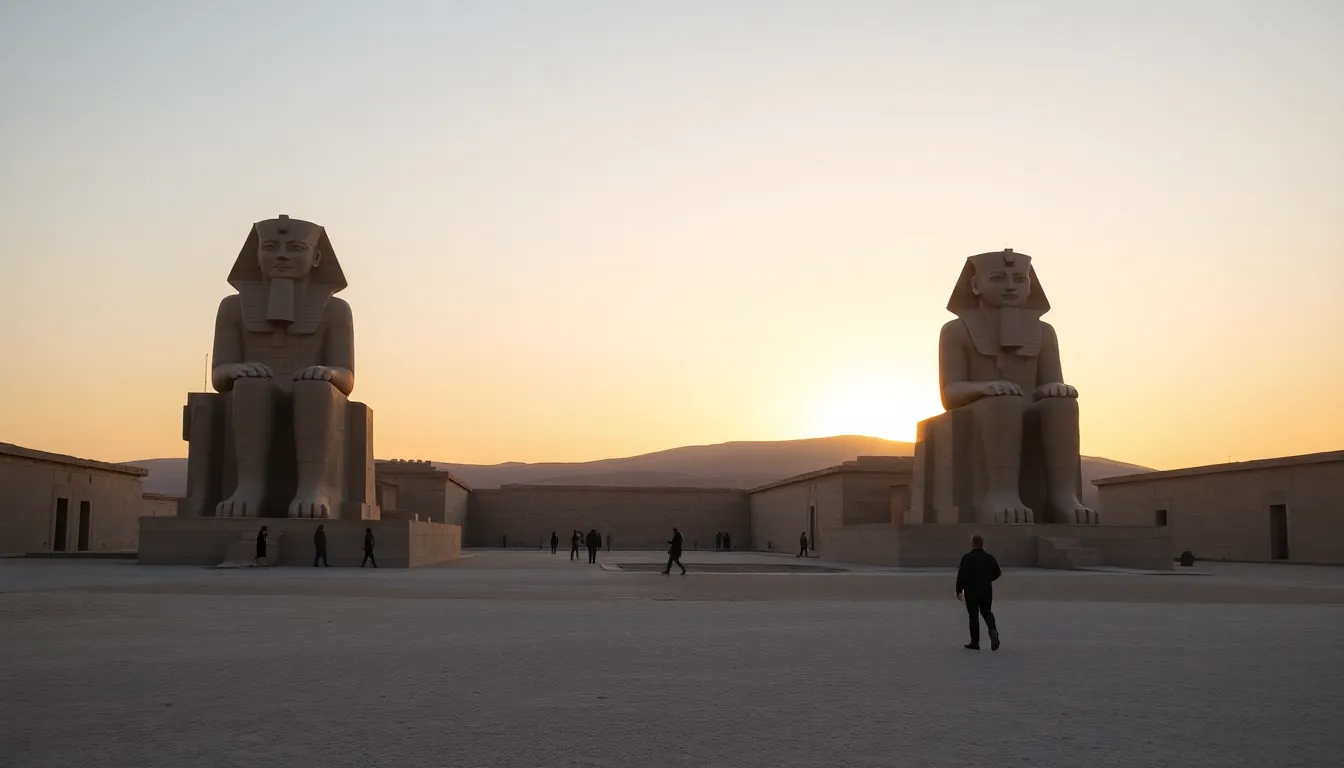
There is a moment, almost every time, when a group crosses to the west bank at Luxor and the two giants come into view across the plain. Conversation stops. Someone leans toward the window. These two seated figures, weathered and broken and still enormous, rise out of flat farmland with nothing around them, and for a second they look like they are waiting for you. The Colossi of Memnon are the first thing most groups see on the Theban west bank, and I have learned to let them be exactly that, the threshold, the opening note of the day rather than a quick photo on the way to somewhere more famous.
They are easy to underestimate because they are free to see and take only a few minutes. Do not let that fool you or your group. Standing under them, with the right story in your ears, is a real moment.
What the Colossi of Memnon Are
The two statues are not, in fact, of someone called Memnon. They are colossal images of the pharaoh Amenhotep III, who ruled Egypt in the fourteenth century BCE, during the height of the New Kingdom. Each figure shows the seated king with his hands resting on his knees, gazing east across the Nile toward the rising sun. Carved from blocks of quartzite sandstone, they stand about eighteen meters tall, roughly sixty feet, and weigh in the range of seven hundred tons each.
They did not always stand alone. The Colossi were the gateway, the entrance pylons, of the mortuary temple of Amenhotep III, which was once the largest temple complex in all of Egypt, larger even than Karnak. But it was built too close to the floodplain, and over the centuries the annual Nile inundation, earthquakes, and later builders quarrying its stone reduced the vast temple to almost nothing. The two guardian statues outlasted the temple they were built to guard. That is the first thing I point out to a group: you are looking at the doorkeepers of a building that has all but vanished.
The Singing Statue
The name Memnon and the fame of these statues come from a legend. After an earthquake in 27 BCE damaged the northern statue, it began to produce a sound at dawn, a kind of whistle or musical note, probably caused by air and moisture moving through the cracked stone as the morning sun warmed it. Greek and Roman visitors heard it and connected it to Memnon, a hero of the Trojan War said to be the son of Eos, the dawn goddess. They imagined the statue was Memnon greeting his mother each morning. Tourists came from across the Roman world to hear it, including emperors, and some carved their names into the base, inscriptions you can still read today. Then, around 199 CE, the statue was repaired, and it never sang again.
I love telling a group that story, because it is a reminder that these stones have been a destination for travelers for two thousand years. We are not the first pilgrims to stand here.
Why the Colossi Belong on a Faith Heritage Day
The Colossi are not a biblical site, and I keep that honest with every group. But they matter on a faith itinerary for two reasons.
The Setting of Thebes
Thebes, the city these statues guarded, was the religious and political heart of New Kingdom Egypt, the Egypt of the pharaohs the Exodus narrative wrestles with. Amenhotep III, whose image these are, was the grandfather of the dynasty that included the pharaohs many scholars connect to the era of Israel in Egypt. To stand here is to stand at the gateway of the Egypt of the Bible’s imagination, the great empire whose power the Exodus story sets itself against. The sheer scale of the Colossi, sixty feet of stone, seven hundred tons, makes that power physical in a way no reading can.
A Sense of Proportion
There is a spiritual value in scale that I have come to rely on as a guide. When a faith group stands beneath statues this large, built to glorify a king who called himself a god, the biblical claim sharpens. The God of Israel is not one more colossus among the Egyptian gods. The Exodus is the story of a power greater than all this stone confronting the greatest empire of its age and prevailing. Standing under the Colossi, that contrast stops being a sermon point and becomes something a group feels in their bodies. I use this stop, early in the day, to set that frame before we go into the tombs and temples.
How Groups Visit the Colossi
The Colossi sit right beside the road on the west bank of the Nile at Luxor, on the route between the river and the Valleys of the Kings and Queens. There is no enclosure and no ticket; the statues stand in the open and the visit is short, usually fifteen to twenty minutes. That makes them the natural first stop of a west bank morning.
A typical west bank day runs from the Colossi to a mortuary temple such as Hatshepsut’s at Deir el-Bahari or the Ramesseum, then on to the Valley of the Kings and the Valley of the Queens. The Colossi open the day because they are the easternmost site, the first you reach crossing from the river, and because they set the theme of scale and vanished glory that everything else builds on.
Practical Notes for Group Leaders
- Keep it short and early. Fifteen to twenty minutes is right. The Colossi are an opening, not a destination, and the open plain gets hot fast.
- There is no shade. Hats and water matter even for a brief stop, and a morning visit is far more comfortable. Our season-by-season guide covers which months keep the west bank pleasant.
- The ground is flat and easy, which makes this one of the most accessible stops of the whole day, good for groups with less mobile members.
- Use the stop to teach. Because it is quick and free of the crowding inside the tombs, it is the ideal place to gather the group, explain Thebes, and set the spiritual frame for the day before the busier sites.
That kind of intentional sequencing, where the easy first stop carries the meaning for everything after, is part of how my team builds a Luxor day. You can see how it fits the wider journey on our Egypt heritage destination page.
Where It Fits in the Trip
The Colossi of Memnon are the doorway to the Theban west bank, and they pair naturally with the Valley of the Queens and the other Luxor sites that fill out the day. For groups whose hearts are set on the biblical narrative, our guide to hidden heritage sites in Egypt reaches the sacred sites most itineraries miss, from the land of Goshen to the Sinai. And because Luxor’s heat can make or break a west bank day, the best time to visit guide is worth reading before you choose your dates.
Two broken giants in an empty field. That is all the Colossi are, on the surface. But they are the doorkeepers of a vanished temple, a destination for travelers for two thousand years, and the threshold of the Egypt the Bible knew. Stand a group beneath them with that story, and the whole Luxor day opens up.
FAQ: The Colossi of Memnon
Who do the Colossi of Memnon actually depict?
They depict the pharaoh Amenhotep III, who ruled in the fourteenth century BCE. The name Memnon came later, from Greek and Roman visitors who linked the statues to a Trojan War hero. The two seated figures originally stood as the gateway to Amenhotep III’s mortuary temple, which was once the largest in Egypt but has almost entirely vanished.
Why are the Colossi of Memnon famous for singing?
After an earthquake in 27 BCE cracked the northern statue, it began producing a musical sound at dawn, probably from air and moisture moving through the stone as the sun warmed it. Greek and Roman tourists traveled from across the empire to hear it and tied it to the legend of Memnon greeting his mother, the dawn goddess. After the statue was repaired around 199 CE, the sound stopped.
Are the Colossi of Memnon worth visiting on a faith trip?
Yes, as the opening stop of a west bank Luxor day. They are not a biblical site, but they stand at the gateway of Thebes, the heart of the Egypt the Exodus narrative confronts. Their sheer scale gives a group a physical sense of the imperial power the biblical story sets itself against, which makes a powerful frame for the tombs and temples that follow.
How long do groups spend at the Colossi of Memnon?
Usually fifteen to twenty minutes. There is no enclosure and no ticket; the statues stand in the open beside the road, so the visit is short. Their value is as the first stop of the day, where a group can gather, hear the story of Thebes, and set the theme before moving on to the Valleys and temples.
When is the best time to visit the Colossi?
Early morning. The Colossi stand on an open plain with no shade, and the west bank heats up quickly, so a morning visit at the start of the day is far more comfortable. It also fits the natural route, since the Colossi are the easternmost site you reach crossing from the river toward the Valleys of the Kings and Queens.
If a meaningful day at Luxor is part of the journey you are planning for your community, I would be glad to help you build it so each stop carries the one before it. With fifteen or more participants, the group leader travels free, and my team handles every arrangement on the ground. Contact us whenever you are ready to talk it through.