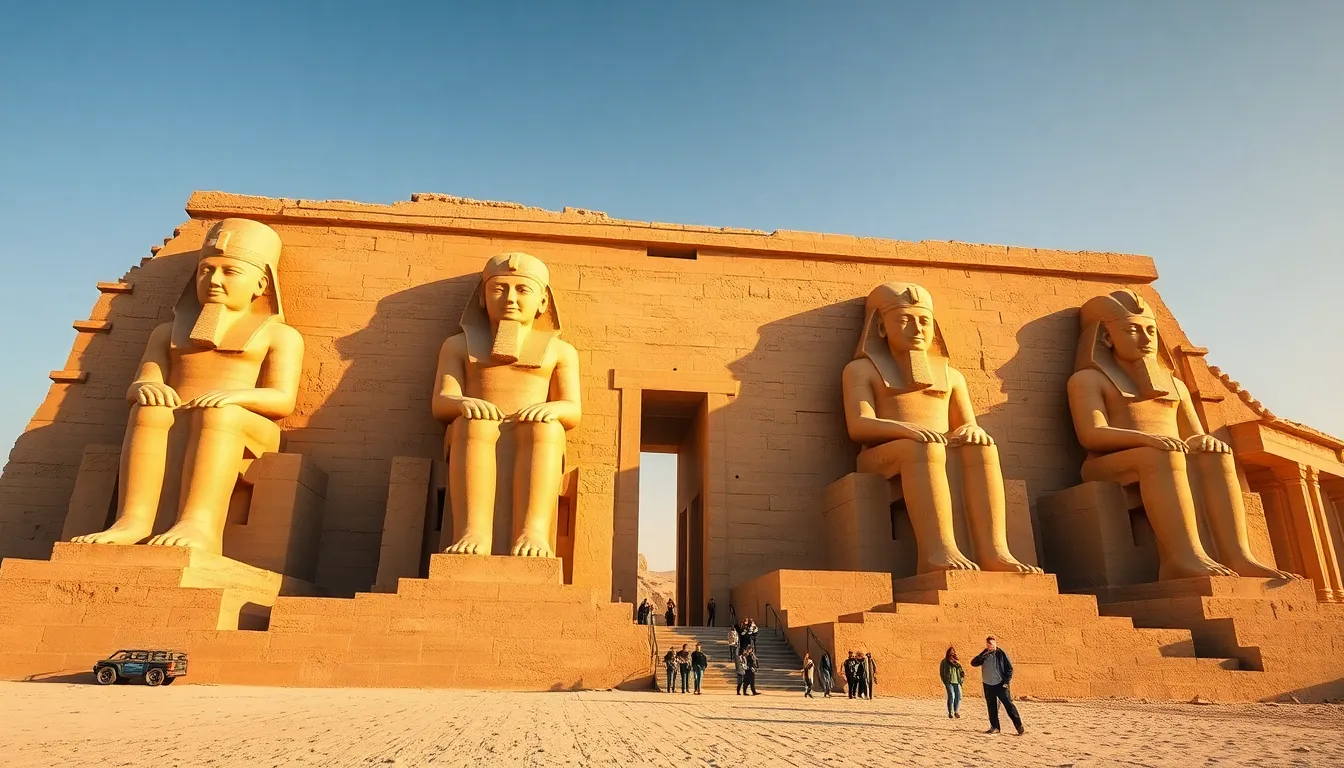
I will tell you the moment I wait for on every southern Egypt trip. It is when the group rounds the last bend at Abu Simbel and the four colossal statues of Ramesses II come into view, sixty-six feet tall, carved straight out of the mountainside, staring out over the desert exactly as they have for more than three thousand years. People go quiet. And then, almost every time, someone says it: “This is the pharaoh, isn’t it.” Yes. This is the face tradition gives to the king who said no to Moses. There is no more direct encounter with the world of the Exodus anywhere in Egypt.
The far south of Egypt, Aswan and Abu Simbel, is a long way from Cairo, and some groups wonder whether it is worth the journey. For a heritage group, my answer is unhesitating. This is where the scale and the audacity of pharaonic power become physical, and where the Exodus story gains a weight that no other site delivers. Let me walk you through the far south.
Why the Far South Belongs in a Heritage Journey
Aswan sits at Egypt’s traditional southern border, where the Nile narrows among granite islands and the great river enters Egypt from Nubia to the south. For the ancient Egyptians, this was the frontier, the edge of the ordered world. Beyond it lay Nubia, a land of gold, trade, and rival power. The pharaohs fortified and adorned this border heavily, and nowhere more dramatically than at Abu Simbel.
For a faith group, the far south matters because it is the clearest statement of what the Exodus narrative is up against. Ramesses II, the figure most scholars identify with the pharaoh of the oppression, built Abu Simbel as a monument to his own divinity and the unshakable reach of Egyptian power. The temples were political theater carved in stone, a message to Nubia and to history: this king is a god, and his empire has no end. Standing in front of that message, and remembering that the story of a band of Hebrew slaves walking out of this empire is read aloud every Passover and every Easter, gives a group an understanding that a lecture never could.
Ramesses II: The Pharaoh of the Exodus
The biblical text never names the pharaoh of the Exodus, and honest heritage travel respects that. But Ramesses II is the leading candidate in the most widely held scholarly reconstruction, and his reign, around 1279 to 1213 BCE, fits the commonly cited thirteenth-century date for the Exodus. The store city of Raamses, which the Israelites are said to have built in the book of Exodus, carries his name.
I lay this out plainly for every group. We cannot point to a single inscription and say, here is the proof of the Exodus. What we can do is stand at Abu Simbel, the supreme monument of this king’s self-glorification, and understand the world the story comes out of. When you grasp the sheer scale of the power that the Bible says God overturned, the Exodus stops being a quaint tale and becomes the staggering claim it actually is.
Abu Simbel: The Great Temple and the Temple of Nefertari
Abu Simbel is two temples, carved into the mountainside on the west bank of Lake Nasser, near the Sudanese border.
The Great Temple of Ramesses II
The Great Temple is dominated by the four seated colossi of Ramesses II at its entrance, each more than sixty feet high. Inside, the rock-cut halls run deep into the mountain, lined with pillars carved as the king and decorated with scenes of his military triumphs, above all the Battle of Kadesh, the campaign Ramesses celebrated relentlessly across Egypt.
What I draw a group’s attention to is the inner sanctuary. Deep inside the mountain sit four statues: the gods Ptah, Amun-Ra, and Ra-Horakhty, and beside them Ramesses himself, seated as their equal. The king placed himself among the gods. That single arrangement tells you everything about the theology the Exodus confronts. Twice a year, the sun aligns to illuminate the sanctuary, a feat of ancient engineering that still draws crowds. For a heritage group, the alignment is impressive, but the theology of a man enthroned as a god is the part that matters.
The Temple of Nefertari
Next to the Great Temple stands the smaller temple dedicated to Ramesses II’s queen, Nefertari, and the goddess Hathor. It is one of very few ancient Egyptian temples built to honor a queen, and its facade carries statues of Nefertari at the same height as the king, an unusual honor. It is a gentler, more human counterpoint to the overwhelming Great Temple, and groups often find it quietly affecting.
A Temple That Was Moved
Here is a detail that astonishes every group. Both temples of Abu Simbel are not where they were originally carved. In the 1960s, when the Aswan High Dam created Lake Nasser, the rising waters threatened to drown them forever. In an extraordinary international rescue, the entire complex was cut into more than a thousand blocks and reassembled, piece by piece, on higher ground. The mountain behind the temples is artificial, a dome built to hold them. Standing before something so ancient and knowing it was lifted and moved within living memory adds a layer of human drama to the visit that I find groups never forget.
Aswan: The Frontier and Its Sacred Islands
Most heritage groups reach Abu Simbel by way of Aswan, and Aswan is rich enough to deserve real time of its own.
Philae: The Temple That Outlasted the Old Gods
The Temple of Philae, dedicated to the goddess Isis, sits on an island in the Nile and was, like Abu Simbel, rescued from the rising waters and relocated stone by stone. Philae matters for a heritage group because of what happened at the end of its life. This was one of the very last functioning temples of the old Egyptian religion. Worship of Isis continued here into the sixth century CE, centuries after the Roman Empire became Christian, until it was finally closed and the temple was turned into a church. You can still see Coptic crosses carved into its ancient Egyptian walls.
That layering tells the whole story of religious change in Egypt in a single building. I stand a group in front of those crosses cut into pagan reliefs and let them see it: the old world giving way, the new faith taking root in the very stones of the old. It is one of the most eloquent sites in the country.
Elephantine Island and a Jewish Footnote in the Far South
Aswan holds a remarkable thread of Jewish heritage that few travelers know. On Elephantine Island, in the Nile at Aswan, archaeologists discovered the records of a Jewish military colony that lived here in the fifth century BCE, during the Persian period. These people had their own temple, wrote letters in Aramaic that survive to this day, and kept a Jewish community at the southern edge of Egypt centuries before the rise of Christianity. For a Jewish heritage group, it is a startling reminder of how widely and how anciently Jewish life was woven through Egypt, far beyond Cairo and the Delta.
The Nile at Aswan
Aswan is also simply one of the most beautiful places on the Nile, where the river runs clear and blue among granite boulders and palm-covered islands. A felucca sail on the Nile at sunset here is not a tourist gimmick. After the intensity of the great temples, it gives a group time to absorb what they have seen. I build it in deliberately.
Getting to the Far South
Aswan and Abu Simbel take planning, and that planning is part of what we handle for a group.
Most groups reach Aswan by domestic flight from Cairo or as part of a Nile cruise between Luxor and Aswan, which is itself one of the most rewarding ways to travel this stretch of the river. From Aswan, Abu Simbel is reached by a further short flight or an early-morning road convoy across the desert. It is a long way south, and that distance is exactly why it carries such weight. Our Egypt heritage travel guide shows how the south fits the full national journey, and our guide to the Valley of the Kings covers the Luxor monuments many groups pair with an Aswan extension.
Practical Notes for a Group Visit
How much time does the far south need? Plan at least two to three days for Aswan and Abu Simbel done properly, more if you include a Nile cruise segment from Luxor. It is not a stop to rush.
How is the heat? The far south is hotter than Cairo, often considerably so. We schedule Abu Simbel for early morning and plan the season carefully. See our guide to the best time to visit Egypt for a heritage journey for the full seasonal picture.
Is it physically demanding? Moderate. Abu Simbel and Philae involve walking and some steps, but they are manageable for most travelers when paced well, including older group members.
Does the group leader travel free? With 15 or more participants, yes. The group leader’s trip is fully covered, which makes adding a southern extension to your itinerary realistic for your community.
FAQ: Aswan and Abu Simbel for Heritage Travelers
Why visit Abu Simbel on a faith heritage tour?
Abu Simbel is the supreme monument of Ramesses II, the pharaoh most scholars identify with the Exodus oppression. Its colossal statues and its inner sanctuary, where the king sits enthroned among the gods, make the theology and the power that the Exodus narrative confronts physically visible. For a faith group, standing before this monument and recalling that the story of slaves walking out of this empire is read every Passover and Easter gives the biblical narrative extraordinary weight.
Is Ramesses II the pharaoh of the Exodus?
The biblical text never names the pharaoh of the Exodus, so certainty is not possible. Ramesses II is the leading candidate in the most widely held scholarly reconstruction, and his reign fits the commonly cited thirteenth-century date. The store city of Raamses, which the Israelites are said to have built, carries his name. Honest heritage travel presents him as the most likely figure, not as proven fact, and lets the site speak for the world the story comes from.
How do you get from Aswan to Abu Simbel?
Abu Simbel lies near the Sudanese border, reached from Aswan by a short domestic flight or an early-morning road convoy across the desert. Most heritage groups base in Aswan, which is reached by flight from Cairo or by Nile cruise from Luxor, and make Abu Simbel a dedicated early start. We handle all the transport and timing so the group travels together and arrives at the temples before the heat builds.
What is there to see in Aswan besides Abu Simbel?
Aswan offers the relocated Temple of Philae, dedicated to Isis and notable for the Coptic crosses later carved into its walls, marking Egypt’s transition from the old religion to Christianity. Elephantine Island preserves the memory of a fifth-century BCE Jewish military colony, a striking piece of Jewish heritage in the far south. Aswan is also one of the most beautiful stretches of the Nile, ideal for a reflective felucca sail at sunset.
Is the far south of Egypt worth the extra travel for a group?
For a heritage group, yes. The far south delivers the clearest physical encounter with the imperial power the Exodus story confronts, plus the religious layering at Philae and the Jewish heritage at Elephantine. It requires more travel time, but the understanding it gives a congregation, especially when paired with Luxor and the Valley of the Kings, repays the journey. We can build it as part of a longer Egypt itinerary or a combined Egypt and Israel journey.
The far south is the deep end of an Egypt heritage journey, and it rewards the groups who make the trip. Abu Simbel is where the Exodus stops being abstract. You can see how the south fits a full itinerary on our Egypt heritage destination page, or explore how we structure group heritage tours.
When you are ready to talk about bringing your congregation as far as Abu Simbel, reach out to us. It is one of the journeys I most love to design, and I would be glad to help you plan it.