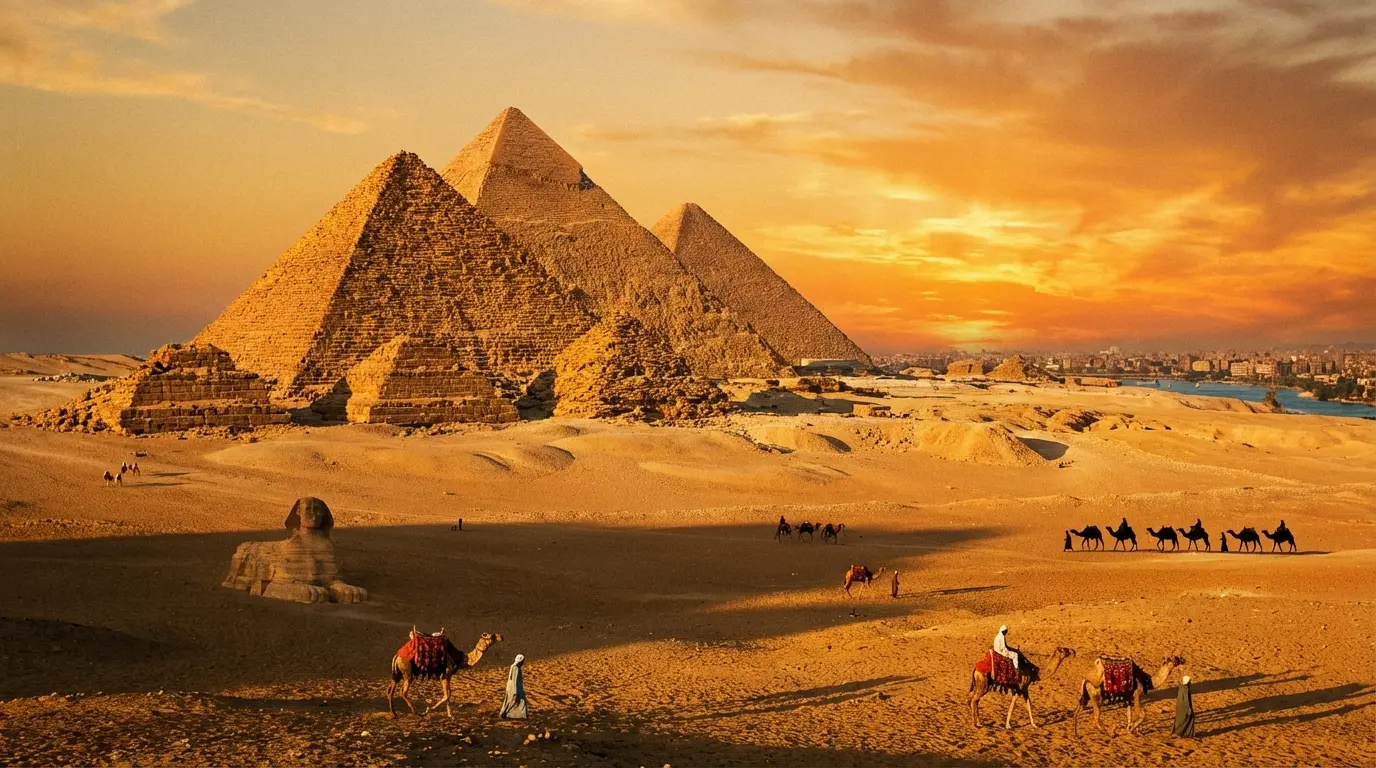
I’ve been bringing groups to Egypt for more than two decades. Rabbis, pastors, congregation members, families. And almost without exception, people arrive expecting the pyramids and leave changed by something else entirely. They leave changed by the shore of the Red Sea. By standing inside Ben Ezra Synagogue with a prayer on their lips. By the smell of incense in a Coptic church that has stood since the first century. Egypt is not a side trip. For people of faith, it may be the most foundational ground on earth.
This guide is what I wish existed when I started leading these journeys. It is not a list of tourist attractions. It is a map of meaning, for the rabbi or pastor who wants to bring their community somewhere that will change them.
Why Egypt Is at the Heart of Every Faith Tradition
Before Israel, before the Temple, before Sinai, there was Egypt. The story of faith, for both Jews and Christians, begins in this land. That is not a metaphor. It is geography. The Nile Delta, the Sinai Peninsula, the Red Sea coast, the ancient streets of Cairo. These are not settings for old stories. They are living places where people have been praying, building, and remembering for thousands of years.
When I walk into these sites with a group, I always say the same thing: the people who wrote what you believe stood on this exact ground. That truth hits differently when you are actually here.
Egypt in the Jewish Story
The entire Exodus narrative unfolds in Egypt. The Israelites lived here. Moses was raised here. The plagues happened here. The moment of liberation, the crossing that defines the Passover Seder every year, happened at the edge of this land. For a Jewish congregation, Egypt is not ancient history. It is the story they retell every spring. Standing in the Nile Delta, in the land of Goshen where the Israelites worked and suffered and hoped, gives that story a physical weight that no sermon can replicate.
And beyond the biblical narrative, Egypt was home to one of the most vibrant Jewish communities in the world for over two thousand years. The Ben Ezra Synagogue in Cairo holds more than 1,200 years of continuous Jewish life. The great medieval sage Maimonides spent years here. The Cairo Geniza, the world’s most significant collection of medieval Jewish manuscripts, was discovered in this building. Egypt’s Jewish story is not just Exodus. It is two millennia of scholarship, community, and faith.
Egypt in the Christian Story
For Christians, Egypt carries two distinct layers of meaning. The first is the Hebrew Bible, which is the shared foundation of Christian faith. Every Christian who celebrates Easter is celebrating the Passover story. The Exodus is the defining act of salvation in Scripture, the template for everything that comes after.
The second layer is distinctly Christian. Egypt was where the Holy Family fled to protect the infant Jesus. The route of the Holy Family, from Bethlehem through Gaza and into Egypt, is one of the most significant pilgrimage paths in Christendom. The Coptic Christian church, which traces its founding directly to the Evangelist Mark, has been worshipping here since the first century. The desert monasteries of Egypt gave the entire Christian world the tradition of monasticism. When you visit a monastery in France, in Ireland, in New England, you are visiting a tradition that was born in the Egyptian desert.
Egypt in the Broader Abrahamic Heritage
There is something that happens to interfaith groups in Egypt that I have witnessed over and over. The land does not separate them. It unites them. Standing at the site where Moses received the Law, a rabbi and a pastor are standing in the same story. The shared roots of these traditions are nowhere more visible than in Egypt, where those roots literally go into the ground.
The Exodus Trail: Walking in Moses’ Footsteps
The Exodus trail is not a single road. It is a series of places across the Nile Delta and the Sinai Peninsula where the biblical narrative can be traced, sometimes with precision and sometimes with wonder. Here is what I take every group through.
The Nile Delta: Land of Goshen and the Israelites
The ancient land of Goshen sits in the northeastern Nile Delta, in the region now called Sharqia Governorate. This is where the Bible says the Israelites settled when Jacob’s family came to Egypt in the time of Joseph. It is where they lived, multiplied, worked as forced laborers, and waited for a deliverer.
The archaeological site of Tell el-Dab’a, identified by many scholars as ancient Avaris, the Hyksos capital and possible site of the city of Ramesses, sits in this region. Walking through Tell el-Dab’a with a group, you can see the foundations of a settlement culture that was distinctly different from native Egyptian culture, with burial practices and material artifacts that some archaeologists believe reflect a Semitic population. I always tell my groups: we cannot prove with absolute certainty that these are Israelite remains. But we can stand here and feel the weight of a story that is ancient, and real, and rooted in this specific soil.
Sinai: The Mountain of the Law
Saint Catherine’s Monastery sits at the foot of the mountain traditionally identified as Mount Sinai, in the southern Sinai Peninsula. The monastery itself is extraordinary. It is the oldest continuously inhabited Christian monastery in the world, and it sits precisely where the Byzantine emperor Justinian built it in the sixth century, over a site that had been considered sacred since the time of Moses.
The mountain above the monastery is a four-hour climb, often done before dawn to reach the summit at sunrise. I have made that climb with hundreds of people over the years, including people in their seventies who thought they could not do it. Almost everyone who reaches the top says the same thing: they did not expect it to feel the way it did. There is nothing I can say in advance that prepares someone for standing on that ground at sunrise.
The Red Sea: Where the Story Turned
The traditional site of the crossing of the Red Sea is a subject of ongoing scholarly debate. What is not debatable is the profound effect that standing at the shore of the Red Sea has on a faith group. Whether at the Gulf of Suez or the Gulf of Aqaba, the water is real. The shore is real. The story is in the air.
I have watched rabbis and pastors lead impromptu prayers at the water’s edge that lasted forty-five minutes. I have watched people weep. I have watched people laugh with a kind of relief that I can only describe as recognition. This is the place where the story says God made a way where there was no way. Whatever you believe about the mechanics of that event, standing there does something to you.
Cairo’s Jewish Heritage: A Community That Shaped the World
Most people who visit Egypt, even Jewish visitors, do not know the depth of what Cairo holds. The Jewish history of this city is not a footnote. It is a foundational chapter in the story of world Jewry.
Ben Ezra Synagogue: One of the World’s Oldest
The Ben Ezra Synagogue stands in Old Cairo, in the ancient Coptic quarter, on a site that Jewish tradition holds was a synagogue before the Common Era. The current building dates to the ninth century, when it was built on land sold to the Jewish community by the Coptic Christian community, a detail I find deeply moving every time I tell it.
Ben Ezra is most famous for one extraordinary discovery. In 1896, the Cairo Geniza was found in a storage chamber of this synagogue. The Geniza contained more than 300,000 manuscript fragments, the largest collection of medieval Jewish documents ever discovered. Letters between Jewish merchants. Legal documents. Poetry. Prayer books. Personal correspondence. Fragments of texts by Maimonides. This single room held almost a thousand years of Jewish life in a way that no archive on earth can match.
Visiting Ben Ezra with a Heritage Tours group is not a brief stop. We spend real time here. I want the members of your congregation to understand what they are standing inside. We prepare groups before they arrive so the visit has the depth it deserves.
The Jewish Quarter of Haret el-Yahud
Walking through the old Jewish quarter of Cairo is a bittersweet experience. The community that once lived here, one of the most ancient and sophisticated Jewish communities in the world, is largely gone now. At its peak in the mid-twentieth century, Cairo’s Jewish population was around 80,000 people. Today, fewer than a handful of Jewish residents remain in the entire country.
The physical traces remain: the old apartment buildings, the narrow streets, the locations of synagogues that have been converted or stand empty. For Jewish groups, this walk through Haret el-Yahud is an act of witness. We are remembering a community. We are making sure they are not forgotten.
Coptic Christian Cairo: Christianity’s Egyptian Roots
Old Cairo is one of the most remarkable neighborhoods in the world for a Christian heritage traveler. In a few square kilometers, you will find churches that have been in continuous use since the first century, a neighborhood where the Holy Family sheltered during their flight from Herod, and the remains of a Roman fortress that predates the Arab conquest of Egypt by six hundred years.
The Hanging Church and the Church of St. Sergius
The Hanging Church, built over the gatehouse of the ancient Roman fortress of Babylon, is the most famous Coptic church in Egypt. Its nave is suspended over the gatehouse passageways, which is how it got its name. The church has been in active use since at least the seventh century, though Coptic tradition traces its origins much earlier.
A short walk away, the Church of St. Sergius and Bacchus (Abu Serga) is built over a cave where Coptic tradition holds that the Holy Family sheltered during their time in Egypt. Standing in the crypt of Abu Serga, a space that feels ancient in every sense of the word, is one of those moments where the distance between the present and the biblical narrative collapses. I have watched pastors stand in that crypt and simply go quiet for a long time.
The Holy Family’s Flight to Egypt
The route of the Holy Family through Egypt, traced by Coptic tradition and codified through centuries of pilgrimage, winds from the northern Sinai coast through the Delta and down to Upper Egypt. The Coptic Orthodox Church recognizes more than 25 sites along this route. You cannot visit all of them in one trip, but following even a portion of this path gives Christian pilgrims a profound sense of the geography of their faith.
Heritage Tours can build a Holy Family focused itinerary for Christian groups who want to walk this path specifically. It is one of my favorite journeys to design.
Beyond Cairo: Abu Simbel, Luxor & the Nile Heritage
Egypt is more than Cairo and Sinai. For heritage groups with time, the Nile Valley offers an astonishing concentration of ancient monuments. Luxor, the ancient city of Thebes, was the capital of the New Kingdom pharaohs, the world of Ramesses II and Thutmose III. The Valley of the Kings. The Temple of Karnak. Abu Simbel, in the far south near the Sudanese border, where the colossal seated statues of Ramesses II have watched over the Nile for three thousand years.
For faith travelers, these monuments are not simply impressive ruins. They are the world that the Hebrew slaves inhabited. The world that Moses grew up in. When you stand in the great hypostyle hall at Karnak, among columns that are sixty-nine feet tall, you are standing in the palace culture of the pharaoh who tradition identifies as the oppressor of Israel. The scale of ancient Egyptian power is not abstract here. It is made of stone, and it is enormous, and it makes the audacity of the Exodus story even more remarkable.
Combining Egypt with an Israel Heritage Tour
One of the most powerful journeys we offer is the combined Egypt and Israel heritage tour. For both Jewish and Christian travelers, there is a profound logic to experiencing these two lands together. The story begins in Egypt and is completed in Israel. The Exodus leads to Sinai, and Sinai leads to the Jordan River, and the Jordan River leads to the Land.
We have been operating Israel heritage tours alongside Egypt extensions for more than twenty years. The connections are not forced. They emerge naturally. Groups who do both journeys come home with a complete narrative, a sense of the whole arc from bondage to freedom, from wandering to home.
If you are considering bringing your congregation on a heritage journey and want to understand what combining these two destinations looks like in practice, we can walk you through a full itinerary. It is one of the trips we know best.
Practical Realities for Faith Groups in Egypt
A rabbi or pastor considering bringing their congregation to Egypt has every right to ask hard practical questions. Let me answer the ones I hear most often.
Is Egypt accessible for a faith group? Yes, and more comfortably than most people expect. Cairo has excellent international hotel infrastructure. Our team handles all ground arrangements, including hotel pickups and drop-offs, so your group moves together and safely. You focus on the spiritual experience. We handle everything else.
Is Egypt safe for Jewish and Christian travelers? Egypt is a country that welcomes millions of international tourists each year. The religious sites in Old Cairo are well-maintained and regularly visited by faith groups from around the world. We have been operating tours here for over two decades without incident. We stay current on travel conditions and we would not operate a program if we had safety concerns.
What about kosher food in Egypt? This is a genuine practical consideration. Cairo has options, and we plan around them, but groups with strict kosher requirements need to plan carefully. We will talk through this with you in detail during the planning process.
Does the group leader travel free? With 15 or more participants, yes. The group leader’s trip is fully covered. This is one of the things that makes faith group travel to Egypt genuinely accessible.
How much time does an Egypt heritage trip take? A meaningful Egypt heritage program requires at least seven to eight days. We can extend that if a group wants to add Luxor and Abu Simbel, or reduce it if Egypt is an extension of a longer Israel itinerary.
FAQ: Egypt Heritage Travel
What are the most important biblical sites in Egypt?
The most significant biblical sites are concentrated in three areas. In the Nile Delta, the land of Goshen and the archaeological site of Tell el-Dab’a connect to the Israelite sojourn and Exodus narrative. In Cairo, Ben Ezra Synagogue and the Coptic churches of Old Cairo are essential. In the Sinai Peninsula, Saint Catherine’s Monastery and the traditional summit of Mount Sinai are among the most powerful sites in the entire region. The Red Sea shore, particularly the Gulf of Suez, completes the Exodus geography.
Where is the Exodus trail in Egypt?
The Exodus trail runs from the northeastern Nile Delta, where the Israelites lived in the land of Goshen, westward through the desert to the Sinai Peninsula. The route Moses and the Israelites likely took after the Exodus ran along the northern Sinai coast or through the central wilderness, depending on the scholarly interpretation you follow. The journey culminates at Mount Sinai in the southern Sinai Peninsula. Heritage Tours traces this route with groups in a way that connects the geography to the narrative at each point.
What is the Ben Ezra Synagogue and why does it matter?
Ben Ezra Synagogue in Old Cairo is one of the oldest synagogues in the world, with origins that some traditions trace back to the period of the Hebrew Bible. The current building dates to the ninth century. It achieved global significance in 1896 when the Cairo Geniza was discovered there, a repository of more than 300,000 medieval Jewish manuscript fragments that transformed our understanding of Jewish history, commerce, law, and daily life in the medieval world. For any Jewish heritage traveler, visiting Ben Ezra is not optional. It is one of the most important Jewish sites on earth.
Can you combine an Egypt heritage tour with an Israel trip?
Absolutely, and we strongly recommend it for groups who have the time. The two destinations tell one continuous story. Egypt is where the story of liberation begins. Israel is where it arrives. The combined journey, typically twelve to fourteen days, is one of the most complete heritage experiences available anywhere in the world. Our team has been building these combined itineraries for more than twenty years.
Is Egypt safe for Jewish and Christian faith group travel?
Egypt welcomes international faith travelers and the heritage sites in Cairo and Sinai are regularly visited by Jewish, Christian, and Muslim pilgrims from around the world. We have operated faith group tours in Egypt for over two decades with an unblemished safety record. We stay closely connected to on-the-ground conditions and work with local partners we trust completely. If you have specific concerns, please ask us directly. We will give you an honest answer.
If you are considering Egypt for your congregation, I would love to talk. Not as a sales conversation, but as a conversation between people who care about meaning. You can reach us through our Egypt heritage destination page, and we can start from there. I have brought hundreds of groups through this land. I have never once had someone tell me it was not worth it.
Every group I have brought to Egypt has left with something they could not have gotten anywhere else. I would love to help you bring your community to that same place.