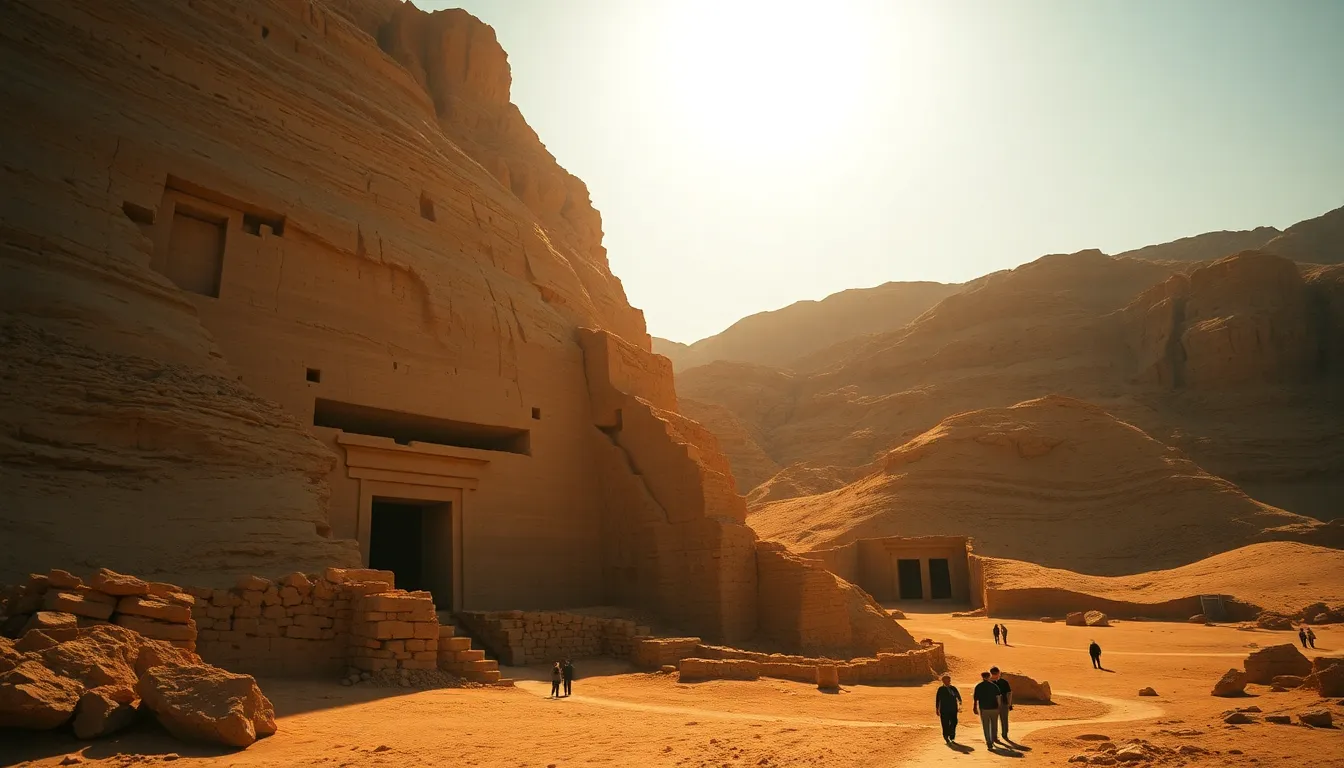
The first time I brought a group down into a royal tomb in the Valley of the Kings, a pastor turned to me at the bottom of the descending corridor and said, very quietly, “So this is what Moses walked away from.” That sentence has stayed with me for years. Because it is exactly right. The Valley of the Kings is not a detour from the heritage story. It is the heritage story, seen from the other side.
Most groups come to the Valley expecting Tutankhamun and a photo. What I want to give them instead is understanding. This is the burial ground of the pharaohs who ruled Egypt at the height of its power, the dynasty that the biblical narrative places at the center of the Exodus drama. When you read the Valley through a faith-heritage lens, it stops being a museum of dead kings and becomes the throne room of the empire that the God of Israel confronted. Let me walk you through how I take a group here.
Where the Valley of the Kings Sits in the Biblical Story
The Valley of the Kings lies on the west bank of the Nile, across the river from Luxor, the city the ancient Egyptians called Thebes and the Bible calls No or No-Amon. For roughly five hundred years, from around 1550 to 1070 BCE, the pharaohs of the New Kingdom were buried here in tombs cut deep into the limestone hills.
That window matters enormously for a faith group. The New Kingdom is the Egypt of the Exodus narrative. Whatever date you hold for the Exodus, whether the earlier fifteenth-century date or the more commonly cited thirteenth-century date, the pharaohs buried in this valley are the dynasty the story is talking about. Thutmose III, Seti I, and Ramesses II all rest here. Ramesses II in particular is the figure many scholars identify with the pharaoh of the oppression. When you stand at the entrance to his tomb, you are standing at the grave of the man tradition names as the king who would not let the people go.
I tell my groups this plainly, because it changes how they see everything in front of them. This is not generic ancient history. This is the imperial machinery of the Bible’s founding conflict.
The Theology Written on the Walls
Here is what catches faith travelers off guard. The walls of these tombs are not decoration. They are scripture. Egyptian funerary texts, the Book of the Dead, the Book of Gates, the Amduat, cover every surface. They are detailed maps of the afterlife, instructions for the king’s soul as it travels through the underworld and is reborn each morning with the sun god Ra.
In other words, you are looking at the religious system that the Hebrew Bible was written in conscious opposition to. The plagues, read in their Egyptian context, are a direct assault on this theology. The Nile turned to blood confronts Hapi, the god of the river. The plague of darkness confronts Ra, the sun god whose nightly journey these very tomb walls were painted to guarantee. The death of the firstborn strikes at the pharaoh himself, who was believed to become a god at death.
When I explain this to a group inside a tomb, surrounded by images of Ra in his solar barque, the Exodus account suddenly reads like a theological argument rather than a list of disasters. That is the kind of understanding I think a heritage journey owes its travelers.
The Tombs Worth Your Group’s Time
You cannot see every tomb, and you should not try. A general admission ticket covers a rotating selection, and a few of the most significant tombs require separate tickets. Here is how I prioritize for a heritage group.
The Tomb of Ramesses II’s World
The tomb of Seti I is the longest and most beautifully decorated in the entire valley, and Seti I was the father of Ramesses II. Walking through it gives a group the full visual vocabulary of New Kingdom royal religion. The astronomical ceiling, the carved and painted reliefs, the sheer ambition of the thing. It requires a separate ticket and it is worth every cent for a group that wants to understand the world the Israelites lived inside.
Nearby, the tomb of Ramesses VI is one of the most complete and color-rich in the valley, and it gives you the full Book of Gates and Book of Caverns on the walls. For groups wanting to actually read Egyptian afterlife theology in situ, this is the one I point them to.
Tutankhamun: Smaller Than You Expect, Larger Than You Think
Tutankhamun’s tomb is famous out of all proportion to its size. It is small, almost cramped, and the wall decoration is limited compared to the great royal tombs. But the boy king’s mummy still lies here, and the story of Howard Carter’s 1922 discovery is part of why so many people in your congregation know the word “pharaoh” at all.
I am honest with groups about this one. If you are expecting grandeur, you will be surprised by how modest it is. But there is something genuinely moving about standing a few feet from a body that lay undisturbed for more than three thousand years, from a reign that overlapped with the world of the patriarchs and the early Israelite presence in Egypt.
Reading a Tomb, Not Just Walking Through It
The difference between a tourist visit and a heritage visit to the Valley is interpretation. Anyone can walk down a corridor and take a photo. What I do with a group is stop at the key scenes and read them: who is this figure with the jackal head, what is happening in this scene of weighing the heart, why does the sun disk appear at the end of the corridor. When a group leaves understanding the religious logic of these walls, they leave understanding the Bible better.
Beyond the Tombs: The West Bank of Thebes
The Valley of the Kings is one piece of a much larger funerary landscape on the Theban west bank, and a heritage group with a full day here should see more of it.
The Mortuary Temples and the Scale of Pharaonic Power
The Ramesseum, the mortuary temple of Ramesses II, lies a short drive from the valley. Its fallen colossal statue, broken and half-buried in the sand, inspired Percy Shelley’s poem “Ozymandias.” For a faith group, there is real theological poetry in standing before the shattered monument of the very king who declared himself a god and refused to bow to the God of Israel. The empire passed. The story it tried to crush is read aloud every Passover and every Easter. I let that sink in without over-explaining it.
The temple of Hatshepsut at Deir el-Bahari, rising in great terraces against the cliff, is one of the most dramatic structures in Egypt and sits just over the ridge from the royal tombs. And the Colossi of Memnon, two enormous seated statues that once guarded a vanished temple, mark the edge of the cultivated land. Together these monuments give a group the full sense of New Kingdom Thebes as the beating heart of an empire.
Connecting Luxor to the Wider Heritage Story
The west bank is the city of the dead. The east bank, across the river, holds the great temples of Karnak and Luxor, the city of the living and the gods. I always pair the Valley of the Kings with at least Karnak, because the contrast tells the story. On one side, kings preparing for the afterlife. On the other, the immense temple complex where they ruled as living gods. This is the full picture of the power the Exodus narrative confronts. For a deeper read on how Luxor fits the broader journey, our Egypt heritage travel guide lays out the whole arc.
Practical Realities for a Group Visit
The Valley of the Kings sits in the desert, and it gets hot. Let me cover the questions group leaders actually ask.
When should we visit during the day? Early morning, without exception. The valley opens early and the heat builds quickly. We get groups in at opening, do the tombs while it is cool, and are heading back across the river before the worst of the midday sun. For the season-by-season picture, see our guide to the best time to visit Egypt for a heritage journey.
How physically demanding is it? Moderate. The tombs involve walking down sloping corridors and back up, and some have steps. It is manageable for most group members, including older travelers, but it is not flat. We pace it, and no one is rushed.
Can we take photographs? General photography is permitted in most tombs with a photo ticket, though some of the special-access tombs restrict it. Rules change, and our guides handle the current situation on the ground so your group is never caught out.
Is it appropriate for a faith group? Completely. I have brought rabbis, pastors, priests, and lay members through these tombs for over twenty years. Understanding ancient Egyptian religion does not threaten anyone’s faith. It deepens their reading of their own scripture. That has been true for every group I have led.
Does the group leader travel free? With 15 or more participants, yes. The group leader’s trip is fully covered. That makes building a Luxor and Valley of the Kings extension into your itinerary genuinely accessible for your community.
FAQ: The Valley of the Kings for Heritage Travelers
Why does the Valley of the Kings matter for a faith group?
The Valley of the Kings is the burial ground of the New Kingdom pharaohs, the dynasty the Exodus narrative centers on. Pharaohs identified with the biblical oppression, including Ramesses II, are buried here. The afterlife texts painted on the tomb walls are the exact religious system that the plagues and the Exodus story were written in opposition to. Visiting with informed interpretation turns the site into a powerful lens on the Bible’s founding conflict, rather than a generic ancient attraction.
Which pharaohs of the Bible are buried in the Valley of the Kings?
The valley holds the tombs of the great New Kingdom pharaohs, including Thutmose III, Seti I, and Ramesses II. Ramesses II is the figure most commonly identified by scholars with the pharaoh of the oppression in the Exodus account, though the biblical text never names him directly. Tutankhamun, whose intact tomb was discovered in 1922, is also buried here. These are the kings who ruled Egypt during the period of the Israelite sojourn and Exodus.
How long should a group spend at the Valley of the Kings?
Plan a half day for the valley itself, ideally starting at opening to beat the heat. A full day on the Theban west bank lets you add the mortuary temples, the temple of Hatshepsut, and the Colossi of Memnon, which together give a richer heritage picture. We usually pair the valley with the temples of Karnak across the river so the group sees both the city of the dead and the city of the living gods.
Is the Valley of the Kings suitable for older travelers?
Yes, with reasonable pacing. The tombs involve walking down and back up sloping corridors, and some have steps, so it is moderately demanding but not strenuous. We schedule visits for the cool early morning, allow plenty of time, and choose tombs appropriate to the group’s mobility. Many of our travelers in their seventies do the full visit comfortably when it is paced well.
Can the Valley of the Kings be combined with an Israel heritage tour?
Yes. Luxor and the Valley of the Kings work beautifully as part of a longer Egypt itinerary or as an Egypt extension of a combined Egypt and Israel journey. The Theban monuments give travelers the full sense of the imperial power the Exodus confronted, which makes the arrival in the Promised Land later in the itinerary land with even more weight. Our team has been building these combined journeys for over twenty years.
If you want your congregation to understand the Exodus from the inside, there are few places more powerful than the Valley of the Kings. This is where the empire of the Bible rests. You can see how Luxor fits a full itinerary on our Egypt heritage destination page, or look at how we structure group heritage tours and how the group leader experience works.
When you are ready to talk it through, reach out to us. I have stood at the bottom of these tombs with hundreds of groups, and I would be glad to help you bring your people to that same ground.