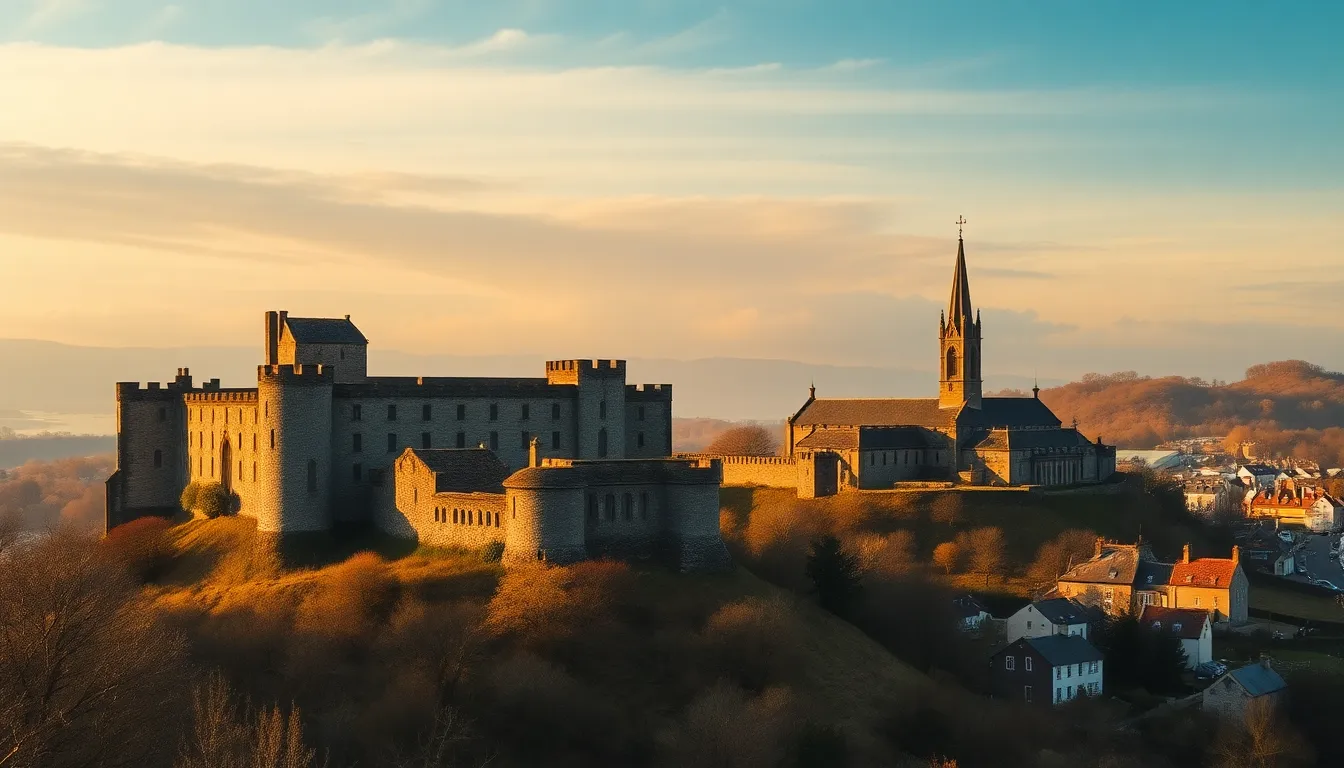
The Town That Sits at Scotland’s Crossroads
There is an old saying that whoever holds Stirling holds Scotland. The town sits on a rock at the country’s narrow waist, where the Highlands meet the Lowlands and the great roads and rivers all converge. For centuries that made it the place where Scotland’s history was decided, in battle and in faith. And it is the faith story that brings my groups here.
I have stood with many congregations in the Church of the Holy Rude, the old parish church on the ridge below the castle, and told them that they are standing in one of the few churches in the world still in use where a monarch was crowned. It is also a church bound tightly to the Scottish Reformation, the turning point that reshaped the nation’s faith. Stirling holds that story at its very center. This guide is meant to orient you before you plan a trip here.
Why Stirling Matters
Stirling matters because it sits at the heart of the Scottish Reformation, both in geography and in story. The Reformation reached Scotland with great force in 1560, led above all by John Knox, and out of it grew the Presbyterian church that would shape Scottish faith for centuries. Stirling, as a royal town at the country’s crossroads, was caught up in the center of those events.
For a heritage group, Stirling offers the Reformation layer of the Scottish story in a single, walkable old town. It pairs naturally with the wider Reformation and Covenanter trail you can trace in our hub guide to United Kingdom heritage travel. Where Iona holds the Celtic root and the southwest holds the later Covenanter struggle, Stirling holds the pivot, the moment the Reformation took hold and the new church was born.
The Church of the Holy Rude
A Church at the Center of History
The Church of the Holy Rude is the heart of the Stirling story. It is one of the oldest buildings in the town, with parts dating back centuries, and it stands just below the castle on the old town ridge. What makes it remarkable for a faith group is its place in the Reformation. In 1567, the infant King James VI, later James I of England, was crowned here, and John Knox himself is traditionally said to have preached the sermon at that coronation. Few churches anywhere can claim so direct a tie to the Reformation’s central figure and to a royal coronation in one place.
The church is still a working place of worship, which gives it a living quality that ruins cannot match. A group can sit in the same space where these events unfolded, under the medieval timber roof, and feel the continuity of Scottish faith from the Reformation to the present day. I always give the Holy Rude unhurried time and let the weight of it settle.
The Reformation Story on the Ground
Standing in the Holy Rude is the best way I know to make the Scottish Reformation real for a group. The Reformation can feel like an abstraction, a matter of theology and dates. Here it becomes concrete: this is where the new church was preached and a king was crowned into it. From this foundation grew the Presbyterian tradition that would later be tested in blood by the Covenanters, whose story runs through our Covenanters heritage trail, and that crossed the sea to shape the Ulster-Scots, told in our guide to the Antrim coast and Ulster-Scots heritage.
Stirling Castle
Above the church rises Stirling Castle, one of the grandest in Scotland, set on its commanding rock. While its story is more royal than religious, the castle is part of understanding Stirling and worth a visit for any group. From its walls you see the whole sweep of the country that made this town so contested, the Highland hills to the north and the Lowland plain to the south.
The castle also holds the political backdrop to the Reformation. This was a royal residence, a seat of the crown, and the religious upheavals of the sixteenth century were bound up with the fortunes of the monarchy that lived here. Seeing the castle and the Holy Rude together, the crown and the church side by side on the ridge, helps a group grasp how faith and power were entangled in Reformation Scotland.
The Old Town
Between the castle and the lower town runs the old medieval thoroughfare, lined with historic buildings, that ties the whole story together. It is a short, steep, walkable stretch, and taking it on foot lets a group feel the shape of the old royal burgh. Stirling is compact in the best way, with its great sites gathered close on the ridge, which makes it one of the easiest places in Scotland to explore well in a short time.
Where Stirling Fits in a Scotland Trip
Stirling sits at the geographic center of Scotland, which makes it not only meaningful but practical. It is within easy reach of both Edinburgh and Glasgow, well connected by road and rail, so most groups fold it into a wider Scottish itinerary rather than treating it alone. Its central position makes it a natural hinge between the Lowland sites and the route north toward the Highlands and the western coast.
For the faith story, Stirling is the Reformation anchor. A well-shaped Scottish trip might join the Celtic heritage of the west, the Reformation pivot at Stirling, and the Covenanter struggle of the southwest into one journey that follows the whole arc of Scottish faith. You can see how the layers fit together in our United Kingdom heritage hub.
Planning a Visit
Stirling is easy for group travel. It sits at the crossroads of the country, with good roads and rail links, and its main sites are gathered close together on the old town ridge. A standard coach reaches it without difficulty, and the old town is walked on foot. Many groups base themselves in Edinburgh or Glasgow and take Stirling as a day, while others give it a night to take the Holy Rude and the castle at a gentler pace.
I usually allow a full day for Stirling, which lets a group take the Church of the Holy Rude slowly, see the castle, and walk the old town without rushing. On timing, the comfortable window is the same as across these northern nations: May to September, with long daylight and the mildest weather. The full seasonal picture is in our United Kingdom heritage hub.
What to Prepare Your Group For
Stirling’s old town runs up a steep ridge, and the streets are cobbled in places, so comfortable shoes that handle slopes and uneven stone matter here. The castle and the church both involve some walking and steps. A waterproof layer is wise in any season, since Scottish weather turns quickly even on a fine day.
As always, a little preparation deepens the visit. A group that arrives understanding the Scottish Reformation, the work of John Knox, and the birth of the Presbyterian church gets far more from standing in the Church of the Holy Rude than one seeing it cold. When people already carry the story, the church where a king was crowned and the Reformation preached speaks with real power.
FAQ: Stirling and Reformation Scotland
Why is Stirling important to the Scottish Reformation?
Stirling sat at the heart of Scotland, both geographically and politically, when the Reformation took hold in 1560. The Church of the Holy Rude in Stirling hosted the 1567 coronation of the infant King James VI, with John Knox traditionally said to have preached the sermon. That ties the town directly to the Reformation’s central figure and makes it a natural anchor for the story.
What is the Church of the Holy Rude?
It is Stirling’s historic parish church, one of the oldest buildings in the town, standing just below the castle on the old town ridge. It is remarkable for being one of the few churches still in use where a monarch was crowned, and for its direct tie to John Knox and the Reformation. It remains a working place of worship, which gives a group a living connection to that history.
How does Stirling fit with the rest of a Scotland trip?
Easily. Stirling sits at the country’s crossroads, within easy reach of both Edinburgh and Glasgow by road and rail, so most groups fold it into a wider Scottish itinerary. For the faith story, it is the Reformation pivot between the Celtic heritage of the west and the later Covenanter struggle of the southwest.
How much time should a group spend in Stirling?
A full day works well, letting a group take the Church of the Holy Rude slowly, see the castle, and walk the compact old town without rushing. Some groups base themselves in Edinburgh or Glasgow and visit Stirling as a day trip, while others give it a night for a gentler pace.
Do group leaders really travel free?
Yes. On all Heritage Tours group itineraries, when your group includes 15 or more participants, the group leader travels free. It is how we honor the work that pastors, rabbis, and educators put into bringing their communities together.
If the Reformation story of Stirling is calling to your community, I would love to talk through what the journey could look like. Begin with our United Kingdom heritage destination and our group heritage tours, then contact us whenever you are ready to start the conversation.