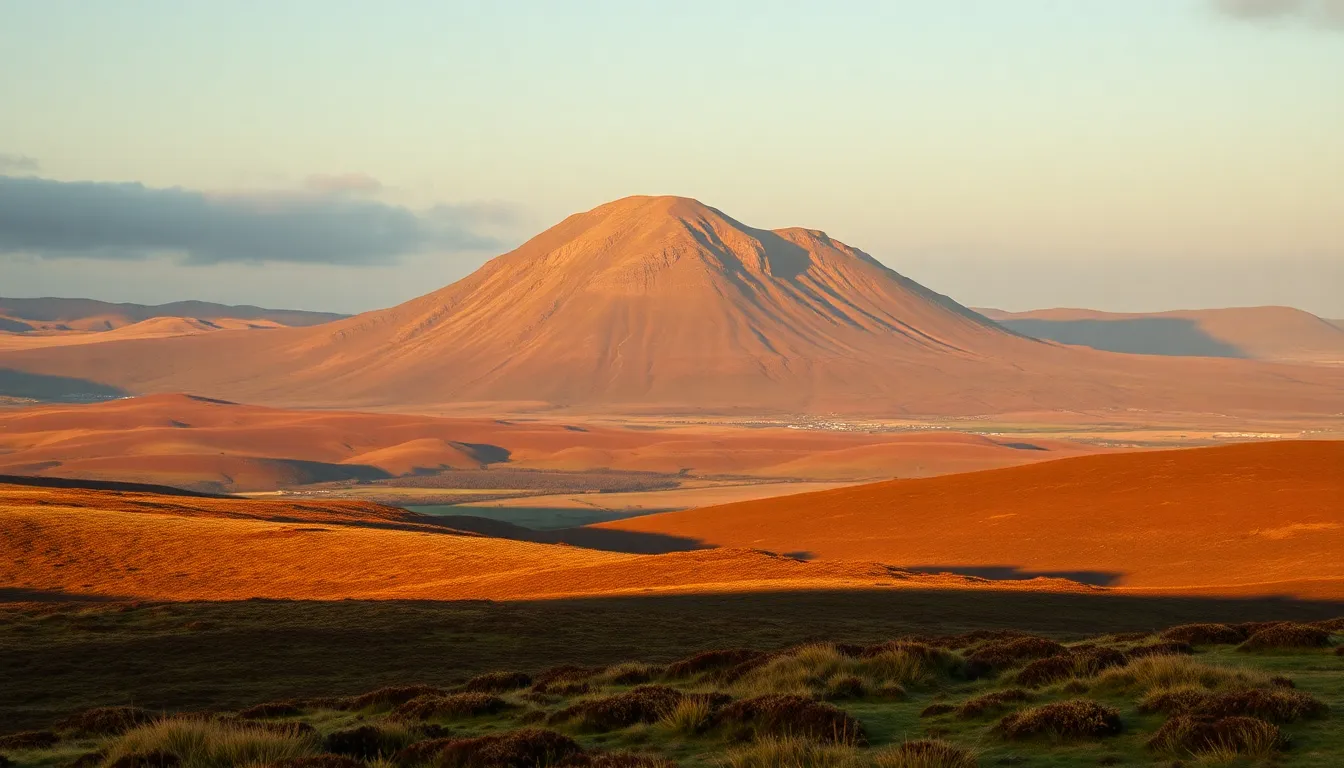
There are two places in County Antrim and County Down where Patrick’s whole story turns, and they are not crowded. No big visitor center, no queues. At Slemish, a lone hump of a mountain rising out of the Antrim farmland, a teenage slave is said to have herded sheep and learned to pray. At Saul, a quiet spot near Downpatrick, the same man, decades later and now a missionary bishop, is said to have preached his first sermon and built his first church on Irish soil. I take groups to these two places together because between them they hold the hinge of Patrick’s life: the bottom, where he was a captive, and the turn, where he came back to give his life to the people who had taken his freedom. Standing in these humble fields does something for a group that no grand cathedral can.
Let me walk you through Saul and Slemish the way I would walk you through it on the ground.
Slemish: The Mountain of Captivity
Patrick tells us himself, in his own Confessio, that he was captured as a teenager and taken to Ireland as a slave, and that he spent about six years tending flocks. The strong local tradition places that captivity at Slemish, a distinctive mountain in County Antrim, where the young Patrick is said to have herded sheep and pigs for a master named Miliucc.
Slemish is the remnant core of an ancient volcano, a steep green hill standing alone above the surrounding farmland, and you can climb it. I tell leaders this is where the trip earns its emotional depth. Patrick writes that in his captivity, alone on the hills, he turned to God. “After I came to Ireland, every day I had to tend sheep, and many times a day I prayed,” he says. The faith that would later convert a nation was forged here, in loneliness and slavery, on a cold hillside.
For a group, Slemish is the place to sit with that. Before Patrick was a saint, he was a frightened, homesick young slave who found God in the worst season of his life. Standing on or below that mountain, your people are at the true beginning of the story, the place where God met a captive. Patrick later escaped from Ireland after six years and made his way home, but he could not forget the place.
Slemish draws pilgrims especially on Saint Patrick’s Day, March 17, when many climb the mountain. For a group visiting at other times, the quiet is its own gift.
The Return: From Britain Back to Ireland
The hinge of Patrick’s life is what he did next, and it is worth slowing down for with a group. Having escaped slavery and returned safely to his family in Britain, Patrick had every reason never to think of Ireland again. Instead, he writes, he had a vision in which the Irish called him to come back and walk among them once more. Against the natural pull of safety and home, he trained for the church and returned to Ireland as a missionary bishop, by tradition around 432.
This is the heart of why Patrick matters, and it is the bridge between Slemish and Saul. The slave came back as a shepherd of souls, to the very island and the very people who had enslaved him. There are not many stories in Christian history with that shape, and congregations feel its force.
Saul: The First Church
When Patrick returned to Ireland to begin his mission, tradition holds that he landed near Strangford Lough in County Down and that a local chieftain named Dichu was his first convert. Dichu gave Patrick a barn, a sabhall in Irish, in which to worship, and this became the site of Patrick’s first church in Ireland. The place is called Saul, from that Irish word for barn.
Saul is therefore where the Irish mission formally began, the first Christian worship Patrick led on the island as a returned missionary. It is also, by tradition, near where Patrick died, which gives the place a quiet completeness. He began and ended his Irish mission in this corner of County Down.
The site today holds a small memorial church, built in the early twentieth century in an early Celtic style, on or near the traditional location, and nearby on a hill stands a large statue of Patrick that looks out over the country he evangelized. I tell groups that Saul is the counterweight to Slemish. At Slemish he was a captive who prayed. At Saul he was a free man who preached. Holding the two together is the whole gospel logic of Patrick’s life.
Honest About the Traditions
As with the grave at Downpatrick, I am straight with groups about what we can and cannot prove. The connection of Slemish to Patrick’s captivity and of Saul to his first church are strong traditions, well rooted in the early Patrician sources and local memory, but they are traditions rather than archaeologically certified facts. Patrick himself names neither place in his surviving writings.
This honesty matters, and it does not weaken the visit. What Patrick does tell us in his own voice is the human core: the captivity, the herding, the praying on the hills, the vision calling him back, the return. The traditions of Slemish and Saul attach those true events to real ground you can stand on. Pilgrims have honored these sites for centuries. For a group, the combination of Patrick’s own honest words and these long-revered places is more than enough to make the story land.
How Saul and Slemish Fit a Patrick Pilgrimage
Saul and Slemish are the natural opening of a Patrick trail, because they are where his story begins. I usually structure a Patrick pilgrimage in the order he lived it: Slemish first, for the captivity and the forging of his faith, then the return, then Saul, for the first church and the start of the mission. That sequence lets a group live the arc rather than visit scattered points.
The sites lie within reach of each other and of the other Patrick landmarks in the same corner of Northern Ireland, so the whole trail fits a compact, coherent journey. From here the story moves on to the center of his authority and finally to his grave. You can trace his church capital in our guide to Saint Patrick in Armagh, and the close of his life in our guide to Downpatrick and the grave of Saint Patrick. To set Patrick among the wider founders of British and Irish Christianity, see our overview of Christian heritage sites across the UK.
A practical note worth raising with your congregation early: with Heritage Tours, the group leader travels free when you bring fifteen or more participants. For a pastor building a Patrick pilgrimage in Northern Ireland, that is worth planning around from the start.
FAQ: Visiting Saul and Slemish With a Faith Group
What is Slemish and why is it linked to Saint Patrick?
Slemish is a distinctive mountain in County Antrim, the eroded core of an ancient volcano, traditionally held to be where Patrick was held as a slave and herded sheep for about six years as a teenager. Patrick writes in his Confessio that he prayed constantly while tending flocks in captivity, and it was there that his faith took root. It marks the true beginning of his story.
What is Saul and what happened there?
Saul, near Downpatrick in County Down, is the traditional site of Patrick’s first church in Ireland after he returned as a missionary bishop. A local chieftain named Dichu, said to be his first convert, gave him a barn to worship in, and the place takes its name from the Irish word for barn, sabhall. It is where Patrick’s Irish mission formally began.
Can you climb Slemish, and is it suitable for a group?
Yes, Slemish can be climbed, and many pilgrims do so, especially on Saint Patrick’s Day. The climb is steep, so for a mixed-age group we plan the visit around what your people can manage, and the mountain is moving even from its base. We structure the pace so everyone shares in the meaningful moment.
Are the Slemish and Saul traditions historically reliable?
They are strong, long-held traditions rooted in the early Patrician sources and local memory, but they are not archaeologically proven, and Patrick names neither place in his own writings. What is certain, from Patrick’s own words, is the captivity, the prayer, the vision calling him back, and the return. The sites attach those true events to ground you can stand on.
In what order should a group visit the Patrick sites?
Follow the order Patrick lived his story. Begin at Slemish for the captivity, then Saul for the first church and the start of the mission, then move to Armagh for the center of his authority, and finish at Downpatrick at his grave. Travelling the sequence lets your group experience the full arc of Patrick’s life from slave to missionary.
If a Patrick pilgrimage that begins where his story began speaks to you for your congregation, I would be glad to help you shape it. Slemish and Saul hold the humblest and most powerful chapters of his life. You can see how we build these trips on our United Kingdom heritage page or learn how the group experience works on our group heritage tours page.
Contact us whenever you are ready to start planning.