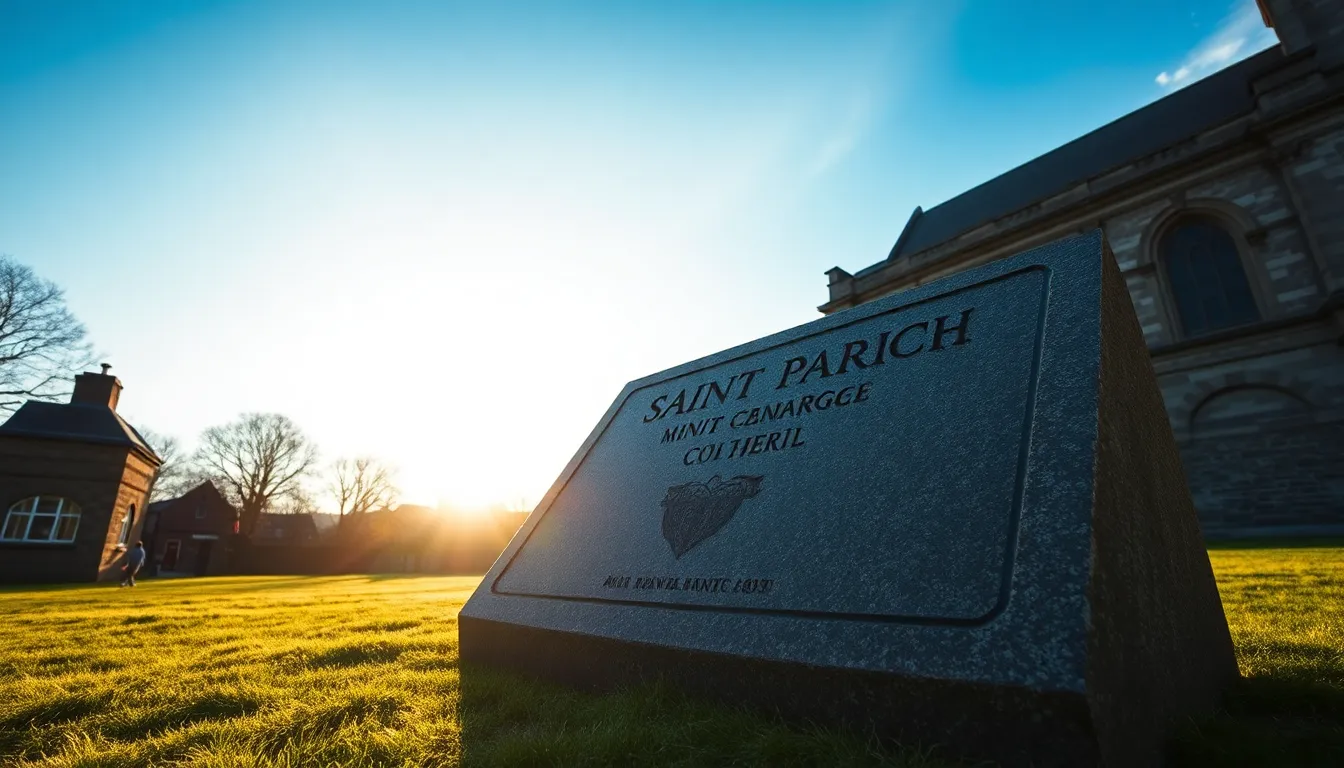
I have stood at a lot of famous graves with groups, and most of them are elaborate. Carved tombs, gilded shrines, the works. The traditional grave of Saint Patrick is the opposite, and the contrast is exactly what makes it powerful. You climb the hill to Down Cathedral in Downpatrick, and there in the churchyard, set into the slope, is a single rough slab of granite with one word and a cross carved into it: PATRIC. That is it. The man who brought Christianity to Ireland, the figure behind a thousand legends and a global feast day, lies, by long tradition, under a plain stone on a quiet hill. I watch groups arrive expecting grandeur and fall silent at the simplicity. It is one of the most honest holy places I know, and it fits the real Patrick perfectly.
Let me walk you through Downpatrick the way I would walk you through it on the ground.
The Hill of Down and Why It Matters
Downpatrick takes its very name from the saint, Dun Padraig, “Patrick’s stronghold.” The town grew up around a hilltop that has been a place of significance since long before Christianity, and it sits in County Down in Northern Ireland, in the heartland of where Patrick’s Irish mission was rooted.
This is not an arbitrary spot. The whole region of Down and the lands around Strangford Lough are tied to the earliest part of Patrick’s story in Ireland, the place where, by tradition, his mission took hold. So the hill where he is said to be buried lies in the very country he is said to have evangelized first. For a group, that closeness matters. Patrick was laid to rest, the tradition holds, in the land he loved and labored over.
Down Cathedral and the Grave
The cathedral that crowns the hill, the Cathedral Church of the Holy and Undivided Trinity, usually called Down Cathedral, is a Church of Ireland cathedral with a long and broken history. There has been a church on this hill since early times, succeeded by a great medieval abbey that was suppressed and ruined, and the present cathedral was rebuilt and reopened in the early nineteenth century on the old foundations. As at the other Celtic sites, I explain this layering to groups. The building is relatively modern. The hill is ancient and sacred.
The grave itself lies just outside the cathedral, in the churchyard on the slope. The large slab of Mourne granite that marks it was placed there in 1900, to stop pilgrims from carrying away soil and stone as relics, which they had been doing for centuries. The marker is deliberately plain, and that plainness is the point. It carries only the name and a Celtic cross.
By the same strong tradition, Patrick does not lie alone. The hill is held to be the burial place of three of Ireland’s great patron saints together: Patrick, Brigid, and Columba. An old verse records it: “In Down, three saints one grave do fill, Patrick, Brigid and Columcille.” Whether or not all three rest here, the tradition binds the founders of Irish Christianity into a single resting place, and groups find that gathering of names quietly moving.
How Reliable Is the Tradition?
I am always honest with groups about this, and the honesty deepens the visit rather than diminishing it. We cannot prove that Patrick is buried under that stone. The grave is a tradition, not an archaeologically verified fact, and the early sources about Patrick’s death and burial are sparse and sometimes conflicting. Other places have made claims over the centuries.
But the tradition tying Patrick to Down is old and strong, and the early accounts do place his burial in this region. The point I make to a group is this: pilgrimage has never depended on forensic certainty. For more than a thousand years, people have come to this hill to remember Patrick. The continuity of that devotion is itself part of what makes the place holy. You are standing where countless believers before you have stood to honor the man who carried the gospel to Ireland.
That framing helps a congregation. They are not there to verify a coffin. They are there to give thanks, and this is the place the faithful have done that for a millennium.
What the Plain Grave Teaches
Here is where I usually let a group linger, because the grave preaches its own sermon. Patrick, in his own writings, calls himself a sinner, the most unlearned of men, humble about his abilities and overwhelmed by his calling. He did not seek greatness. He returned to the people who had enslaved him and spent his life among them.
A plain granite slab on a windy hill is exactly the right monument for a man like that. There is no gold, no soaring shrine, just his name and a cross. For a faith leader, the contrast between Patrick’s enormous influence and the humility of his grave is a ready-made reflection on what God does with surrendered, ordinary lives. I have seen that land harder on a group than any grand tomb ever could. The simplicity does the work.
How Downpatrick Fits a Patrick Pilgrimage
Downpatrick is one anchor of the Patrick trail in Northern Ireland, and it pairs naturally with the sites where his Irish story began nearby. The grave makes a fitting close to a Patrick journey, the end of the saint’s life after you have traced its beginning, so many groups save Downpatrick for near the end of the trail.
The town is also home to the Saint Patrick Centre, an exhibition that tells his story using his own words from the Confessio, which makes a useful companion to the grave for groups who want the historical depth.
For pacing, Downpatrick fits comfortably into a day alongside the nearby Patrick sites, since the County Down landmarks sit close together. You can trace the beginning of his Irish story in our guide to Saul and Slemish, where Patrick’s story began, and the center of his church authority in our guide to Saint Patrick in Armagh. To set Patrick alongside the wider family of British and Irish founders, see our overview of Christian heritage sites across the UK.
A practical note worth mentioning to your congregation early: with Heritage Tours, the group leader travels free when you bring fifteen or more participants. For a pastor planning a Patrick pilgrimage, that is worth building into the plan from the start.
FAQ: Visiting the Grave of Saint Patrick With a Faith Group
Where is Saint Patrick buried?
By long tradition, Patrick is buried on the hill of Down Cathedral in Downpatrick, County Down, Northern Ireland. A plain slab of Mourne granite in the churchyard marks the spot. The town’s name itself, Dun Padraig, means “Patrick’s stronghold,” and the burial tradition tying him to this hill is old and strong.
Is it certain that Patrick is buried there?
No, it is a tradition rather than a proven fact. The early sources about Patrick’s death and burial are limited, and the grave has not been archaeologically verified. But the tradition is ancient and the early accounts place his burial in this region. Pilgrims have honored Patrick on this hill for over a thousand years, and that continuity of devotion is part of what makes the site meaningful.
Why is the grave marked by such a plain stone?
The granite slab was placed in 1900 to stop pilgrims from carrying away soil and stones as relics. Its plainness suits the historical Patrick, who described himself in his own writings as a humble and unlearned sinner. The contrast between his vast influence and his simple grave makes a natural theme for group reflection.
Are other saints buried with Patrick at Downpatrick?
Tradition holds that Patrick shares the hill with two other great Irish saints, Brigid and Columba, captured in an old verse about three saints filling one grave at Down. Whether all three rest here cannot be proven, but the tradition gathers the founders of Irish Christianity into one resting place, which many groups find moving.
How does Downpatrick fit into a wider Patrick trip?
It works best as the close of a Patrick pilgrimage, after you have traced the beginning of his Irish story at nearby sites. Downpatrick, the Saint Patrick Centre, and the surrounding County Down landmarks sit close together and fit comfortably into a day. We help groups build the trail so it tells the whole arc of Patrick’s life.
If a Patrick pilgrimage that ends at his grave speaks to you for your congregation, I would be glad to help you shape it. The plain stone on its quiet hill is one of the most honest holy places in these islands. You can see how we build these trips on our United Kingdom heritage page or learn how the group experience works on our group heritage tours page.
Contact us whenever you are ready to start planning.