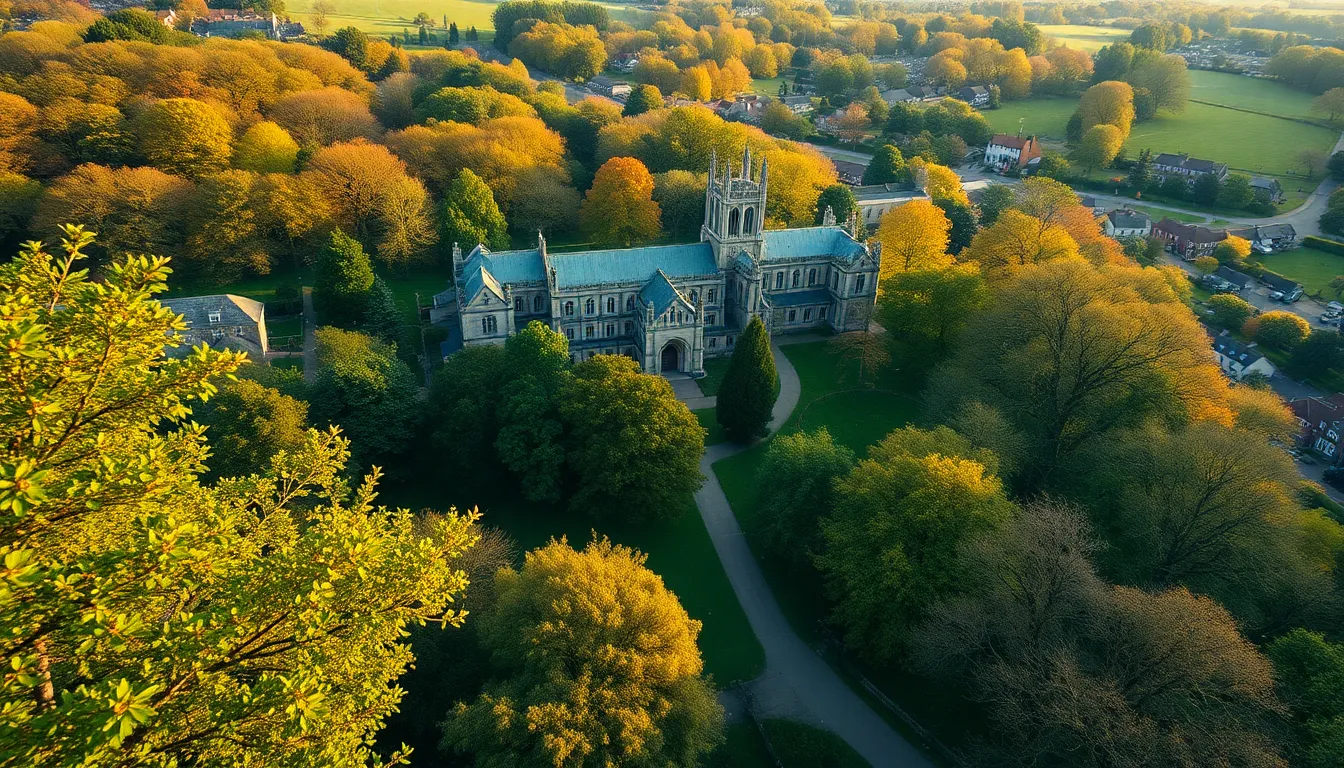
Most groups arrive in Cardiff thinking of it as a modern capital, a castle, a stadium, a waterfront. Then we drive a few minutes north of the city center, the streets give way to a village green, and the road dips. You look down, and there is a cathedral sitting below you in a hollow, as if the ground had folded around it to keep it safe. Almost every group goes quiet at that point. Llandaff is not what they expected, and it is one of my favorite arrivals in all of Wales.
What makes Llandaff worth a stop is not just the building. It is the length of the story underneath it. This is one of the oldest Christian sites in Britain that is still in continuous use, and the layers of that history are part of what you come to see.
A Cathedral in a Hollow: Why Llandaff Sits Where It Does
The name tells you part of the answer. Llandaff, Llandaf in Welsh, means the church, or llan, on the River Taff. The early Christian community here chose the low ground beside the river, in the manner of the Celtic saints who founded their enclosures near water. By the time a great medieval cathedral rose on the spot, the location was fixed by centuries of holy use, so the building went where the faith had always been, down in the hollow rather than up on the hill.
That setting gives Llandaff a character no hilltop cathedral has. You descend to it. For a faith group, the symbolism is hard to miss and worth naming aloud. This is a church you go down into, not up to, and there is something fitting in that for a place built on the memory of humble founders.
The Long History: From Celtic Foundation to Medieval Cathedral
Tradition traces the Christian community at Llandaff back to the early Celtic saints, with Dyfrig and Teilo named among its founding figures in the sixth century. Teilo, whose main foundation lay west at Llandeilo, is honored at Llandaff as one of its patrons, and the cathedral guards his memory closely. The early medieval text known as the Book of Llandaff, compiled in the twelfth century, records land grants and the lives of these saints, and it remains one of the most important documents of the early Welsh church.
The cathedral as a substantial stone building took shape from 1120 onward, under the first Norman bishop, Urban, who wanted a structure worthy of the relics and the standing he claimed for the see. Over the following centuries it grew, was damaged, was repaired, and was at times badly neglected. By the eighteenth century parts of it had fallen into ruin, and an extraordinary classical temple was inserted into the medieval shell, an episode most Welsh churchmen later regretted. The Victorians undertook a thorough restoration in the nineteenth century that returned the cathedral to its Gothic character.
I tell groups this long arc deliberately. Llandaff is not a perfectly preserved jewel. It is a survivor. It has been founded, rebuilt, ruined, patched, restored, and, as we will see, very nearly destroyed within living memory. That is a more honest picture of how Christian heritage actually survives, and groups respond to honesty.
The Blitz and the Majestas: Destruction and Resurrection
On a January night in 1941, a German landmine fell beside the cathedral and exploded. The blast tore off much of the roof, brought down the medieval timber, and left Llandaff one of the most heavily damaged cathedrals in Britain. For years it stood open to the sky.
The rebuilding that followed produced the single most arresting feature of Llandaff today. Spanning the nave on a concrete arch is a vast aluminum sculpture of Christ, the Majestas, by the artist Jacob Epstein, unveiled in 1957. It is unlike anything else in a British cathedral, modern, unadorned, and enormous, the figure of Christ rising above the heads of everyone who enters. Some visitors love it immediately. Others need a moment. Either way, it does what the rebuilders intended: it makes the resurrection of the cathedral itself part of the message.
For a faith group, the Blitz story and the Epstein Christ together create one of the strongest teaching moments on a Wales itinerary. Here is a Christian community that watched its cathedral fall, and chose to crown the rebuilt nave with a figure of the risen Christ. The destruction and the recovery are both visible at once. I have stood under that figure with groups and watched a whole coach of people fall silent without being asked to.
Cardiff Beyond the Cathedral: A Wider Christian Story
Llandaff anchors a faith visit to Cardiff, but it is not the whole of it. The wider city carries a Christian history worth a half day on its own.
Wales in the eighteenth and nineteenth centuries was shaped profoundly by Nonconformity, the chapels of the Methodists, Baptists, and Independents that became the spiritual home of much of the Welsh-speaking working population. The industrial valleys north of Cardiff were chapel country, and the Welsh Revival of 1904 and 1905, which began in this region and drew worldwide attention, is a chapter many Protestant groups want to trace. For groups with that interest, Cardiff is a natural gateway into the story of Welsh Nonconformist faith and the great revival that moved through these valleys.
The contrast itself is instructive. Llandaff represents the ancient, episcopal, cathedral tradition of Welsh Christianity. The chapels of the valleys represent the fervent, congregational, revival tradition that grew up alongside and often in tension with it. A group leader can hold both in view from Cardiff, and that fuller picture is more truthful than either tradition on its own.
Practical Notes for Visiting Llandaff with a Group
Llandaff is an easy and welcoming stop. It sits about three miles from Cardiff city center, accessible by coach, with a village green and cathedral close that give groups room to gather before going in. The cathedral is an active place of Anglican worship, so service times shape the day, and it is worth coordinating a visit around them.
I usually suggest pairing Llandaff with one other Cardiff element, either the castle for general history or, for groups tracing Welsh faith, an excursion toward the chapel heartland and the Revival sites in the valleys. That gives you a balanced day: the ancient cathedral in the morning, the wider story in the afternoon.
FAQ: Llandaff Cathedral for Faith Travel Groups
Why is Llandaff called the cathedral in a hollow?
Llandaff sits in a low dip beside the River Taff, below the surrounding village rather than on a hilltop, which is unusual for a major cathedral. The location goes back to the early Celtic Christian community that founded a church here near the water, in the tradition of the Welsh saints. When the great medieval cathedral was built, it rose on that long-established holy ground, which is why visitors descend to reach it.
What is the Epstein Christ at Llandaff?
The Majestas is a large aluminum sculpture of Christ by the artist Jacob Epstein, installed in 1957 as part of the cathedral’s rebuilding after it was bombed in 1941. It spans the nave on a concrete arch and is one of the most striking pieces of modern religious art in any British cathedral. For faith groups it often becomes a focal point for reflection on destruction and resurrection, since the figure crowns a cathedral that was very nearly lost.
Is Llandaff connected to the Celtic saints?
Yes. Tradition names Dyfrig and Teilo, both sixth-century Celtic saints, among the founders of the Christian community at Llandaff, and Teilo is honored there as a patron. The twelfth-century Book of Llandaff records the lives of these saints and the early grants to the see, making Llandaff one of the important links between the age of the Welsh saints and the later medieval church.
How much time should a group plan for Llandaff and Cardiff?
For Llandaff Cathedral itself, allow ninety minutes to two hours so your group can take in the building, the Epstein Christ, and have some quiet time. To include the wider Christian story of Cardiff and the chapel and Revival heritage of the nearby valleys, plan a half to a full day. We can shape the balance depending on whether your group’s focus is the ancient cathedral tradition or the Welsh Nonconformist and Revival story.
Llandaff is a natural anchor for a faith visit to south Wales, and it connects to a much larger story. Begin with our United Kingdom spiritual sites guide, then read about the Celtic saints of Wales and the Welsh Bible of William Morgan to see how Cardiff fits into the wider Welsh Christian heritage. Our United Kingdom destination page and our group heritage tours page explain how we structure these journeys, including free travel for group leaders bringing fifteen or more.
When you want to plan a Cardiff and Llandaff visit for your community, contact us and we will help you build it.