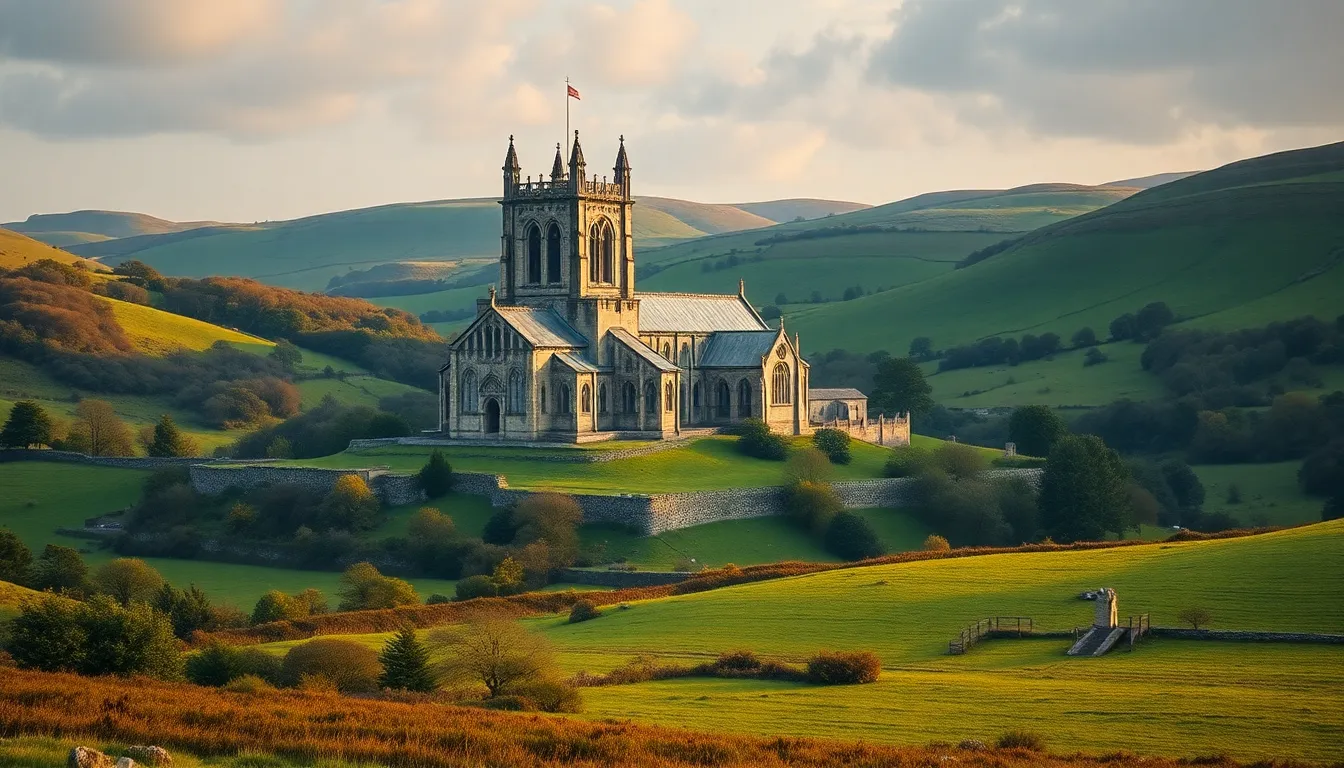
The first time I brought a group into Pembrokeshire, a pastor in the back of the coach asked me a question I have heard many times since. “Where exactly are we, in church history terms?” It is a fair question. Most of us learn our Christian heritage through Rome, through the Reformation, through the great cathedrals of England and the continent. Wales sits somewhere else. It belongs to an older, quieter chapter, the age of the Celtic saints, when Christianity in Britain grew not from cities and bishops but from small communities of monks gathered around a holy man, a well, and a stretch of difficult coastline.
That chapter is real, it is well documented, and you can still stand in the places where it happened. Let me walk you through three of the men at the center of it, and the sites where your group can encounter them.
The Age of the Saints: What Actually Happened in Wales
When the Roman legions left Britain in the early fifth century, the structures of Roman Christianity went with them in much of the island. But in the west, in Wales, Cornwall, and Ireland, something different took root. From roughly 500 to 700 AD, a generation of monastic founders established communities across the Welsh landscape. They are remembered as the Celtic saints.
These were not saints in the later medieval sense, canonized by Rome after a formal process. They were founders. A saint in this tradition was a man, or sometimes a woman, who established a llan, a sacred enclosure where a community lived under a rule of prayer, study, and work. The Welsh place names that begin with Llan, and there are hundreds of them, almost always mark one of these foundations. Llandeilo means the llan of Teilo. Llanddewi means the llan of David. The map of Wales is, in a real sense, a map of these saints.
For a faith group, this is the thing to grasp before you travel. You are not visiting cathedrals first and saints second. You are visiting the saints first, in the landscape they shaped, and the cathedrals came later, built on top of what they began.
Saint David: Patron of Wales
David, or Dewi Sant in Welsh, is the patron saint of Wales and the only patron saint of the British nations who was native to the land he represents. He lived in the sixth century, and the community he founded sits at the far western tip of Pembrokeshire, in the smallest city in Britain, which now bears his name.
What strikes most groups about St Davids is its setting. The cathedral does not stand proudly on a hill. It sits down in a hollow, in the valley of the River Alun, deliberately hidden from the sea so that Viking raiders sailing the coast would not spot it. You walk down to it. That descent matters. David’s rule was famously austere. His monks pulled the plough themselves rather than use oxen, drank only water, and ate bread with herbs. The Welsh remember his last words to his followers: “Be joyful, keep the faith, and do the little things.” That phrase, “the little things,” gwnewch y pethau bychain, is still quoted across Wales.
For Christian groups, St Davids works on two levels. The present cathedral, begun in 1181, is a magnificent medieval building with a famously sloping floor and a carved oak ceiling worth the trip on its own. But underneath the medieval grandeur sits the memory of a man who built nothing grand at all. That contrast is a gift for a group leader. It opens a real conversation about what faithfulness looks like, and whether it needs to be impressive to be lasting.
Saint Teilo: The Saint of the Tywi Valley
Teilo was a contemporary and friend of David, and in the early Welsh church his reputation stood nearly as high. His main foundation was at Llandeilo Fawr in the Tywi valley of Carmarthenshire, and his influence spread south to Llandaff near Cardiff, where he is remembered as one of the founding figures of that cathedral.
Teilo’s story carries one of the more striking legends of the Welsh saints. When he died, three churches each claimed his body, and tradition says the dispute was settled when his remains miraculously became three, one for each. It is a legend, and I tell groups so plainly. But the legend itself tells you something true: Teilo mattered enough to three communities that each wanted to be his resting place. A saint who is fought over after death was a saint who shaped lives while alive.
There is a tangible relic connected to Teilo that I always mention. The Gospels of St Teilo, an eighth-century illuminated manuscript, contain some of the earliest written Welsh in the margins, notes recording land transactions made on the altar of his church. The manuscript later traveled to Lichfield in England and is known today as the Lichfield Gospels. When your group hears that the oldest surviving written Welsh sits in the margins of a gospel book laid on Teilo’s altar, the connection between faith, language, and land becomes concrete rather than abstract.
Saint Beuno: The Miracle Worker of the North
If David belongs to the southwest and Teilo to the south, Beuno belongs to the north. He was a seventh-century founder active across Gwynedd, and his great foundation was at Clynnog Fawr on the Llyn Peninsula, on the old pilgrim road to Bardsey Island.
Beuno is remembered above all for his connection to his niece, Saint Winefride. The story holds that Winefride was beheaded by a rejected suitor, that a healing spring rose where her head fell, and that Beuno restored her to life. That spring is Holywell in Flintshire, which has been a place of Christian pilgrimage for fourteen centuries and is sometimes called the Lourdes of Wales. It is one of the few British shrines that never fully stopped receiving pilgrims, even through the Reformation.
For a group leader, Beuno opens up the north of Wales and the theme of healing and pilgrimage. The church at Clynnog Fawr is large for a village, a sign of how important the site once was, and the pilgrim route past it toward Bardsey, the island of twenty thousand saints, gives a sense of how organized Welsh pilgrimage became.
How to Build These Saints into a Group Itinerary
You cannot do justice to all three in a single afternoon, and you should not try. The Welsh saints are spread across the country, which is part of what makes them meaningful. Here is how I generally frame it for groups.
A southern route built around St Davids and Llandeilo gives you David and Teilo together, with the dramatic Pembrokeshire coast and the gentle Tywi valley. This pairs naturally with Llandaff Cathedral in Cardiff at the start or end. A northern extension reaches Beuno’s country, Clynnog Fawr, Holywell, and the approach to Bardsey, and connects well with the wider story of Welsh pilgrimage.
What I tell every group leader is this: resist the urge to treat these as checkpoints. The Celtic saints were people of place and patience. A morning spent walking down into the hollow at St Davids, sitting in the cathedral, and talking together about David’s “little things” will form your group far more than three rushed stops in one day.
FAQ: Celtic Saints of Wales for Faith Travel Groups
Who are the most important Celtic saints of Wales?
David, or Dewi Sant, is the patron saint of Wales and the most significant, with his foundation at St Davids in Pembrokeshire. Teilo, founder at Llandeilo and a key figure at Llandaff, and Beuno, the miracle worker of north Wales connected to Holywell, are the other two most prominent. Beyond these three, figures like Illtud, Cadoc, and the women saints Non, David’s mother, and Winefride round out the picture. The Llan place names across Wales each commemorate one of these founders.
When did the age of the Welsh saints take place?
The main period runs from roughly 500 to 700 AD, after Roman authority left Britain and before the Norman reorganization of the Welsh church. This is sometimes called the Age of the Saints. It was a monastic movement: holy founders established communities, the llannau, across the Welsh landscape, and these became the seed of later parishes and cathedrals.
Is St Davids Cathedral worth visiting for a non-Catholic group?
Yes. St Davids is an Anglican cathedral today and welcomes Christian visitors of every tradition. Its appeal goes beyond denomination. The setting in a hollow, hidden from Viking raiders, the medieval architecture, and above all the memory of David’s austere and humble rule speak to Protestant, Catholic, and Orthodox groups alike. Many group leaders find it one of the most quietly moving stops on a Wales itinerary.
Can you arrange quiet reflection time at the Welsh saint sites?
At many of them, yes. Sites like St Davids Cathedral, the church at Llandeilo, and St Winefride’s Well at Holywell can often accommodate a group’s request for unhurried, quiet time, depending on the season and on advance planning. These are not crowded mass-tourism sites in the way some European cathedrals are, which makes genuine reflection easier to arrange. We coordinate this ahead of your visit wherever the site allows it.
If you want to build a Wales journey around the Celtic saints for your congregation, we would be glad to help you think it through. Start with our United Kingdom spiritual sites guide, then look at Llandaff Cathedral and the heritage of Cardiff and the story of the Welsh Bible to see how the pieces connect. You can also explore our United Kingdom destination page and learn how group heritage tours work, including that group leaders travel free with fifteen or more participants.
When you are ready to talk through an itinerary, contact us and we will start mapping it together.