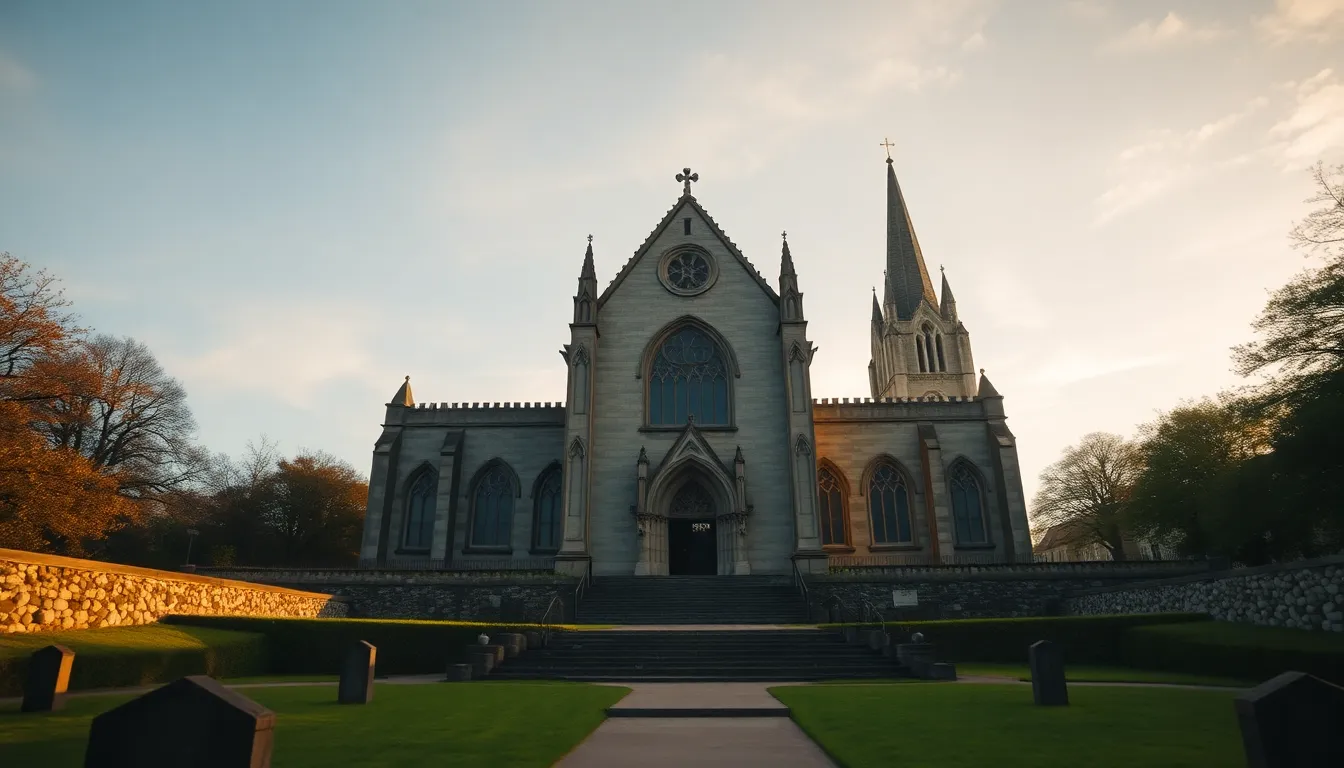
Standing at Patrick’s Grave
There is a large slab of Mourne granite in the churchyard at Downpatrick, set into the grass on the hill below the cathedral, carved simply with the name PATRIC. The first time I brought a group to stand beside it, an older pastor in the party took off his hat without being asked. That gesture says more than I could about what this place means. Down Cathedral sits on the hill of Down in County Down, Northern Ireland, and the tradition holds that beneath this slab lie the bones of Saint Patrick himself, the man who carried the Gospel to Ireland in the fifth century.
I am always careful to tell groups what is tradition and what is certain here, because the honesty matters and the story is strong enough without exaggeration. We cannot prove that Patrick lies under that stone. What we can say is that Downpatrick has been associated with his burial for many centuries, that it sits at the heart of the landscape where Patrick worked, and that to stand here is to stand at the center of how Ireland has remembered its apostle. For a Christian group, that is reason enough to come.
The Tradition of Patrick’s Burial
Patrick died around the year 461, and the early accounts place his burial at Saul or Downpatrick, in the part of Ireland where his mission began. The tradition that grew up held that three of Ireland’s greatest saints, Patrick, Brigid, and Columba, were all buried together on the hill of Down. A medieval Latin verse captured it, and the belief drew pilgrims here through the Middle Ages, making Downpatrick one of the principal places of pilgrimage in Ireland.
The great granite slab over the grave is not ancient. It was placed in 1900 to mark the traditional spot and to protect it, after generations of pilgrims had worn the ground away and carried off soil as relics. The stone is plain and heavy, fitting for a saint who, in his own writing, called himself a sinner and the most unlearned of men. That humility, preserved in Patrick’s own surviving Confession, is part of why his story still moves people who visit.
Saul and the Wider Patrick Landscape
Downpatrick does not stand alone. A short distance away is Saul, where tradition says Patrick founded his first church in Ireland in a barn given to him by a local chieftain, and where he is said to have died. Nearby is Struell Wells, a set of holy wells long associated with Patrick, and the great statue of the saint on Slieve Patrick. Together these form a compact landscape of sites within easy reach of one another, which makes the area especially rewarding for a group with a day to give it.
Down Cathedral Itself
The cathedral that crowns the hill is worth time in its own right. The Cathedral Church of the Holy and Undivided Trinity, to give its full name, belongs to the Church of Ireland. There has been a church on this hill since early Christian times, with a monastery and later a Benedictine abbey occupying the site through the Middle Ages. The building suffered destruction and neglect over the centuries, including damage during the turbulent medieval and Reformation periods, and the cathedral seen today was largely restored and rebuilt by the early nineteenth century.
Inside, the cathedral repays a slow walk. There is a fine eighteenth-century organ, box pews of a kind rare elsewhere, and the quiet dignity of a working cathedral that has held worship on this hilltop for well over a thousand years. From the churchyard, the views across the County Down countryside open out toward the very lands where Patrick traveled. For a group, the combination of the grave, the cathedral, and the surrounding Patrician sites gives a fuller encounter with the saint than almost anywhere else on the island.
What a Group Takes From Downpatrick
Patrick is one of the most recognized saints in the world, yet most people know him only through legend, the shamrock, the snakes, the parades. Downpatrick strips that away and returns the group to the real man, a Roman Briton carried to Ireland as a slave, who escaped, returned as a missionary, and gave his life to a people who had once enslaved him. Standing at his traditional grave, with his own words from the Confession read aloud, a group meets a Patrick far more powerful than the legend.
This site pairs naturally with the wider Patrician story across Northern Ireland. Most groups combine Downpatrick with our coverage of Saint Patrick and Armagh, the hill that Patrick made the ecclesiastical center of Ireland, and with the early Celtic sites we trace in our guide to hidden heritage sites. Read together, Armagh and Downpatrick frame the beginning and the end of Patrick’s mission, the seat of his church and the place of his rest.
How Groups Visit Down Cathedral
Downpatrick is well set up for a group, which is a relief after some of the remoter sites in this part of the world. The town sits about an hour south of Belfast, on good roads, with parking that can take a coach. The cathedral is open to visitors through the week, with the grave in the churchyard accessible at any reasonable hour. The Saint Patrick Centre in the town below offers an exhibition on Patrick’s life that works well as an orientation before walking up the hill, especially for a group that wants the historical grounding before the visit.
Practical Access
The cathedral and churchyard are reached by a short walk up the hill, on paths that most visitors manage comfortably, though the slope should be noted for any group members with limited mobility. There is no charge to visit the cathedral or the grave, and the cathedral welcomes groups for quiet visits and, with advance arrangement, for a short service or moment of worship. Because Saul, Struell Wells, and Slieve Patrick lie close by, a half day or full day allows a group to take in the whole landscape without rushing. As always, a little advance contact with the cathedral smooths the visit and ensures the building is open and welcoming when the group arrives.
FAQ: Visiting Down Cathedral and Saint Patrick’s Grave
Is Saint Patrick really buried at Down Cathedral?
Tradition has long held that Patrick is buried on the hill of Down, and the site has drawn pilgrims for centuries. We cannot prove it archaeologically, and I am always clear with groups about that. What is certain is that Downpatrick sits at the heart of the landscape where Patrick worked and that it has been honored as his resting place since the Middle Ages. The granite slab marking the grave was placed in 1900.
What else can a group see near the grave?
Plenty within a short distance. Saul, where Patrick is said to have founded his first church and to have died, lies just outside the town. Struell Wells, a set of holy wells linked to Patrick, and the towering statue on Slieve Patrick are both nearby. The Saint Patrick Centre in Downpatrick offers an exhibition on his life. Together these make a rich half day or full day around the saint.
Is Down Cathedral easy for a group to reach?
Yes. Downpatrick is about an hour south of Belfast on good roads, with coach parking available. The cathedral and the churchyard are reached by a short uphill walk that most visitors manage comfortably, though the slope is worth noting for anyone with limited mobility. The cathedral is open through the week, and there is no charge to visit.
Can a group hold a short service at the cathedral?
In many cases, yes, with advance arrangement. Down Cathedral is a working Church of Ireland cathedral and welcomes respectful group visits. A short act of worship or a reading at the grave, perhaps from Patrick’s own Confession, can be deeply meaningful. We make these arrangements ahead of time so the building is open and prepared when the group arrives.
How does Downpatrick fit with Armagh in a tour?
The two belong together. Armagh was the ecclesiastical center Patrick established and still holds two cathedrals bearing his name. Downpatrick holds his traditional grave. Visiting both frames the whole arc of his mission, from the seat of his church to the place of his rest. We routinely build itineraries that take in both within a Northern Ireland heritage journey.
If the Patrick story matters to your group, I would be glad to help you plan it. Heritage Tours builds every itinerary around your community, and with 15 or more participants, the group leader travels free. Begin with our spiritual sites of the United Kingdom, our United Kingdom heritage destination, and our group heritage tours. When you are ready, contact us and we will shape the journey together.