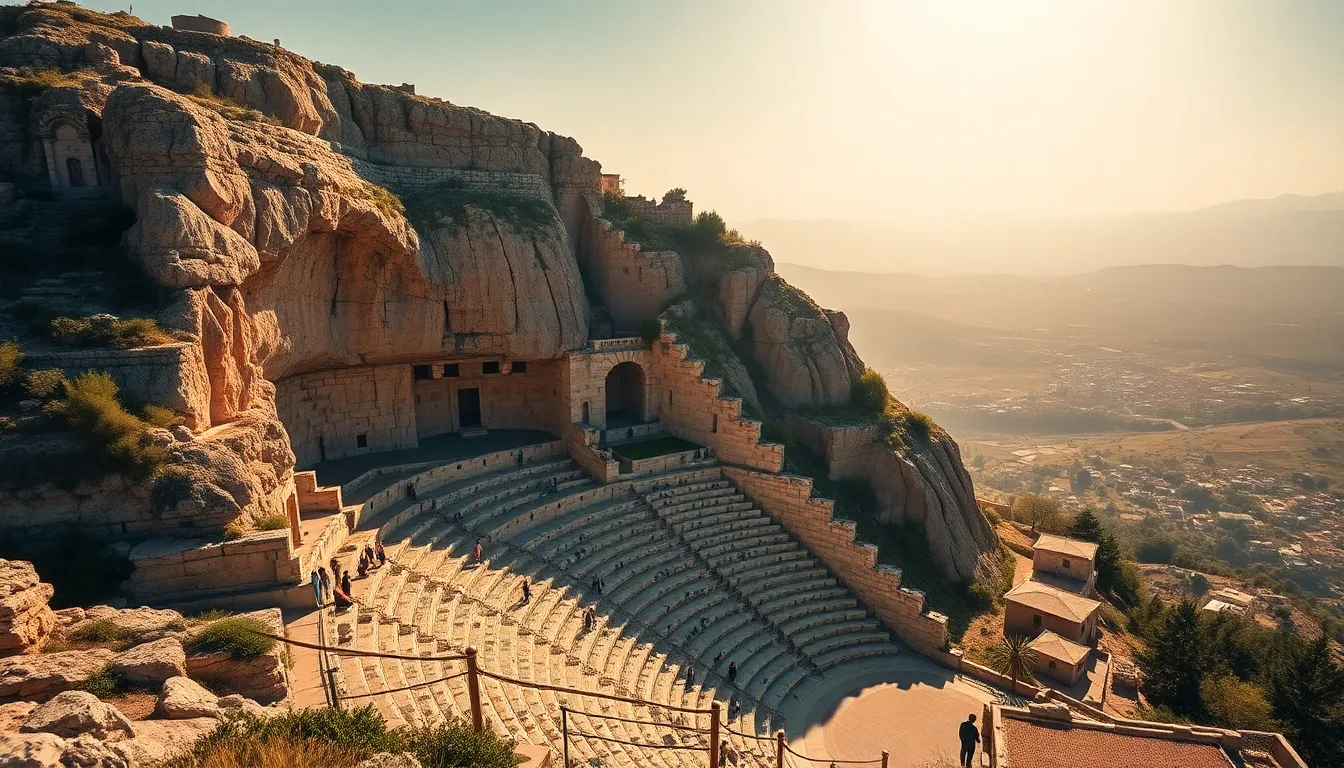
I always read Revelation 2 to my groups before we climb the acropolis at Pergamon, the part where the risen Christ says, “I know where you live, where Satan has his throne.” Then we go up. And when people stand at the top, looking out over the plain with the steep theater dropping away beneath them and the foundations of the great altar at their feet, that line stops being strange and starts being concrete. This was a real city, with real power, and the early Christians here held their faith under real pressure. Pergamon is one of the seven churches of Revelation, and standing in it changes how people read the book.
Pergamon, with the modern town of Bergama at its foot, sits in western Turkey not far inland from the Aegean coast. It is one of the most spectacular ancient sites in the country and one of the most important for a Christian heritage group, yet it gets less attention than Ephesus. Let me show you why it deserves a full place on your itinerary.
Pergamon: One of the Seven Churches of Revelation
In the book of Revelation, John writes letters to seven churches in Asia, and Pergamon is the third. The message to Pergamon is striking. Christ commends the believers for holding fast to his name even where “Satan has his throne,” a phrase scholars connect to the city’s dominant pagan worship, including the great altar of Zeus and the imperial cult that demanded emperor worship.
That is what makes Pergamon so vivid for a group. The pressures the letter describes were not abstract. This was a center of pagan religion and Roman power, a city where refusing to worship the emperor could cost you everything. The believers here lived their faith surrounded by all of it. When your group reads the letter on the acropolis, with the evidence of that pagan grandeur all around, the courage of the early church becomes tangible.
I treat Pergamon as a companion to the other churches of Revelation. Many groups trace several of the seven on a western Turkey route, and Pergamon is among the most powerful because the setting so clearly matches the words.
The Acropolis
The acropolis of Pergamon is one of the great sights of the ancient world. It rises steeply above the plain, and you reach the top by a cable car that gives your group a dramatic approach. At the summit sit the remains of the upper city: the temple of Trajan with its re-erected white columns, the foundations of the temples and palaces, and the famous library that once held two hundred thousand scrolls, second only to Alexandria.
The most dramatic feature is the theater, carved into the steep hillside at a breathtaking angle, one of the steepest in the ancient world. Standing at the top and looking down its sweep to the plain below is something people never forget.
The foundation of the great altar, often called the altar of Zeus, is here too, though the reconstructed altar itself was removed to a museum in Berlin long ago. Many connect this altar to the “throne of Satan” image in Revelation. Standing on its foundation, your group feels the weight of what the letter was describing.
There is also the matter of Antipas, named in the letter to Pergamon as a faithful witness who was killed in the city. Christ calls him “my faithful witness, who was put to death in your city, where Satan lives.” We do not know the details of his death, but the letter holds him up as proof that faithfulness here carried a real cost. I pause on Antipas with groups, because he puts a name and a life to the pressure the letter describes. The believers of Pergamon were not facing an idea. They were facing a power that had already taken one of their own.
The Asklepion: The Ancient Healing Center
At the foot of the acropolis lies the Asklepion, one of the most famous healing centers of the ancient world, dedicated to Asklepios, the god of medicine. People came from across the Roman world seeking cures here. The site has a sacred spring, treatment rooms, a small theater, and a long colonnaded walkway.
For a group, the Asklepion adds a fascinating dimension. This was where ancient medicine and pagan religion met, where healing was sought through dreams, water, and ritual. Galen, one of the most important physicians of the ancient world, trained and worked here. Walking the Asklepion gives your people a window into the world the early Christians lived in, a world that looked to gods like Asklepios for healing while the new faith offered something different. The contrast deepens the reading of Revelation.
Bergama: The Living Town
The modern town of Bergama sits at the base of the ancient city, and it is a pleasant Turkish market town worth a little time. The Red Basilica, the Kizil Avlu, is the major site in the lower town. It was built as a massive Roman temple, likely to Egyptian gods, and later converted into a Christian basilica. Some traditions associate it with the church of Pergamon mentioned in Revelation. Its enormous brick walls still tower over the surrounding streets.
Bergama also has a good archaeological museum, a covered bazaar, and the ordinary rhythms of a Turkish town. I encourage groups to spend a little time at street level here, not just on the acropolis. It grounds the ancient story in a living place.
Practical Orientation for Group Leaders
Here is how I plan Pergamon and Bergama for a group.
Getting There
Bergama lies inland from the Aegean coast, reachable by road from Izmir in about two hours. Most groups visit Pergamon as part of an Aegean route that includes Ephesus and other coastal sites, with Izmir as the regional hub.
How Much Time
A full day covers the acropolis, the Asklepion, and the Red Basilica comfortably, with time to read the Revelation passages on site. The cable car up to the acropolis saves the climb, but there is still substantial walking on uneven ancient ground at the top, so plan the pace for your group.
Combining With Other Sites
Pergamon fits best on a western Turkey itinerary tracing the early church and the churches of Revelation. It connects naturally with Ephesus and the Aegean sites, and a fuller route can reach inland toward Konya and Paul’s missionary cities. Our Turkey heritage travel guide shows how the Aegean and inland regions link together.
Walking and Footing
The acropolis is steep and the stone is uneven. For older group members, this is a place to take it slow, use the cable car, and choose viewpoints carefully. I make sure no one is left out of the meaningful moments, even where the footing is hard.
FAQ: Heritage Travel to Pergamon
Is Pergamon one of the seven churches of Revelation?
Yes. Pergamon is the third of the seven churches addressed in Revelation 2 and 3. The letter to Pergamon speaks of the church living where “Satan has his throne,” a phrase often connected to the city’s great altar and its role as a center of pagan and imperial worship. Reading the letter on the acropolis makes its meaning vivid.
What is the Asklepion and why visit it?
The Asklepion was a famous ancient healing center dedicated to Asklepios, the god of medicine, where people sought cures through sacred water, dreams, and ritual. The great physician Galen worked here. For a faith group, it offers a window into the pagan religious world the early Christians lived within, deepening the contrast that Revelation describes.
How does Pergamon compare to Ephesus?
Ephesus is larger and more famous, but Pergamon is more dramatic in its setting, with a steep acropolis, one of the ancient world’s steepest theaters, and a clear connection to Revelation. Many groups visit both on an Aegean route. I find Pergamon often surprises people who expected Ephesus to be the high point.
How much walking is involved at Pergamon?
The acropolis is steep, though a cable car carries you up. At the top there is significant walking on uneven ancient ground, and the Asklepion below adds more. We plan the pace around your group and make sure older members can take part in the key moments without overexertion.
Do group leaders travel free to Pergamon with Heritage Tours?
Yes. With 15 or more participants, the group leader travels free on all Heritage Tours itineraries in Turkey, including Aegean programs that combine Pergamon, Ephesus, and the churches of Revelation. This is our standard practice, so the spiritual leader can focus on guiding the group.
If you are tracing the early church or the seven churches of Revelation, Pergamon gives your group a setting where the words of scripture and the stones underfoot line up exactly. It is one of the most powerful stops in western Turkey. You can see how we shape these trips on our Turkey heritage page or learn how the group experience works on our group heritage tours page.
Contact us whenever you are ready to start planning.