The Ottoman Welcome: Why Sultan Bayezid II Said Yes
In 1492, Ferdinand and Isabella signed the Alhambra Decree, ordering the expulsion of all Jews from Spain. Families who had built communities on the Iberian Peninsula for over a thousand years were given four months to leave. They could take almost nothing.
This story is well known. What comes next is not known nearly well enough.
Sultan Bayezid II of the Ottoman Empire did not merely allow the expelled Jews to enter his lands. He actively welcomed them. Ships were sent to Spanish ports. Communities were offered settlement in Istanbul, Thessaloniki, Izmir, and across the empire. According to one widely cited account, Bayezid said of Ferdinand: “You call this king wise? He is impoverishing his country and enriching mine.”
Whether those are his exact words matters less than what actually happened. Tens of thousands of Sephardic Jews arrived in Ottoman lands and were given the freedom to practice their faith, establish businesses, build synagogues, and educate their children. It was one of the most consequential acts of refuge in recorded history.
If you have already read our post on Jewish heritage in Spain, you know the first half of this story. This is the second half. This is where the expelled community landed, and what it built over five centuries.
Five Centuries of Sephardic Life in Istanbul
The Sephardic Jews who settled in Istanbul did not simply survive. They became central to the city’s economic and cultural life. They established printing presses (the first in the Ottoman Empire), traded across the Mediterranean, served as physicians and diplomats, and maintained a distinct identity rooted in the Spain they had lost.
The most remarkable marker of that identity was language. For five hundred years, Sephardic Jews in Istanbul continued speaking Ladino, a form of medieval Spanish mixed with Hebrew, Turkish, and other influences. Ladino newspapers were published in Istanbul into the 20th century. Songs, proverbs, and stories passed through generations in a language that carried the sound of 15th-century Castile.
Today, Ladino is critically endangered. Only a few thousand native speakers remain, most of them elderly. But the fact that it survived at all, carried across the Mediterranean by exiled families and maintained for half a millennium in a Turkish-speaking empire, tells you something about the depth of the community that held it.
For a rabbi bringing a congregation to Istanbul, this is not background reading. This is the story you are stepping into.
Neve Shalom Synagogue: The Heart of Istanbul’s Jewish Community
Neve Shalom, in the Beyoglu district of Istanbul, is the largest synagogue in the city and the spiritual center of Turkey’s remaining Jewish community. Built in 1951 on the site of an older synagogue, it serves as the main house of worship for Istanbul’s approximately 15,000 Jews.
The name means “Oasis of Peace,” and its history has tested that name severely. Neve Shalom was the target of a devastating attack in 1986 and was struck again in 2003. Each time, the community rebuilt and continued. That persistence is part of what you encounter when you visit.
The interior is elegant and spacious, with a high ceiling and stained glass that fills the sanctuary with colored light. Services still follow the Sephardic rite. For a visiting Jewish group, attending or observing a service at Neve Shalom connects the abstract history of Ottoman welcome to a living, breathing community that never left.
Heritage Tours coordinates access to Neve Shalom through Istanbul’s Jewish community organizations. Visits require advance arrangement, and we handle that as part of every Jewish heritage itinerary in Turkey.
Balat: Walking Through Five Centuries of Jewish Istanbul
Balat sits along the Golden Horn, about twenty minutes from the tourist center of Sultanahmet. For centuries, it was the primary Jewish neighborhood of Istanbul. When the Sephardic families arrived from Spain, many settled here, joining a smaller existing Jewish community.
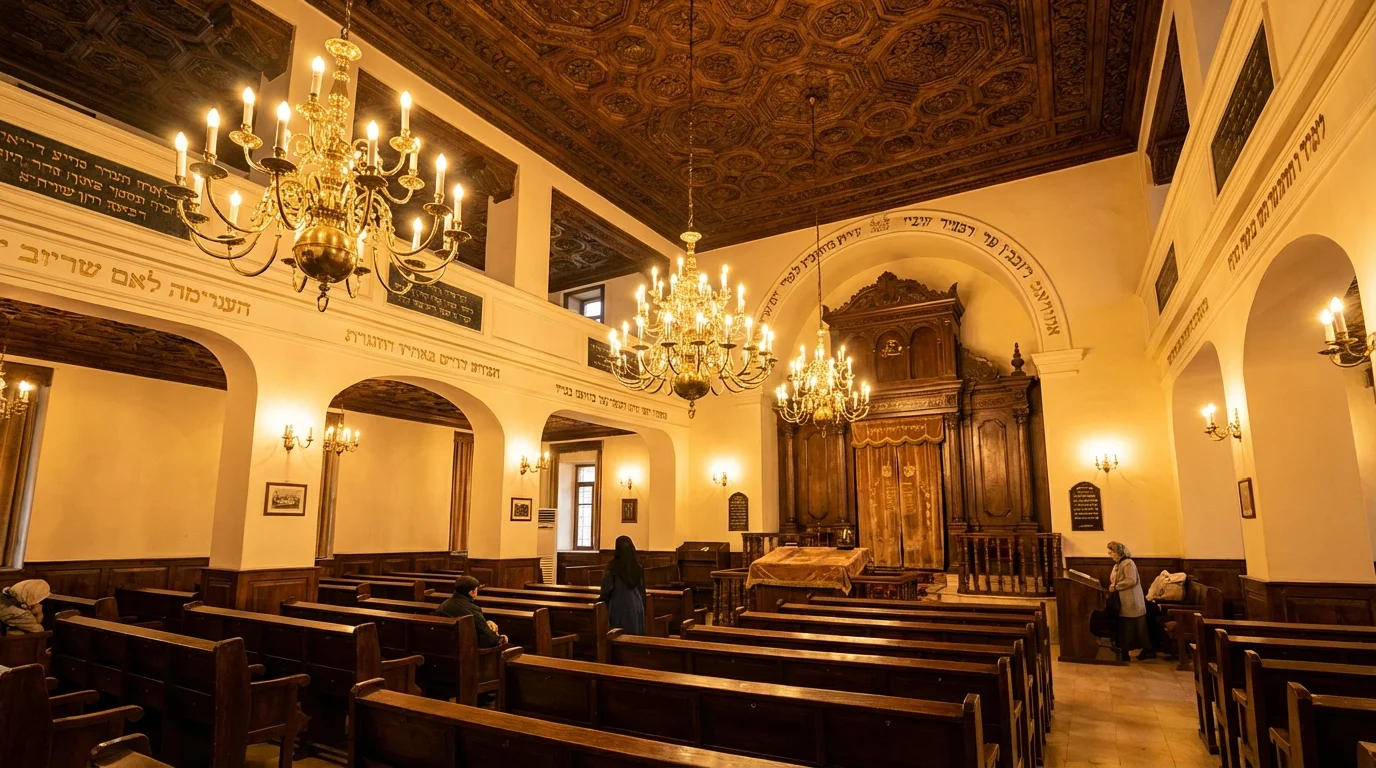
Walking through Balat today, you pass colorful Ottoman-era houses, narrow streets climbing the hillside, and, if you know where to look, the traces of Jewish life that defined this neighborhood for generations. The Ahrida Synagogue, believed to date from the mid-15th century, is still active. Its bimah is shaped like a ship, a design said to honor the vessels that brought the exiles to safety.
Balat has changed, of course. Most of Istanbul’s Jewish population has moved to other neighborhoods. Young artists and entrepreneurs have moved in, and the area has a new energy. But the bones are still there. The streets still follow the lines they followed when Ladino was the language of daily life.
For a group, Balat works best with a guide who can read the neighborhood, who can point to a doorway and explain what was there before the cafe. That is part of what Heritage Tours provides: not just access to the site, but context that makes it land.
The Great Synagogue of Edirne: Recently Restored, Rarely Visited
Edirne, in Turkey’s far northwest, near the borders with Greece and Bulgaria, was once home to a significant Sephardic community. The Great Synagogue, completed in 1909, was one of the largest in Europe. Its design was inspired by Vienna’s Leopoldstadter Tempel, with a grand dome and ornate interior.
As the Jewish population of Edirne declined through the 20th century, the synagogue fell into severe disrepair. The roof eventually collapsed. For decades, the building sat open to the elements, a monument to what had been lost.
The restoration, led by a collaboration between the Turkish government and international Jewish organizations, took nearly twenty years. When the synagogue reopened in 2015, it was fully restored: the dome repaired, the interior repainted, the original ark preserved.
What makes Edirne remarkable for a visiting group is the quiet. This is not a tourist destination. On most days, your congregation will have the synagogue to yourselves. The scale of the building, built for a community of thousands, and the silence of a room that now serves a handful of visitors, tells its own story about what time does to communities and what restoration means.
Izmir’s Jewish Legacy: A Community That Shaped a City
Izmir, on the Aegean coast, had perhaps the most integrated Jewish community in the Ottoman Empire. At its height, Jews made up such a large portion of Izmir’s merchant class that the city’s commercial life slowed noticeably on Shabbat and Jewish holidays.
The Kemeralt bazaar district still holds synagogues from this era. Bikur Holim and Shalom synagogue sit between market streets, modest from the outside, significant from within. The old Jewish quarter, though transformed, carries traces of the community that built Izmir’s reputation as one of the most cosmopolitan cities in the eastern Mediterranean.
Izmir is easy to pair with Ephesus, which is only about an hour south. For a group that is already spending time on the Aegean coast, a morning exploring Izmir’s Sephardic roots adds a dimension that Ephesus alone cannot provide.
What This History Means for a Group Visit Today
Turkey’s Jewish heritage is not a museum exhibit. It is a living story with a beginning in 1492 Spain, five centuries of community in Ottoman and then Turkish lands, and a present that is smaller but still real.
For a rabbi considering Turkey for a congregational journey, the question is not whether the history is there. It is. The question is how to present it in a way that lets your community feel it. That means the right sequence of sites, the right pacing, the right moments of silence, and the context that connects what your group sees to the larger arc of Sephardic history.
This is what I have been helping group leaders plan for over twenty years. Every community has its own connection to this story, and every itinerary should reflect that. If Turkey’s Jewish heritage speaks to what your congregation is looking for, I would welcome the chance to plan it together. Start with our Turkey destination page.
FAQ: Jewish Heritage Travel to Turkey
Why did Sephardic Jews settle in Turkey? When Spain expelled its Jewish population in 1492, Sultan Bayezid II of the Ottoman Empire actively welcomed them. Ships were sent to Spanish ports, and communities were offered settlement across Ottoman lands, including Istanbul, Izmir, and Thessaloniki. The Ottoman policy of religious tolerance made the empire one of the safest places in the world for Jewish life at that time.
What are the most important Jewish sites in Istanbul? Neve Shalom Synagogue (the main synagogue of Istanbul’s Jewish community), the Ahrida Synagogue in Balat (dating to the 15th century, with its ship-shaped bimah), and the Balat neighborhood itself, where Sephardic families settled after 1492. The Jewish Museum of Turkey, housed in the former Zulfaris Synagogue, also provides essential context.
Is Neve Shalom Synagogue open to group visits? Yes, but visits must be arranged in advance through Istanbul’s Jewish community organizations. Heritage Tours coordinates this access as part of Jewish heritage itineraries, ensuring your group can visit during appropriate hours with proper arrangements.
What happened to the Sephardic community in Turkey over five centuries? The community thrived for centuries, maintaining Ladino (Judeo-Spanish), building synagogues, and contributing to Ottoman commerce and culture. The population declined through the 20th century due to emigration (particularly to Israel after 1948) and economic shifts. Today, approximately 15,000 Jews live in Turkey, mostly in Istanbul, maintaining active synagogues and community institutions.
How does Turkey’s Jewish heritage connect to Spain’s 1492 expulsion? Turkey’s Sephardic community exists because of Spain’s expulsion. The families who settled in Istanbul, Izmir, and elsewhere were the same families expelled from Toledo, Cordoba, and Seville. They carried their language (Ladino), their customs, and their liturgical traditions across the Mediterranean. A heritage journey that includes both Spain and Turkey follows the complete arc of this story, from expulsion to welcome to five centuries of community.