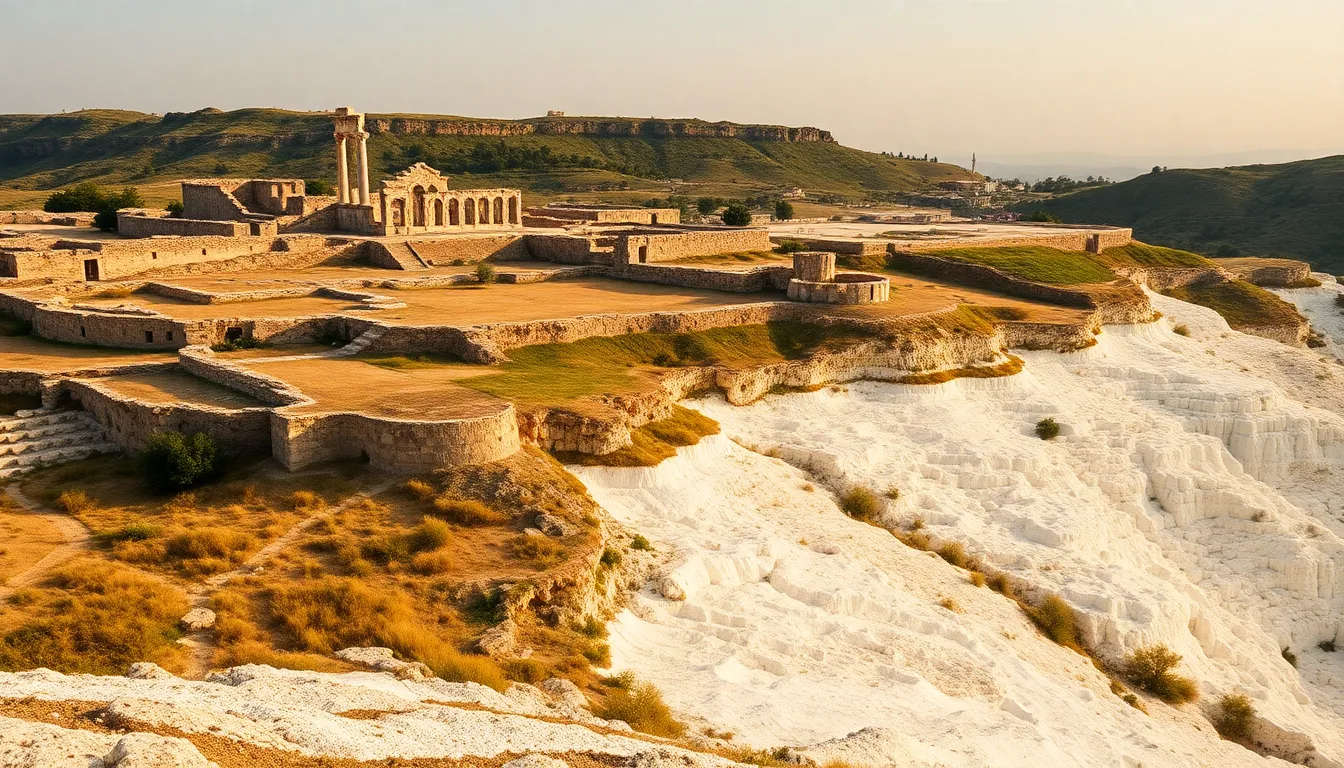
Most groups come to Pamukkale for the white terraces, those famous cascading pools of mineral water that look like frozen waterfalls on the hillside. They are stunning, and worth seeing. But I tell my groups before we ever arrive that the terraces are not why we are really here. We climb above them to the ruins of Hierapolis, and near the top of that ancient city we reach the place where the Apostle Philip was martyred and buried. That is the reason a faith group makes this stop, and it is one that surprisingly few standard tours teach well.
Hierapolis is a place where natural wonder and apostolic history sit one on top of the other. Let me explain what is here and how a group takes it in.
The City Above the Terraces
Hierapolis was a Greco-Roman spa city, founded in the second century BC and famous in the ancient world for its hot mineral springs. The same waters that built the dazzling white travertine terraces of Pamukkale below drew the sick and the wealthy here for healing and rest. The city grew prosperous, and you can read that prosperity in the ruins today.
The site is large and impressive. There is a grand theater, beautifully preserved, cut into the hillside. There is a long colonnaded main street, the remains of monumental gates, the sacred pool where you can still swim among fallen ancient columns, and one of the most extensive ancient cemeteries, or necropolis, in the world, with hundreds of tombs lining the approaches to the city. People came here to be healed, and many came here to die in a place they considered blessed.
For a faith group, this prosperous, pagan spa city is the backdrop. Hierapolis was named in the New Testament. In Colossians 4:13, Paul commends a man named Epaphras for his hard work on behalf of the believers in Laodicea, Hierapolis, and Colossae, three cities clustered together in this valley. So there was a Christian community here in apostolic times, and tradition ties one of the Twelve directly to it.
The Apostle Philip
Philip was one of the twelve apostles, the man who in John’s Gospel brought Nathanael to Jesus with the words “Come and see,” and who Jesus tested before feeding the five thousand. Early Christian tradition holds that Philip preached the gospel in this region in his later years and was martyred at Hierapolis, crucified or stoned, around the late first century. His daughters, also remembered in early sources, are associated with the city as well.
For centuries Philip’s tomb was venerated here, and a great octagonal building known as the Martyrion of Philip was raised on the hill above the city in the fifth century to honor him. Pilgrims came from across the Christian world. Then in 2011, an Italian archaeological team made a discovery that drew worldwide attention. Excavating near the Martyrion, they uncovered a first-century Roman tomb that the lead archaeologist identified as the original burial place of Philip, with a church built around it. The find gave fresh weight to a tradition that had stood for nearly two thousand years.
I am honest with my groups about what this is. The identification of the tomb is a strong, serious scholarly claim, not a closed case, and I say so. But standing at the Martyrion on the hill, at the site where the church has remembered Philip’s martyrdom since antiquity, with a first-century tomb uncovered close by, the weight of that long memory is real. Here is one of the Twelve, an apostle who walked with Jesus, who gave his life for the gospel far from home, on this very hillside.
How Groups Visit Hierapolis
The site is spread out across the hilltop above Pamukkale, so a group should plan a relaxed half day to take it in well. The walking is the thing to plan around. From the terraces below to the Martyrion of Philip up the hill is a real climb across a large ancient site, much of it on uneven ground and stone.
Here is the rhythm I use. We usually enter at the upper gate to keep the walking manageable, take in the theater and the main street, and make our way to the Martyrion and the tomb area, where we gather to read from John’s Gospel and remember Philip. Then we descend gradually toward the travertine terraces, where the group can walk barefoot in the warm mineral water as the path requires. Ending at the terraces gives a natural, restful close to a meaningful day.
For travelers who are unsteady on their feet, the full climb to the Martyrion can be demanding, and the necropolis and upper city involve a good deal of ground. We arrange the route, the entry point, and the pace so that everyone shares in the apostolic moment that matters, and no one is pushed beyond what they can manage.
Hierapolis in the Wider Circuit
Hierapolis sits in the Lycus valley alongside Laodicea, one of the seven churches of Revelation, just a short drive away, and Colossae, named in Paul’s letter. Many groups visit Hierapolis and Laodicea together in a single rich day in this valley. It also fits the broader western Turkey route that follows Paul and John’s footsteps. For how these sites connect, see our overview of spiritual sites across Turkey, and for a nearby Revelation stop we cover the Asklepion of Pergamon.
For 15 or more travelers we arrange a guide who knows the apostolic history and the recent Philip excavations, and we coordinate Hierapolis with Laodicea and the wider circuit so the route flows in order. We plan the pace around the people you bring.
FAQ: Visiting Hierapolis and the Tomb of Philip
Is Hierapolis the same place as Pamukkale?
They are the same site on two levels. Pamukkale refers to the famous white travertine terraces formed by mineral springs on the hillside. Hierapolis is the ancient Greco-Roman city built above those terraces. A visit takes in both, with the apostolic history found in the upper city.
Was the Apostle Philip really martyred and buried at Hierapolis?
Early Christian tradition holds that Philip, one of the twelve apostles, preached in this region and was martyred at Hierapolis in the late first century. A fifth-century Martyrion was built to honor him on the hill. In 2011, archaeologists uncovered a first-century tomb nearby that the team identified as his original burial place, giving fresh weight to a long tradition.
Is Hierapolis mentioned in the Bible?
Yes. Paul names Hierapolis in Colossians 4:13, commending Epaphras for his work among the believers in Laodicea, Hierapolis, and Colossae. There was a Christian community here in apostolic times, and the city sat in the same valley as Laodicea, one of the seven churches of Revelation.
How much walking is involved?
A fair amount. The site is large and spread across a hilltop, and the climb to the Martyrion of Philip crosses uneven ancient ground. We choose the entry point and route to keep it manageable, and we adjust the pace so anyone unsteady on their feet can still share in the key moments.
What else does a group see at the site?
A well-preserved theater, a colonnaded main street, monumental gates, one of the largest ancient necropolises in the world, and the sacred pool where you can swim among fallen columns. Most groups end at the travertine terraces, walking barefoot in the warm mineral water.
Hierapolis joins natural wonder and apostolic history in a way few places do, and the tomb of Philip is the heart of it for a faith group. If you want to build this valley into a heritage journey for your congregation, I would be glad to help. You can see how we structure these trips on our Turkey heritage page or explore our group heritage tours.
Contact us whenever you are ready to start the conversation.