When I tell a group we are going to Harran, most have never heard the name, and then I open a Bible to Genesis and read it to them, and the room shifts. This is the place where Abraham’s family settled on the way out of Ur, where Terah his father died, and where God’s call to Abram was renewed. It is one of the oldest continuously inhabited spots on earth, down near the Syrian border in southeastern Turkey, and standing in it feels like standing at the headwaters of the whole biblical story.
Harran is off most tourist routes, which is exactly why it rewards a group that makes the effort. Let me tell you what it is, why it matters to faith travelers, and how groups visit it.
What Harran Is
Harran sits on a hot, flat plain in the Sanliurfa province of southeastern Turkey, part of ancient Mesopotamia. The name appears in the Bible as the place Abraham’s family came to from Ur, and it shows up in ancient records going back four thousand years and more. People have lived here, with few breaks, across that entire span.
For most of its long history, Harran was a major center for the worship of the moon god Sin, with a famous temple that drew pilgrims and rulers from across the ancient Near East. It later became an important city under the Assyrians, the Babylonians, the Romans, and the early Islamic caliphates, and it held one of the early world’s notable centers of learning. The ruins on site include the remains of what some consider one of the oldest mosques in Anatolia, an old fortress, and the eroded city mound that holds thousands of years of layered settlement.
What catches every visitor’s eye, though, are the beehive houses.
The Beehive Houses
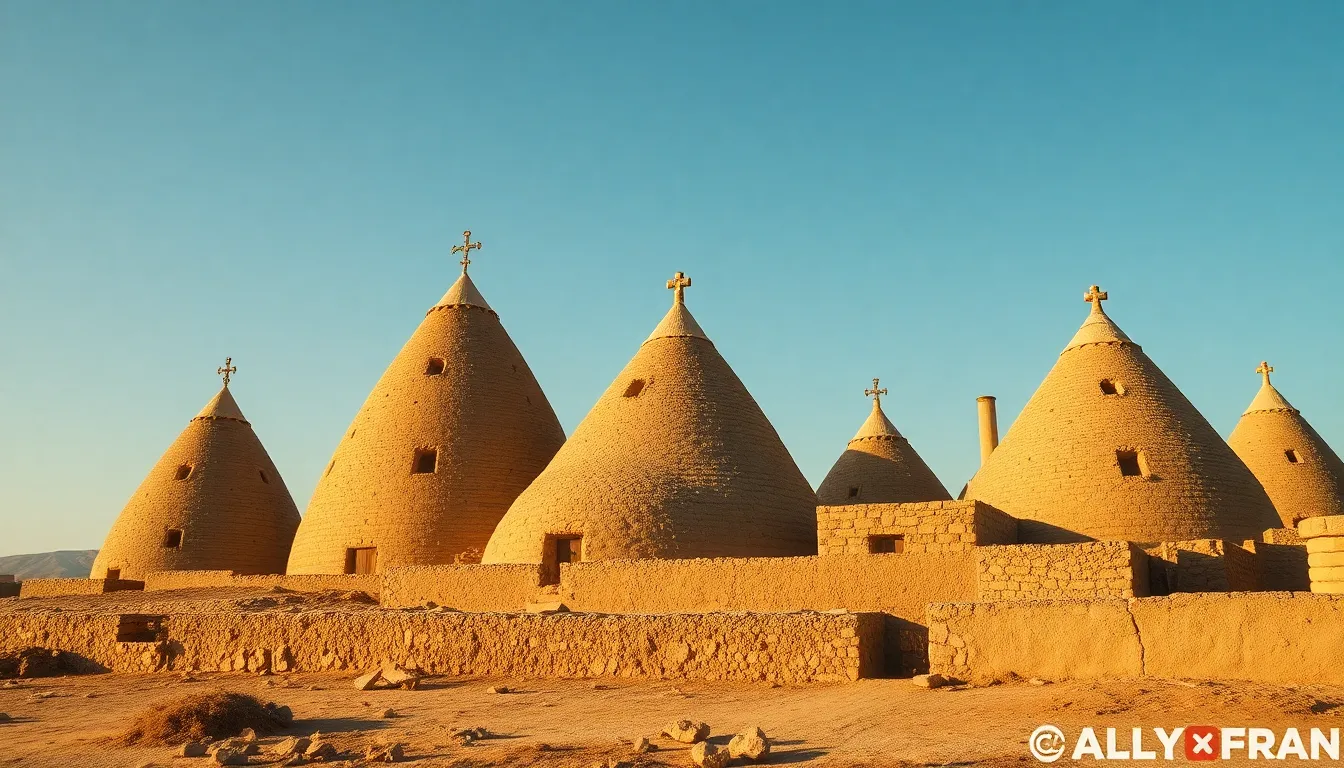
Harran is famous for its distinctive mud-brick homes, built in tall conical domes that look like clusters of beehives rising off the plain. They are made without wood, using only mud brick laid in tapering rings up to a point, a technique passed down for centuries and well suited to a treeless region with brutal summer heat.
The design is brilliantly practical. The thick mud walls and the high domes keep the interiors remarkably cool in a place where summer temperatures are punishing. Some of the houses are clustered together with shared walls, and a preserved group is open for visitors to step inside and feel the drop in temperature for themselves.
For a group, the beehive houses do something important. They make the ancient world tangible. It is one thing to read that Abraham lived as a herder in Mesopotamia, and another to stand inside a cool, domed mud-brick room that the region has been building, in much this form, since deep antiquity. The houses are not from Abraham’s time, but they connect a group to the land and its way of life in a vivid, physical way.
The Faith Significance for a Group
Harran’s weight for a faith group comes from Abraham. Genesis 11 tells how Terah took his son Abram, his grandson Lot, and his daughter-in-law Sarai out of Ur of the Chaldeans toward Canaan, and “they came to Harran and settled there.” Terah died in Harran. Then, in Genesis 12, the great call comes: “Go from your country and your kindred and your father’s house to the land that I will show you.” Abraham left Harran in obedience, and the whole story of the people of God flows from that departure.
Standing in Harran, a group stands at a hinge point of Scripture. This is where the patriarch waited, buried his father, and then stepped out in faith toward a land he had never seen. Reading Genesis 12 here, with the same plain stretching to the horizon, makes the call concrete in a way that stays with people. Abraham is the shared father of Jews, Christians, and Muslims, which gives Harran a reach across faith groups that few sites can match.
The region around Harran deepens the Abrahamic story. For the broader biblical landscape of the country, our overview of Turkey’s spiritual sites sets the context, and Harran pairs naturally with the deeper-history sites in our hidden heritage guide.
Sanliurfa and the Sites Around Harran
Harran is rarely visited alone, because it sits close to Sanliurfa, a city with its own deep Abrahamic tradition, and groups build a circuit that takes in both.
Sanliurfa, known as Urfa, holds a tradition that it was the birthplace of Abraham, with a cave revered as his birthplace and a beautiful complex of pools and mosques around it. The Pool of Sacred Fish there, fed by a spring, is tied to a legend of Abraham, and the whole site is a place of genuine pilgrimage for Muslim visitors, peaceful and moving to walk through.
Nearby is one of the most astonishing archaeological discoveries of our age, Gobekli Tepe, a temple complex carved with massive stone pillars some eleven thousand years ago, older than Stonehenge and the pyramids by millennia. It reframes how a group thinks about the antiquity of organized religion. Together, Harran, Urfa, and Gobekli Tepe make southeastern Turkey one of the most profound regions for a faith group willing to travel for it.
How Groups Visit Harran
Here is how I run a Harran day.
We base in Sanliurfa and drive out to Harran, about an hour away across the plain. The heat is the planning constraint, so in summer we go early or late and avoid the worst of the midday sun. At the site, we walk the ruins, the old mound and fortress, and then spend time at the preserved beehive houses, stepping inside to feel the cool.
The reflection happens out on the plain or near the ruins, where we read Genesis 11 and 12, the settling, the death of Terah, and the call of Abraham. This is the heart of the visit, and I keep it unhurried. For a group of fifteen or more, an early start and shaded rest stops make the heat manageable, and pairing Harran with Sanliurfa gives the day a full, balanced shape.
A Practical Word on Access
The honest planning point is heat and distance. Harran is in the far southeast of Turkey, reached by a domestic flight to Sanliurfa and a drive across the plain, and the summers are genuinely hot. This is a committed destination for groups that want the deep Abrahamic roots of the journey, not a casual stop.
The site itself is gentle to walk, mostly flat with the beehive houses and ruins close together, which makes it open to a mixed-age group as long as the timing avoids midday heat. Hats, water, and an early start are essential in the warm months. We handle the flights, the drives from Sanliurfa, and the timing, and we build in shade and rest so your people can focus on the place rather than the temperature.
FAQ: Visiting Harran
Why is Harran important in the Bible?
Harran is where Abraham’s family settled after leaving Ur, where his father Terah died, and where God renewed the call to Abraham to go to the land he would be shown. Genesis 11 and 12 place these events here. It stands at the very start of the story of the people of God.
What are the beehive houses of Harran?
They are distinctive mud-brick homes built in tall conical domes without wood, a technique used in the region for centuries. The thick walls and high domes keep the interiors cool in extreme summer heat. A preserved cluster is open for visitors to step inside, and they are the most recognizable feature of Harran.
Where is Harran and how do groups get there?
Harran is on a plain in southeastern Turkey near the Syrian border, about an hour’s drive from the city of Sanliurfa. Groups usually fly into Sanliurfa and drive out, basing in the city. It is a committed destination suited to a deeper Abrahamic-focused itinerary.
Can groups visit Harran together with Sanliurfa?
Yes, and most do. Sanliurfa holds a strong tradition as Abraham’s birthplace, with a revered cave and the Pool of Sacred Fish, and the extraordinary ancient temple of Gobekli Tepe is nearby. Together, Harran and Sanliurfa make a rich, balanced Abrahamic circuit in southeastern Turkey.
Is Harran meaningful for Jewish, Christian, and Muslim groups alike?
Yes. Abraham is the shared father of all three traditions, and Harran’s place in his story gives it a reach across faith groups that few sites can match. Reading Genesis 12 on the plain where Abraham received his call is moving for travelers of any of these backgrounds.
Harran offers the deepest biblical roots a Turkey journey can reach. If your congregation wants that, I would be glad to help you plan it well. You can see how we shape these trips on our Turkey heritage page or explore our group heritage tours.
Contact us whenever you are ready to start the conversation.