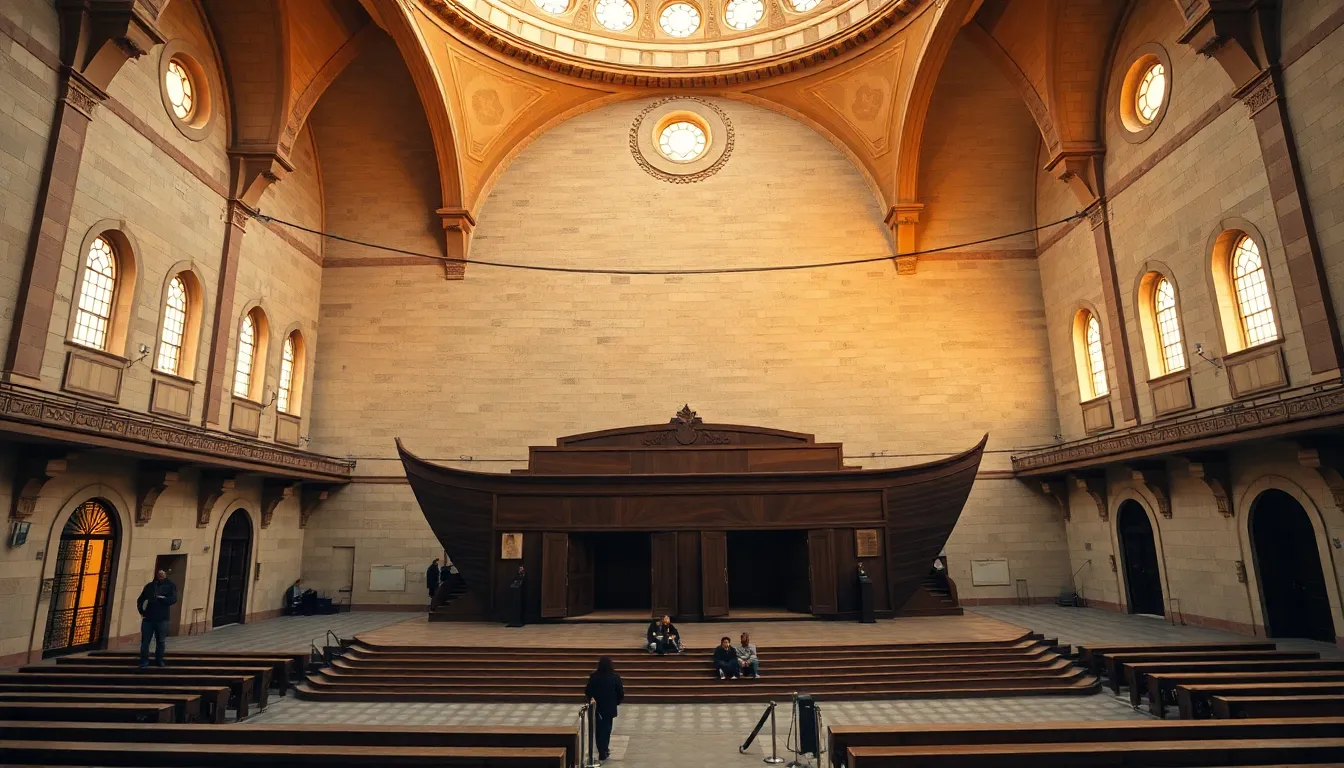
There is a moment in the Ahrida Synagogue that I wait for with every group. We file in, the room is dim and smaller than people expect, and then someone notices the bimah. It is not a plain raised platform. It curves. It comes to a point at one end like the prow of a boat, and once a person sees it, they cannot unsee it. A ship, sitting in the middle of a synagogue in a back street of Istanbul. Somebody always asks why, and that question is the door into five hundred years of history.
The Ahrida Synagogue is the oldest in Istanbul and one of the oldest in continuous use anywhere in the Jewish world. For a heritage group walking the Jewish quarters of Balat and Galata, it is the single building that anchors everything else. Let me tell you what your group will see, and why it matters.
Older Than the Ottoman Conquest
The Ahrida Synagogue was founded in the first half of the 15th century, before Mehmed II conquered Constantinople in 1453. That date is worth sitting with. This congregation was praying here while the city was still Byzantine, before it became Istanbul at all.
Its name comes from Ohrid, the town in what is now North Macedonia, the home of the Jews who founded it. They were Romaniote Jews, the Greek-speaking community that had lived in these lands since Roman times, with their own liturgy and customs distinct from anything in Western Europe. The Ahrida is, at its root, a Romaniote foundation, which makes it older and stranger and more layered than the Sephardic story most people come to Turkey for.
Then 1492 happened. The Sephardim arrived from Spain after the expulsion and the Ottoman welcome, and over the following generations the Sephardic rite and the Ladino language spread across Istanbul’s congregations, the Ahrida included. So this one room holds both stories: the Greek-speaking community that was already here, and the Spanish exiles who arrived and reshaped it. For a group, that overlay is the whole point. The Ahrida is not a single chapter. It is the seam where two chapters meet.
The Boat-Shaped Bimah
Now, the bimah. The reading platform at the center of the Ahrida is built in the shape of a ship’s prow, and it is the feature every visitor remembers.
There are a few explanations, and I give groups all of them rather than pretending there is one clean answer. The most beloved holds that the shape honors the ships that carried the Sephardic exiles out of Spain to safety in Ottoman lands, a memorial in wood to the vessels of rescue. Another reading connects it to Noah’s Ark, the vessel that carried life through catastrophe. A more sober historical view notes that the prow may also evoke the fleet of the Ottoman navy, under whose protection the community lived.
I do not tell a group which is true. I tell them all three and let the room do its work. Standing next to a wooden ship in the heart of an old synagogue, your people feel the meaning before they settle on the history. That is usually the right order.
What a Group Actually Sees Inside
The Ahrida you walk into today is not untouched. It was rebuilt and restored several times across the centuries, most significantly in the 17th century in the Ottoman Baroque style, and again in a careful restoration in the 1990s funded by the local Jewish community. So the bones are 15th century, but much of the decoration you see is later, and beautifully kept.
The interior is intimate. The ceiling, the ark, the curved bimah, and the seating wrap close around you, and the scale tells you this was a neighborhood synagogue, built for the families living on the steep streets just outside, not a grand monument meant to impress visitors. That intimacy is its strength. A group of fifteen or twenty fills the room, and the experience becomes communal in a way a vast hall never allows.
The Ahrida is still a working synagogue. It holds services, particularly on special occasions and for the surrounding community. Your group is a guest in a living house of prayer, not a tourist filing past a relic, and I find that visitors feel the difference and carry themselves accordingly.
Visiting the Ahrida With a Group
This is where the planning matters, so let me be plain about it. You cannot simply walk up to the Ahrida and go in. The active synagogues of Istanbul require visits to be arranged in advance through the city’s Jewish community organizations, with passport details submitted ahead of time, and security at the door is real and serious. The community has lived through attacks, and the precautions exist for good reason.
Heritage Tours handles every piece of that. We submit the paperwork, schedule the visit during permitted hours, and arrange a guide who can explain what your group is looking at, from the bimah to the ark to the inscriptions you would otherwise walk past. Your group arrives expected and welcomed, which is the only way this visit works.
A few practical notes. Balat is hilly, and the streets around the synagogue are steep and cobbled, so for older travelers I plan the approach carefully and build in time to rest. Modest dress is expected, as in any house of worship, and men should bring a head covering or use one provided at the door.
And for pastors and rabbis weighing the cost of a trip: with Heritage Tours, the group leader travels free when you bring fifteen or more. For a congregation, that is worth factoring in from the start.
Why This One Building Is Worth the Effort
There are larger synagogues in Istanbul and grander ones across Turkey. But the Ahrida holds something none of them do, which is time. To stand in a room where Jews have prayed continuously since before the Ottoman conquest, in front of a wooden ship that may commemorate the exile of 1492, in a community that is smaller now but never left, is to feel the full span of this story in a single space.
That is what I want a group to take away. Not a fact about a date, but the weight of continuity. The Ahrida has outlasted empires. Your congregation gets to stand inside it for an hour, and that hour tends to stay with people long after the trip is over.
FAQ: Visiting the Ahrida Synagogue
How old is the Ahrida Synagogue?
The Ahrida was founded in the first half of the 15th century, before the Ottoman conquest of Constantinople in 1453. That makes it the oldest synagogue in Istanbul and one of the oldest in continuous use in the Jewish world. It was rebuilt and restored several times, most notably in the 17th century and again in the 1990s.
Why is the bimah shaped like a boat?
The reading platform is built like a ship’s prow. The most cherished explanation is that it honors the ships that carried the Sephardic exiles from Spain to safety after 1492. Other interpretations connect it to Noah’s Ark or to the Ottoman navy that protected the community. I share all three with a group rather than settling on one.
Can a group visit the Ahrida Synagogue?
Yes, with advance arrangement. The Ahrida is an active synagogue, and visits must be booked ahead through Istanbul’s Jewish community organizations, with passport details submitted for security. Heritage Tours coordinates this access, schedules the visit, and provides a guide as part of the itinerary.
What is the Romaniote connection?
The Ahrida was founded by Romaniote Jews from Ohrid, the Greek-speaking community that had lived in these lands since Roman times, with their own distinct liturgy. After 1492, the Sephardic rite and Ladino spread through Istanbul’s congregations, including this one, so the Ahrida carries both the older Romaniote roots and the later Sephardic story.
Is the Ahrida hard to reach for older travelers?
The synagogue sits in Balat, a hilly neighborhood with steep, cobbled streets. With planning, it is reachable for most groups. We route the approach to minimize the hardest climbs and build in places to rest, so older congregation members are not left out of the visit.
If the Ahrida is the kind of place you want your congregation to stand inside, I would be glad to help you plan it. The visit takes arrangement, and that is exactly what we handle. You can see how we build these journeys on our Turkey heritage page or learn how the group experience works on our group heritage tours page.
Contact us whenever you are ready to start planning.