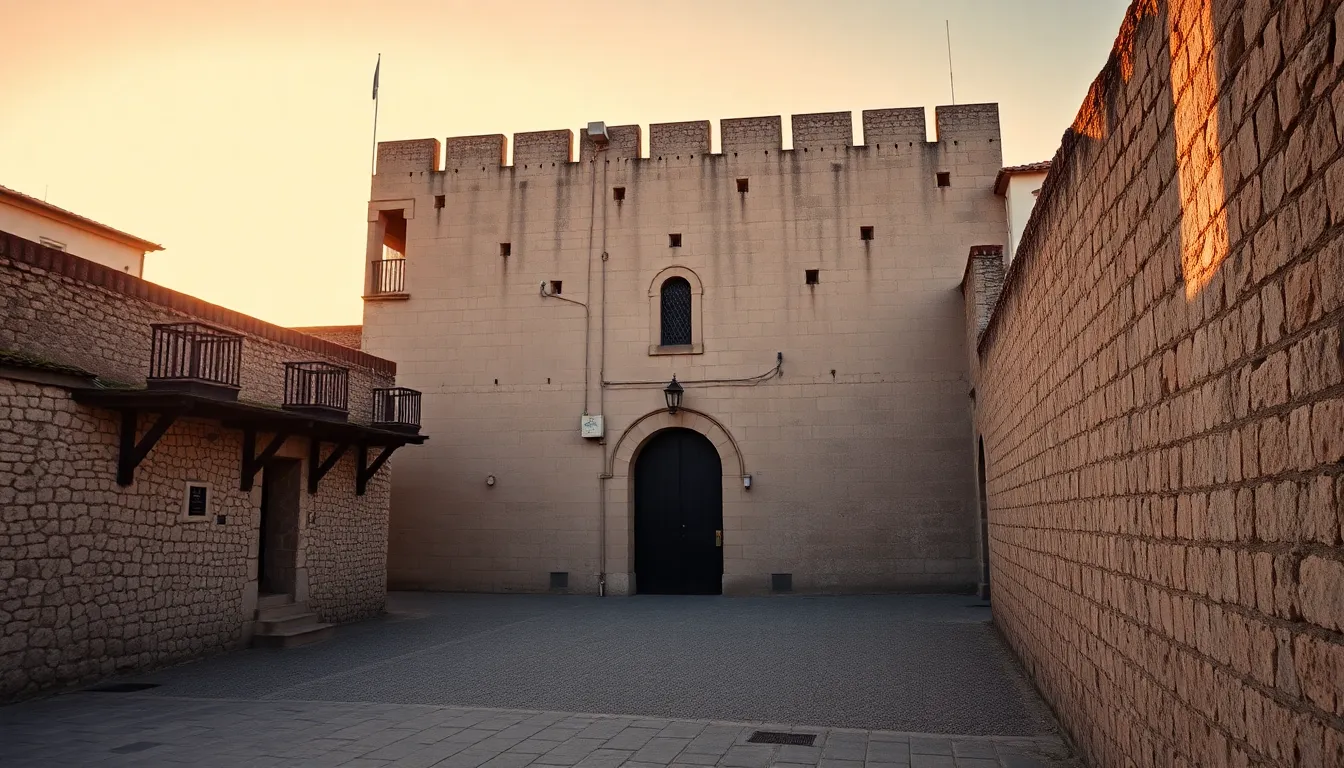
There is a moment I wait for whenever I bring a group into Trancoso. We come through one of the old gates in the town wall, and the modern world drops away behind us. Inside the walls, the streets are medieval, the houses are granite, and the scale is human. I let people walk a minute in silence before I say anything, because Trancoso does the introduction better than I can.
What makes Trancoso matter for a Jewish heritage group is not just that it is beautiful and intact. It is that this walled town held one of the more important Jewish communities of the Portuguese interior, and that the town has done real work to recover and present that history. You can stand at a specific doorway here and read, carved into the stone, a trace of a converso family’s faith. That is rare, and it is the heart of a Trancoso visit.
A Town Inside Its Walls
Trancoso sits in the Beira interior, in the highlands of central Portugal, not far from Guarda and a short drive from Belmonte. Like its neighbors, it was a fortified frontier town, and unlike many of them, its walls and castle survive largely intact. You enter through medieval gates, walk streets laid out centuries ago, and feel the town the way its medieval residents did: enclosed, defended, compact.
That enclosure shaped Jewish life here. The community lived within the walls, in a quarter woven through the town. Trancoso sat on trade routes and drew Jewish families through the medieval period, and like other interior towns it absorbed refugees after Spain’s 1492 expulsion. By the time of Portugal’s forced conversions in 1497, Trancoso had a substantial Jewish presence, significant enough that the town remains one of the key stops on any serious tour of Jewish interior Portugal.
The Casa do Gato Preto
If Trancoso has a single famous Jewish landmark, it is the house known as the Casa do Gato Preto, the House of the Black Cat.
The name comes from a worn carving on the building’s facade. But the reason it draws Jewish heritage groups is the doorway. Carved into the stone of this house are inscriptions, including elements that have been read as a Hebrew inscription and religious symbolism. The most cited reading connects part of the carving to a verse expressing faith, the kind of declaration a Jewish family might place at the threshold of a home.
I give groups the honest version. Scholars debate the precise reading and dating of the carvings, and you will hear different interpretations from different guides. What is not seriously in doubt is that this was a house connected to the Jewish or converso community, and that someone carved into its stone a statement of faith that has outlasted them by five centuries. Standing in front of that doorway, the debate over the exact translation matters less than the fact of it: a family marked their home, in stone, in a town where being Jewish was about to become a crime.
I usually let people approach the doorway one or two at a time. It is the kind of detail that rewards a close look and a quiet moment, not a crowd pressing in. The carving sits at the threshold, where a family entered and left every day, and that is the right place to think about what they carried in and out with them.
The Jewish Heritage Center: Isaac Cardoso
Trancoso has gone further than most interior towns in interpreting its Jewish past. The town established a Jewish heritage and interpretation center, named for Isaac Cardoso, a 17th-century physician and writer of converso origin connected to the region, who left Portugal, returned openly to Judaism abroad, and wrote in defense of the Jewish people.
His life is, in miniature, the whole story. Born into a New Christian family under suspicion, he built a career, then chose to leave the Iberian world entirely in order to live and write as a Jew without hiding. Naming the center for him is a quiet statement: this is a town that remembers not only what was taken but what people chose to reclaim.
The center gives a group what the streets alone cannot, the interpretive frame. It is the place where a guide can lay out the full arc for your people: the medieval community, the forced conversion, the generations of New Christians under the Inquisition’s watch, and figures like Cardoso who carried the faith back into the open. I like to do the streets and the Casa do Gato Preto first, let the questions build, and then bring the group to the center where those questions get their context. The town has put this story at the center of how it presents itself, which is not something every Portuguese town has chosen to do.
Holding the Loss with Dignity
Trancoso, like Guarda nearby, was a town where the converso experience was lived under real and lasting pressure. The Portuguese Inquisition, established in 1536, gave particular attention to interior communities with large New Christian populations, and Trancoso’s families lived for generations knowing that suspicion could become accusation, and accusation could become ruin.
When I stand with a group here, I try not to rush this. It is tempting to move quickly from the carved doorway to the heritage center, from loss to recovery, because the recovery feels better. But the families who carved that inscription, and the families who later scraped such marks away or plastered over them, deserve to have their situation held honestly. They were forced to abandon their faith in public and were then hunted on suspicion of keeping it in private. Our guide to the Portuguese Inquisition treats that experience with the depth it warrants, and I often point groups to it before or after a Trancoso visit.
How a Group Experiences Trancoso
Trancoso is one of my favorite interior stops for a group, and the walls are a large part of why. The enclosed old town means no long transfers between sites, no traffic, no sprawl. You park outside the walls, walk in through a gate, and spend an unhurried morning on foot: the streets, the Casa do Gato Preto, the castle, and the heritage center, all within a compact, atmospheric core.
It pairs naturally with the nearby towns. Belmonte and its crypto-Jewish story are close, Guarda is a short drive, and together these form the heart of an interior journey. Our Jewish heritage in Portugal overview shows how the pieces connect, and the Rede de Juderias network explains how towns like Trancoso are linked into a single signed heritage route across the country.
For mixed-age groups, the old town has cobbled, gently sloping streets that most travelers manage well, with the castle climb being optional for those who want it. As always, we set the pace around the people in the group.
For groups of 15 or more traveling with Heritage Tours, the group leader travels free, which often turns a congregation’s “someday” trip into a real one on the calendar. You can see how the wider Portugal journey fits together on our destination page and learn how the group leader experience works on our group tours page.
FAQ: Trancoso Jewish Heritage
What is the Jewish history of Trancoso, Portugal?
Trancoso was a walled frontier town in the highlands of central Portugal with a substantial medieval Jewish community, strengthened by refugees after Spain’s 1492 expulsion. After Portugal’s forced conversions of 1497, the community became New Christians and lived under the watch of the Inquisition. The town has since established a heritage center and preserved key Jewish landmarks within its intact walls.
What is the Casa do Gato Preto in Trancoso?
The Casa do Gato Preto, or House of the Black Cat, is a granite house known for the carvings on its facade and doorway, including elements read as a Hebrew inscription expressing faith. Scholars debate the precise reading, but the house is connected to the Jewish or converso community and is the most visited Jewish landmark in the town.
What is the Trancoso Jewish heritage center?
Trancoso established a Jewish heritage and interpretation center named for Isaac Cardoso, a 17th-century physician and writer of converso origin who left Portugal to live and write openly as a Jew. The center provides the interpretive frame for the town’s Jewish history, covering the medieval community, the forced conversions, and the converso experience under the Inquisition.
Is Trancoso good for a Jewish heritage group?
Yes. It is one of the strongest interior stops, with intact medieval walls, the Casa do Gato Preto, a dedicated heritage center, and a compact, walkable old town that suits group travel. It pairs naturally with nearby Belmonte and Guarda to form the heart of an interior itinerary.
How is Trancoso to walk for older travelers?
The walled old town has cobbled streets with gentle slopes that most travelers manage comfortably, and there are no long transfers between sites since everything sits within the walls. The castle climb is optional. We set the pace around the group and plan places to pause.
If you are picturing Trancoso as part of your community’s journey through Portugal, I would be glad to help you plan it. Contact us whenever you are ready to begin.