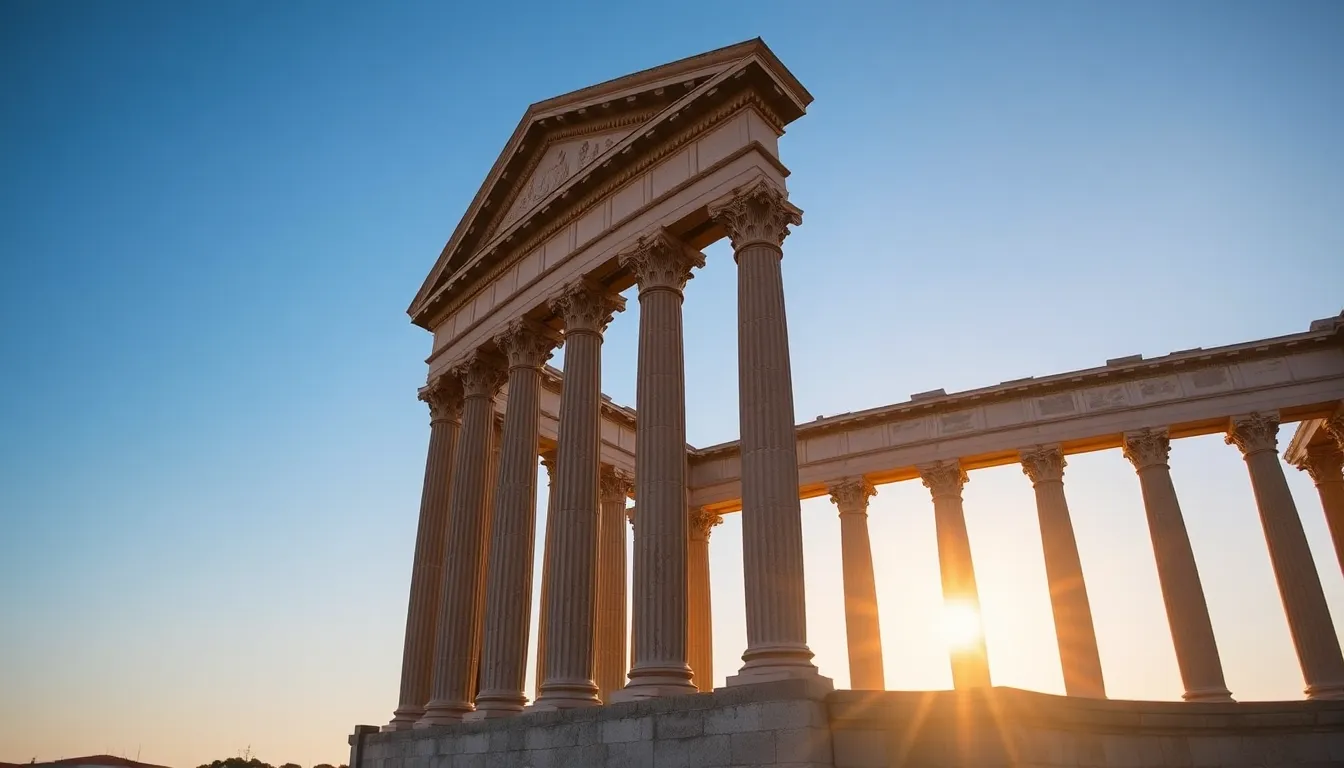
I always try to bring groups to the Roman Temple of Evora in the late afternoon, when the light goes gold and the granite columns warm up against the sky. People expect Roman ruins in Rome, in Athens, in the eastern Mediterranean. They do not expect to round a corner in a small Portuguese hill town and find a temple that has stood, in part, for nearly two thousand years. That surprise is half the gift of this site.
The other half is what it teaches. This temple is a doorway into the world the early church and the Jewish diaspora actually lived in, the Roman Empire that stretched all the way to the Atlantic. Standing here, the New Testament and the rabbinic period stop being distant and become a world with roads, cities, and temples like this one.
A Roman Temple at the Western Edge of the Empire
The temple was built in the first century, most likely during the reign of Augustus, when Evora was the Roman city of Liberalitas Julia. Rome’s reach in this period was enormous, and this corner of the Iberian Peninsula, far from the capital, was a working part of the empire, with its own forum, its own civic life, and a temple at the center of it.
What survives today is the podium, a row of fourteen granite columns, and their marble Corinthian capitals. The columns are local granite, quarried nearby, while the capitals and bases were carved from marble brought from Estremoz, a town not far away that still produces fine marble. That detail tells you something about how the Romans built even at the edges of their world: with care, with regional materials, with permanence in mind.
The temple’s survival is itself a story. In the Middle Ages, the structure was walled up and used as a fortress and even a slaughterhouse. That sounds like an indignity, and in some ways it was, but the walls that enclosed it also protected the columns from being quarried away for other buildings. It was only in the 19th century that the medieval additions were removed and the columns revealed again. The thing that hid the temple is the thing that saved it.
The Truth About the “Temple of Diana” Name
You will hear this site called the Temple of Diana, and your group will see that name on signs and in guidebooks. It is worth telling them, gently, that the name is almost certainly wrong, because the real story is more interesting.
The association with the goddess Diana came from a 17th-century Portuguese priest who linked the ruins to a local legend. There is no archaeological evidence that the temple was dedicated to Diana at all. Most scholars now believe it was dedicated to the imperial cult, the worship of the emperor and the power of Rome itself, which was common in provincial cities trying to show their loyalty to the capital.
I find this matters for a faith group, and not as a trivia correction. The imperial cult is the exact religious backdrop of the New Testament. When early Christians refused to worship the emperor, when they confessed that Jesus, not Caesar, was Lord, they were standing against a system that built temples like this one in every province. Telling your group that this was likely a temple to imperial power, not a charming shrine to a huntress goddess, puts them inside the real tension the first believers faced.
How Heritage Groups Visit the Temple
This is one of the easier sites to bring a group to, which is a relief on a busy itinerary. The temple sits in an open public square at the highest point of Evora’s old town, free to visit, with no ticket and no entry line. You walk right up to it. There is room around the columns for a group to gather, listen, and look without crowding.
I treat it as a teaching stop more than a touring one. There is no interior to file through, so the value comes from standing in front of it and unpacking what it means: the reach of Rome, the world of the early church, the way empires build monuments to their own power. Fifteen to twenty minutes with a good guide or a prepared leader is enough to make the site land.
The temple also anchors the rest of Evora beautifully. It stands beside the Evora Cathedral and the former Inquisition palace, and it is a short walk from the Capela dos Ossos. I often build a single morning or afternoon around all three, walking the group from imperial Rome to medieval Christianity to the Franciscan meditation on death, all within a few hundred meters. Few towns let you tell that much history on foot.
Because there is no entry fee or timed ticket, the temple is also a flexible point in a day. If a group is running ahead or behind, this is the stop you can stretch or shorten without throwing off reservations elsewhere.
Practical Access and Planning
The square around the temple is paved and mostly level once you reach it, though Evora’s old town involves some gentle uphill walking on cobblestones to get there. For groups with members who tire on inclines, I plan the walking route to approach from the easier side and keep the pace relaxed.
The site is open and visible at all hours since it sits in a public square, but I prefer late afternoon or early evening for the light and the smaller crowds. Sunset behind the columns is genuinely beautiful, and it gives a group a quiet, memorable end to a day of touring.
Evora is roughly ninety minutes from Lisbon and works well as a day trip or an overnight stop. I lean toward the overnight, because the town empties of day visitors in the evening and the whole old quarter, temple included, takes on a calm that day-trippers never see. Evora is a UNESCO World Heritage Site, so there is no shortage of things to fill the time.
The temple fits naturally into a wider Portugal heritage route through the Alentejo and beyond. You can see how Evora connects to the rest on our Portugal destination page and in our guide to Portugal’s hidden heritage sites.
FAQ: The Roman Temple of Evora
Was the Roman Temple of Evora really dedicated to Diana?
Almost certainly not. The name comes from a 17th-century legend, not from evidence. Most archaeologists now believe the temple was dedicated to the imperial cult, the Roman worship of the emperor and the power of the empire. The “Temple of Diana” name persists in guidebooks, but the imperial-cult story is both more accurate and more meaningful for a faith group, since it reflects the religious world of the early church.
How old is the Roman Temple of Evora?
The temple dates to the first century, likely built during the reign of Augustus, making it nearly two thousand years old. Evora was then the Roman city of Liberalitas Julia. The surviving columns are local granite topped with marble capitals from nearby Estremoz.
Why is the Roman Temple of Evora so well preserved?
It survived because it was hidden. In the Middle Ages the temple was walled up and used as a fortress and a slaughterhouse. Those medieval walls, while undignified, protected the columns from being quarried away for other construction. The walls were removed in the 19th century, revealing the columns we see today.
How much time should a group spend at the Roman Temple?
Plan for fifteen to twenty minutes. There is no interior to tour, so the temple works as a teaching stop where a guide or leader unpacks the history of Rome’s reach and the world of the early church. It pairs naturally with the nearby cathedral and the Capela dos Ossos for a longer walk through Evora’s old town.
Is the Roman Temple of Evora free to visit?
Yes. The temple stands in an open public square at the top of Evora’s old town. There is no entrance fee and no ticket, which makes it an easy and flexible stop on a group itinerary. The square is paved and level, though reaching it involves some gentle uphill walking on cobblestones.
If you are planning a Portugal heritage journey for your congregation or school, Evora gives your group a rare chance to walk from imperial Rome to medieval faith in a single afternoon. For groups of 15 or more, the group leader travels free. Explore our group heritage tours or contact us to begin building your itinerary.