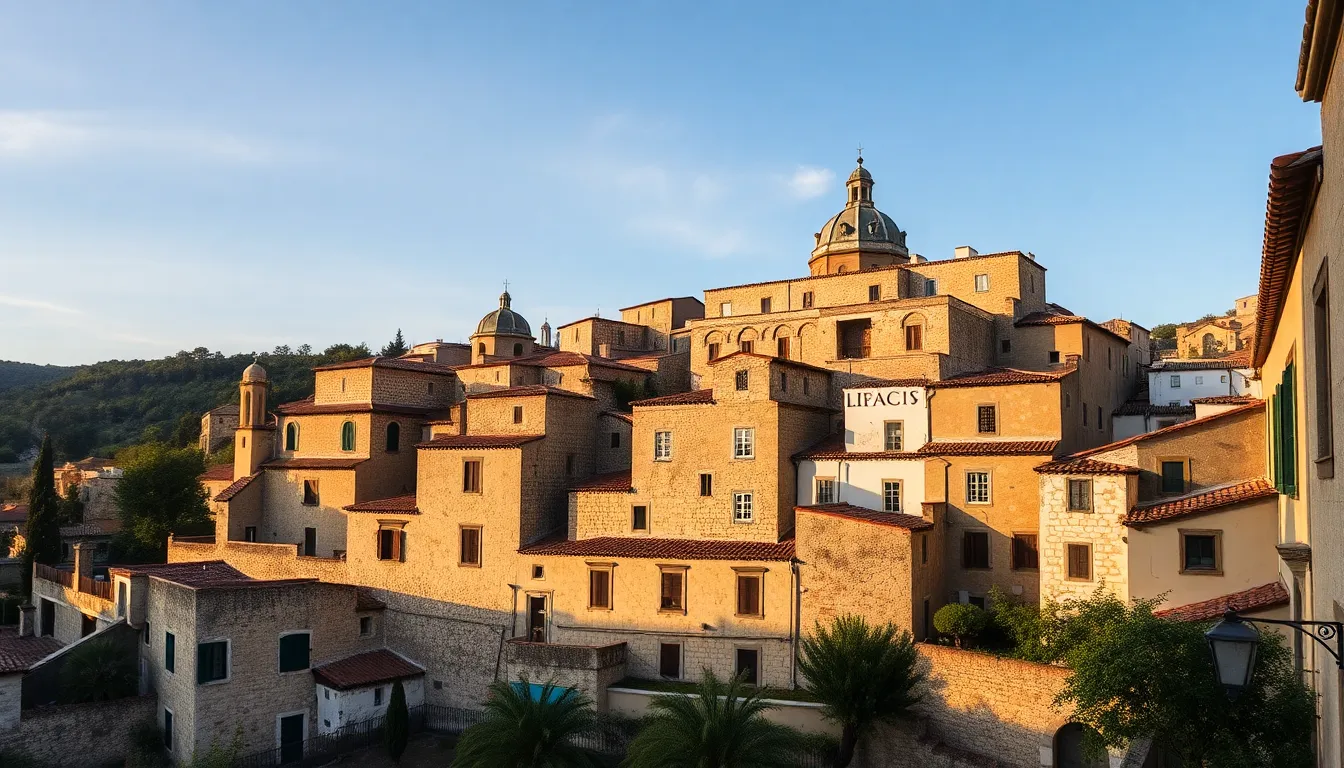
Guarda is the highest city in Portugal, and you feel it the moment you step off the bus. The air is thinner, the light is sharper, and the granite buildings have a weight to them that the whitewashed towns of the south do not. I always tell my groups that Guarda is a city you arrive at with your collar up. It was built to be cold, defensible, and serious. That seriousness runs straight through its Jewish history too.
People come to the Portuguese interior expecting the famous names: Belmonte, Tomar, Castelo de Vide. Guarda gets overlooked. That is a mistake. This was one of the most important Jewish communities in the interior, and the story of what happened here, before and especially after the forced conversions, is one of the clearest windows we have into the converso experience.
A Fortress City on the Frontier
Guarda sits high in the Serra da Estrela, the mountain range that forms the spine of central Portugal, close to the Spanish border. Its name means “guard,” and that is exactly what it was: a fortified watch city protecting the frontier of the medieval kingdom. The cathedral that anchors the old town is built like a castle, all granite and buttresses, because in a border city the line between a church and a fortress was thin.
Jewish families were drawn to Guarda for the same reasons they settled in other frontier towns. It sat on trade routes between Portugal and Castile. It offered the relative safety of city walls. And when Spain expelled its Jews in 1492, Guarda, like other interior towns, took in families crossing the border. By the late 15th century, the Jewish community here was substantial, with its quarter woven into the streets below the cathedral.
Finding the Judiaria Today
Here is where I set expectations honestly with groups. Guarda’s Jewish quarter is not a preserved museum-piece the way Castelo de Vide’s is. There is no reconstructed synagogue you can walk into. What survives is more subtle, and reading it takes a guide who knows the streets.
The old Judiaria lay in the area around the Rua Dom Luís de Almeida and the surrounding lanes, downhill from the cathedral. Walk these streets and you are walking the footprint of the community. Some of the houses preserve medieval Gothic doorways, the tall, narrow, pointed-arch frames typical of the period. On a number of the door posts, you can find the small carved marks that local tradition associates with the mezuzah, the parchment Jewish families fixed to their thresholds.
I am careful with groups about these marks, because not every notch in old granite is a verified mezuzah scar, and serious historians ask for caution. But the pattern across the quarter is real, and standing in front of one of these doorways, you are looking at the threshold of a Jewish home from before 1497. That is enough to make people go quiet.
The granite matters here in a way it does not elsewhere. These doorways were carved into hard highland stone, and stone like this does not erase easily. Five centuries of weather and reuse, and the marks are still legible. The mountains that made Guarda cold and remote also made it a place where the past survived in the rock.
The Converso City: Guarda and the Inquisition
If Belmonte is the town where crypto-Jews survived in secret for 500 years, Guarda is, in a hard sense, one of the towns that explains why they had to hide.
After the forced conversions of 1497, the Jewish families of Guarda became, on paper, New Christians. They were baptized, given Christian names, recorded in the parish rolls. But the suspicion never lifted. New Christian families across Portugal lived under permanent watch, and when the Portuguese Inquisition was established in 1536, the interior cities with large converso populations became some of its primary hunting grounds.
Guarda’s New Christian community was significant, which meant it drew the attention of the tribunal. Families here lived for generations under the weight of being watched. A neighbor’s accusation, a whispered observation that someone had changed their linen on a Friday or refused pork, could begin a process that ended in arrest, interrogation, confiscation of property, and worse. This is not distant abstraction. These were the great-grandparents and great-great-grandparents of families whose descendants are alive today.
I treat this part of the story with care when I am standing in the quarter with a group. The temptation is to rush past the loss to get to the recovery. But the converso experience deserves to be held honestly. These were people who had been forced to abandon their faith publicly, and who were then punished on suspicion of keeping it privately. That double bind is the heart of what happened here, and a heritage group does well to sit with it rather than hurry through.
For the fuller story of the tribunal itself, how it worked, and what the converso experience involved, our guide to the Portuguese Inquisition treats the subject in the depth it deserves.
The Cathedral and the Wider Story
No visit to Guarda skips the cathedral, the Sé. It dominates the old town, a vast granite structure built over more than two centuries. For a Jewish heritage group, it is worth entering not as a detour but as part of the story.
The cathedral is the institution that the converted Jewish families were absorbed into. After 1497, the New Christians of Guarda were baptized into this church, attended Mass within these walls, and were recorded in its registers. Standing inside, you are standing in the building that represented both the demand to convert and, for the Inquisition, the standard against which converso families were measured. Holding the granite of the synagogue doorways and the granite of the cathedral in the same morning gives a group the full shape of what conversion meant: not a free choice of faith, but an absorption enforced by the most powerful institution in the city.
How a Group Experiences Guarda
Guarda works best as a stop on a wider journey through the Portuguese interior rather than a destination on its own. It pairs naturally with Belmonte, which is a short drive away, and with Trancoso and Castelo de Vide. Our Jewish heritage in Portugal overview shows how these towns connect into a single arc, and the Trancoso heritage guide covers the walled town just to the north.
Because Guarda’s Jewish heritage is read in streets and doorways rather than in a single museum building, the quality of the guide matters more here than almost anywhere. The story is not behind glass. It is in the granite, and someone has to help your group see it. That is exactly the kind of local relationship we build our interior itineraries around.
For groups of 15 or more traveling with Heritage Tours, the group leader travels free. You can see how the full Portugal journey fits together on our destination page and learn how the group leader experience works on our group tours page.
FAQ: Jewish Heritage of Guarda
What is the Jewish history of Guarda, Portugal?
Guarda was a fortified frontier city in the Serra da Estrela mountains with a significant medieval Jewish community, strengthened by families crossing from Spain after the 1492 expulsion. After Portugal’s forced conversions of 1497, the community became New Christians and lived for generations under the watch of the Inquisition, which targeted interior cities with large converso populations.
Can you still see the Jewish quarter in Guarda?
Yes, though it is read through streets and doorways rather than a preserved building. The old Judiaria lay below the cathedral, around the Rua Dom Luís de Almeida. Several medieval houses preserve Gothic doorways, some with small carved marks that local tradition associates with the mezuzah. A knowledgeable guide is important, since the quarter is not a museum and the details need interpretation.
Why was Guarda important to the Inquisition?
After 1497, Guarda had a large New Christian population, the descendants of forcibly converted Jewish families. When the Portuguese Inquisition was established in 1536, cities with significant converso communities became primary targets. Families in Guarda lived for generations under suspicion, vulnerable to accusations that could lead to arrest, interrogation, and confiscation of property.
Is Guarda worth visiting for a Jewish heritage trip?
Yes, especially as part of a wider interior itinerary. It is often overlooked in favor of Belmonte and Tomar, but it offers one of the clearest windows into the converso experience. It pairs well with nearby Belmonte, Trancoso, and Castelo de Vide, and a good guide brings the granite doorways and Inquisition history to life.
What is the highland setting of Guarda like for older travelers?
Guarda is the highest city in Portugal, set in mountainous terrain with a cool climate and some steep, cobbled streets in the old town. The main sites are walkable, and we set the pace around the group with planned places to rest. Travelers should pack for cooler weather than the Portuguese coast, especially outside the summer months.
If you are thinking about how Guarda might fit into your community’s journey through Portugal, I would be glad to help you plan it. Contact us whenever you are ready to start.