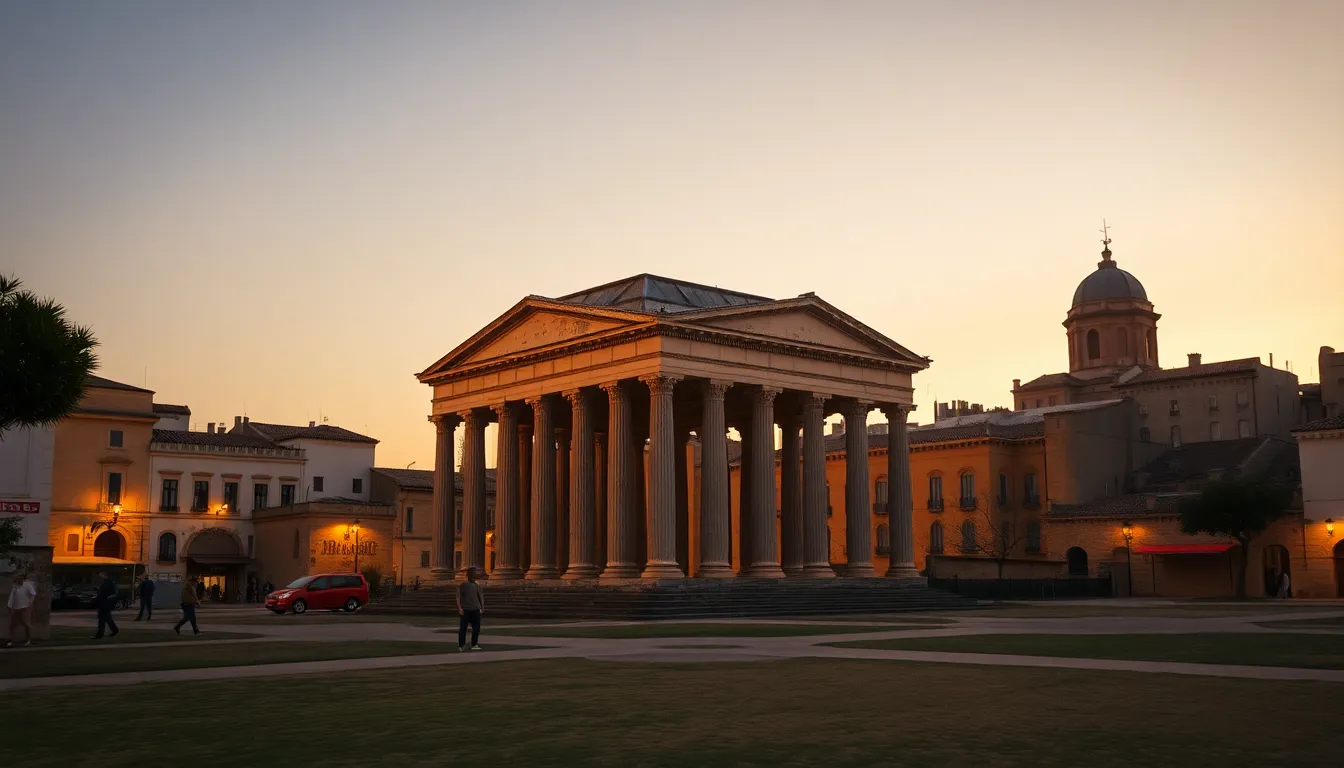
I tell groups that Evora is the city where Portugal stops being a coastline and becomes a layered, ancient place. You drive east from Lisbon into the Alentejo, the wide golden plain of cork oaks and wheat, and after about ninety minutes a walled city rises out of the flat land. Inside those walls, in a few square blocks, you can stand in a Roman temple, walk into a medieval cathedral, sit in a chapel built from human bones, and trace the streets of a Jewish quarter emptied five centuries ago. There are not many places on earth where the layers stack that tightly.
The whole historic center is a UNESCO World Heritage Site, and unlike many old towns it is still a living, working city. Students fill the squares, because Evora has one of the oldest universities in Portugal. For a heritage group, this is a city where you can cover Roman, Christian, and Jewish history on foot in a single unhurried day, and that density is exactly what makes it so good for our kind of travel.
Let me take you through Evora the way I take a group.
The Roman Temple and the Ancient Layer
Evora’s most photographed monument is the Roman temple, standing in the highest part of the old city. People often call it the Temple of Diana, but that name is a later invention with no historical basis. It most likely honored the imperial cult, the worship of Rome’s emperors, and it dates from around the first century. The Corinthian columns have survived nearly two thousand years partly because the structure was walled up and used as a slaughterhouse for much of its later life, which protected the stone until it was uncovered in the nineteenth century.
For a group, the temple is more than a photo stop. It is the anchor of Evora’s oldest layer, a reminder that this city was a significant Roman settlement long before Portugal existed as a nation. Standing among those columns, with the cathedral towers rising just behind, you can see two civilizations in a single sightline. I use that moment to set up the whole day, because everything else in Evora was built on top of, or in conversation with, what the Romans left.
The Cathedral: Evora’s Christian Heart
A short walk from the temple stands the Se de Evora, the cathedral, the largest medieval cathedral in Portugal. Construction began in the late twelfth century, soon after the city was taken from Moorish rule, and the building has a fortress-like solidity that tells you it was raised in a frontier age. The two asymmetrical towers and the granite walls give it a weight you feel before you even enter.
Inside, the cathedral opens into a vast Gothic nave. The cloister is one of the finest in the country, and the rooftop, which groups can climb, offers a sweeping view over the white city and the Alentejo plain beyond. There is also a sacred art museum in the cathedral with a remarkable collection, including a celebrated ivory carving of the Virgin.
What I point out to Christian groups is the role this cathedral played in Portugal’s outward expansion. It was from cities like Evora that the church organized the religious life of a kingdom that would soon send ships across the world. Several of the explorers and missionaries of Portugal’s age of discovery were tied to this region. The cathedral is not a side chapel of Portuguese Christianity. It was a center of it.
The Chapel of Bones: A Meditation on Mortality
No site in Evora affects groups the way the Capela dos Ossos does, the Chapel of Bones, attached to the Church of St. Francis. In the sixteenth century, Franciscan monks faced a city running out of burial ground, with bones filling dozens of cemeteries. Their solution was to gather the remains of some five thousand people and build them into the walls and columns of a chapel.
Over the entrance is the inscription, “Nos ossos que aqui estamos pelos vossos esperamos,” which translates roughly as “We bones that are here await yours.” It is meant to stop you. The chapel was not built to shock. It was built as a meditation, a deliberate confrontation with mortality designed to turn the visitor’s thoughts toward eternity. The monks wanted people to leave changed.
For a faith group, this is a place that earns silence. I do not rush people through it. Whatever a community’s tradition, the chapel asks the oldest spiritual question directly, and groups almost always want a few quiet minutes there before we move on. It is one of the most honest religious spaces I take groups into anywhere in Europe.
The Old Judiaria: Evora’s Jewish Quarter
Before 1497, Evora held one of the most important Jewish communities in Portugal. The Judiaria, the Jewish quarter, sat in the streets around what is today the Rua do Raimundo and the surrounding lanes. Jewish merchants, scholars, and physicians lived here and contributed to a city that was, for a period, a royal residence and a center of learning.
Then came the forced conversion of 1497, when King Manuel I ordered every Jew in Portugal to convert to Christianity or leave. Evora’s open Jewish life ended. The community became New Christians, and the city later became a notorious seat of the Portuguese Inquisition, with tribunals that pursued those suspected of secretly keeping the old faith. That history is harder to see on the surface than a temple or a cathedral, but it is woven into these streets.
I am honest with Jewish groups that Evora does not have a standing medieval synagogue the way Tomar does. What it offers is the layout of a Jewish quarter, the documented history of a major community, and the sober weight of a city where the Inquisition operated. For groups tracing the Sephardic story across Portugal, Evora is an essential stop, the urban and southern counterpart to the hidden inland villages where crypto-Jewish life survived longest. To follow that thread, our Castelo de Vide and Marvao guide covers one of the best-preserved Judiarias in the country, and the Portugal heritage guide lays out the full arc.
Practical Orientation for Evora
Getting There
Evora sits about 130 kilometers east of Lisbon, an easy ninety-minute to two-hour drive across the Alentejo. Most groups visit Evora as part of a wider Portugal itinerary, either as a day trip from Lisbon or, better, as an overnight that lets you experience the walled city after the day visitors leave. The old center is compact and walkable, which suits group travel well, though the streets are cobbled and some are steep, so comfortable shoes matter.
When to Come
The Alentejo is the hottest part of Portugal in summer, and Evora in July and August can climb past 35 degrees Celsius. For a group doing a full day on foot, spring and fall are far more comfortable. April through June and September through October give you warm days, manageable temperatures, and the golden Alentejo light that makes the plain so beautiful. Spring also brings the wildflowers across the cork oak country around the city.
How Long to Stay
A focused group can cover the temple, the cathedral, the Chapel of Bones, and the old Judiaria in a single well-paced day. If you can give Evora an overnight, you gain the evening city, quieter and lit, and time to add the megalithic sites nearby, including the Almendres Cromlech, a stone circle older than Stonehenge that sits in the countryside just outside the city. For groups interested in the deep human story of this land, that prehistoric layer is a remarkable addition.
For groups of 15 or more, the group leader travels free. That is how Heritage Tours honors the spiritual leader who brings the community together and gives the journey its purpose.
FAQ: Evora Heritage Travel
What are the main heritage sites in Evora?
The essential sites are the Roman temple, the medieval cathedral (the largest in Portugal), the Chapel of Bones at the Church of St. Francis, and the old Judiaria, the former Jewish quarter. The entire historic center is a UNESCO World Heritage Site and can be explored on foot. Nearby, the Almendres Cromlech offers a prehistoric stone circle older than Stonehenge for groups interested in the deeper human history of the region.
What is the Chapel of Bones in Evora?
The Chapel of Bones, or Capela dos Ossos, is a small chapel whose walls and columns are built from the bones of around five thousand people. Franciscan monks created it in the sixteenth century, partly to solve a shortage of burial ground and partly as a meditation on mortality. An inscription over the door reads, “We bones that are here await yours.” For faith groups, it is a quiet, powerful place that confronts the oldest spiritual questions directly.
Is the Roman temple in Evora really the Temple of Diana?
No. The name “Temple of Diana” is a later legend with no historical basis. The temple most likely honored the Roman imperial cult and dates from around the first century. It survived nearly two thousand years partly because it was walled up and reused over the centuries, which protected the Corinthian columns until they were uncovered in the nineteenth century. It is the anchor of Evora’s oldest layer.
Is there Jewish heritage to see in Evora?
Evora had one of the most important Jewish communities in medieval Portugal, centered on the Judiaria around the Rua do Raimundo. The forced conversion of 1497 ended open Jewish life, and the city later became a seat of the Inquisition. There is no standing medieval synagogue as in Tomar, but the layout of the Jewish quarter and the documented history make Evora an important stop for groups tracing the Sephardic story across Portugal.
How long should a group spend in Evora?
A full, well-paced day covers the temple, cathedral, Chapel of Bones, and old Judiaria on foot. An overnight is better, giving you the quieter evening city and time for the nearby megalithic sites. Evora sits about ninety minutes to two hours east of Lisbon across the Alentejo, so it works well as a day trip or, ideally, an overnight within a wider Portugal itinerary.
If Evora sounds like the right layer of history for your community, I would welcome the conversation. Start with our Portugal heritage guide, explore the Portugal destination page, or see how our group heritage tours work.
Contact us whenever you are ready to start planning.