Most groups arrive in Portugal thinking about Lisbon and Fatima, and they plan their whole trip around the center of the country. I understand why. But when I take a group north into the Minho, into Braga and the green hills around it, something shifts. People slow down. They stop checking the itinerary. The north of Portugal has a different weight to it, older and quieter, and Braga sits at the heart of that.
Braga calls itself the religious capital of Portugal, and that is not a marketing line. It is one of the oldest Christian cities in the world, an archbishopric since the days of the Roman Empire, and the seat of Portuguese Catholicism for longer than most European nations have existed. If your group cares about the deep roots of the faith, this is where you go to find them.
Let me walk you through Braga and the Minho the way I walk a group through it, so you can decide whether the north belongs in your itinerary.
Braga: The Religious Capital of Portugal
The Cathedral and the Weight of Centuries
The Se de Braga, the cathedral, is the oldest in Portugal. Construction began in the late eleventh century, and the building has been added to in every century since, which means walking through it is like reading the architectural history of the country in a single visit. You move from Romanesque arches into Gothic chapels into baroque gilt woodwork, all under one roof.
For a group, what matters is not the architectural labels. It is the sense that this place has held continuous worship for nearly a thousand years. The treasury holds reliquaries and vestments going back to the medieval period. The tombs of the cathedral’s founders are here. When I bring a Christian group into this space, I tell them they are standing in the church that effectively organized Christianity across northern Portugal and into Spain. That context changes how people look at the stones.
Bom Jesus do Monte: The Stairway of the Five Senses
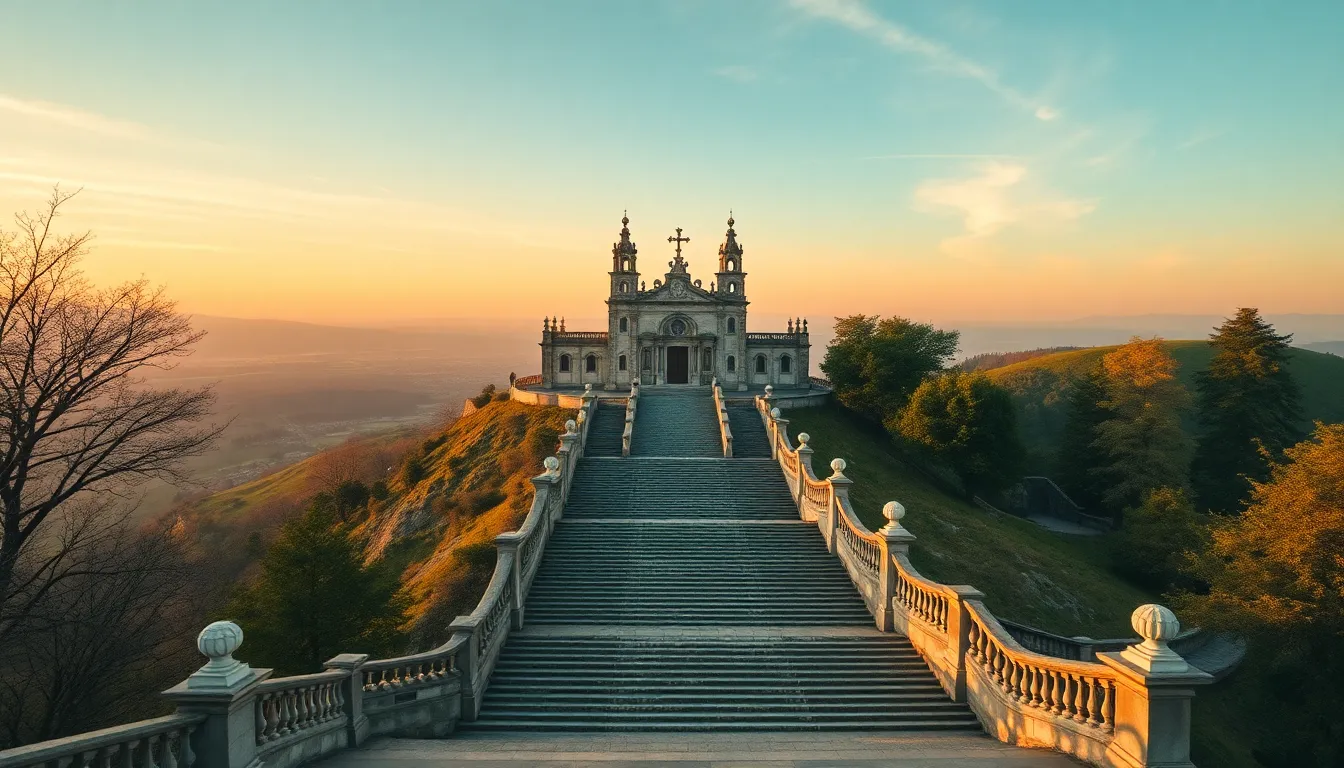
A few kilometers outside the city center, on a wooded hill, sits Bom Jesus do Monte. This is the image most people have seen of Braga even if they did not know its name: a vast baroque stairway zigzagging up the hillside to a church at the top. It became a UNESCO World Heritage Site in 2019, and it is one of the most significant pilgrimage sites in the country.
The stairway is the point. Pilgrims climb it on foot, and each landing carries a theme. The lower section represents the five senses, with fountains for sight, hearing, smell, taste, and touch. Higher up come the theological virtues. The whole ascent is designed as a spiritual journey, a movement from the earthly toward the divine, built into stone in the eighteenth century.
For groups who can manage the climb, walking up Bom Jesus is one of the most moving things you can do in the Minho. For those who cannot, there is a water-powered funicular from 1882, the oldest of its kind in the world, that carries you to the top. Either way, the view back over Braga and the surrounding hills is worth the trip on its own.
Holy Week in Braga
If your timing is flexible, Braga during Holy Week is something to consider seriously. The city holds some of the most elaborate Holy Week processions in Portugal, with the streets given over to candlelit walks and the cathedral at the center of it all. It draws pilgrims from across the country. For a Christian group, being in Braga in that week frames the entire visit. I would say it requires early booking, because the city fills, but the experience is on a different level.
The Jewish Memory of the North
The Minho is not where most people look for Jewish heritage in Portugal. The famous crypto-Jewish stories sit further inland and south, in Belmonte and the historic villages. But the Jewish presence in the north of Portugal was real and significant, and Braga had a Jewish community in the medieval period.
Like everywhere else in the country, that community ended formally in 1497, when King Manuel I ordered the forced conversion of all Jews in Portugal. The Jews of Braga and the surrounding towns became New Christians, and many continued to practice in secret. The physical traces in the north are subtle. There is no standing medieval synagogue here the way there is in Tomar. What you find instead are street names, the memory of a Jewish quarter, and the broader story of a community absorbed and hidden.
I am direct with Jewish groups about this. If Jewish heritage is the primary focus of your trip, the Minho is a supporting chapter rather than a main one, and the heart of that story lies inland. But if your group is building a fuller picture of Portuguese history, understanding that the forced conversions reached every corner of the country, including the deeply Catholic north, completes the map. The same edict that emptied the south of its open Jewish life reached Braga too.
For groups who want to connect the threads, our Belmonte and crypto-Jewish heritage story and the historic villages trail carry the Jewish narrative where it runs deepest.
Guimaraes: Where Portugal Was Born
You cannot understand the Minho without Guimaraes, twenty minutes from Braga. This is where the Portuguese nation began. The first king, Afonso Henriques, was born here in the twelfth century, and the city carries the phrase “Aqui nasceu Portugal,” Portugal was born here, on its old walls.
The medieval center of Guimaraes is a UNESCO World Heritage Site and one of the best-preserved old towns in the country. The castle, the ducal palace, and the tight medieval streets give a group a clear sense of where the whole story started. For Christian and historic-heritage travelers, pairing Guimaraes with Braga gives you both the religious capital and the political birthplace of Portugal within a single day. The two cities sit close enough that you do not need to choose.
Practical Orientation for the Minho
Getting There and Getting Around
Braga sits in the far north of Portugal, about an hour from Porto by car or train. Most groups reach the Minho through Porto, which has the nearest international airport. I usually build the north into an itinerary that starts or ends in Porto, so the region flows naturally rather than requiring a long detour.
The Minho is compact. Braga, Guimaraes, and the surrounding river valleys are all within easy reach of one another. This is good news for group travel, because you can base yourself in or near Braga and reach the major sites without long transfer days.
When to Come
The Minho is the greenest part of Portugal, and there is a reason for that. It rains more here than in the south, particularly in winter and early spring. Late spring through early fall gives you the most reliable weather for the outdoor sites like Bom Jesus, which loses much of its power if you are climbing the stairway in heavy rain.
If Holy Week is on your radar, that locks you into the spring date for that year. Otherwise, I find September and October ideal in the north: the summer crowds thin, the hills stay green, and the light through the river valleys is beautiful.
How Many Days
For a group that wants to do the Minho properly, I suggest two to three days in the region. That gives you a full day for Braga and Bom Jesus, a day for Guimaraes, and time for the river valleys and a vineyard visit in the Vinho Verde country, which is the heart of the Minho’s landscape and culture. Rushing the north into a single day is possible, but it turns a contemplative region into a checklist, and that is exactly the wrong note for this part of Portugal.
For groups of 15 or more, the group leader travels free. That is how Heritage Tours honors the pastor, rabbi, or educator who gathers the community and makes the journey possible.
FAQ: Braga and the Minho Heritage Travel
Why is Braga called the religious capital of Portugal?
Braga has been a Christian archbishopric since the era of the Roman Empire, making it one of the oldest Christian centers in the world. It became the seat of Portuguese Catholicism and held that authority across northern Portugal and into Spain for centuries. The cathedral, the Se de Braga, is the oldest in the country. The title reflects that long, continuous role at the center of the church in Portugal.
What is Bom Jesus do Monte and is it worth visiting?
Bom Jesus do Monte is a baroque pilgrimage sanctuary on a hill outside Braga, famous for its monumental zigzag stairway that pilgrims climb on foot. The ascent is designed as a spiritual journey, with sections representing the five senses and the theological virtues. It became a UNESCO World Heritage Site in 2019. For groups, it is one of the most meaningful sites in the north. A historic funicular carries those who cannot manage the stairs.
Is there Jewish heritage in Braga and the Minho?
The Minho had medieval Jewish communities, including in Braga, but the visible traces are subtle compared to inland Portugal. The forced conversions of 1497 turned these communities into New Christians, and many practiced in secret. For groups focused primarily on Jewish heritage, the deeper stories lie inland in Belmonte and the historic villages. The Minho fills in the broader picture of how the conversions reached every part of the country.
Should I combine Braga with Guimaraes?
Yes. Guimaraes, twenty minutes from Braga, is where the Portuguese nation was born in the twelfth century, with a beautifully preserved medieval center that is a UNESCO World Heritage Site. Pairing the two gives a group both the religious capital and the political birthplace of Portugal in a single day. They sit close enough that visiting both requires no difficult logistics.
How many days should a group spend in the Minho?
Two to three days lets a group experience the region properly: a day for Braga and Bom Jesus, a day for Guimaraes, and time for the green river valleys and the Vinho Verde country. The north rewards a slower pace, so I advise against compressing it into a single rushed day. Most groups reach the Minho through Porto, which has the nearest airport.
If the north of Portugal sounds like the right chapter for your community, I would welcome the conversation. You can start with our Portugal heritage guide, explore the Portugal destination page, or see how the group heritage tours work.
Contact us whenever you are ready to begin planning.