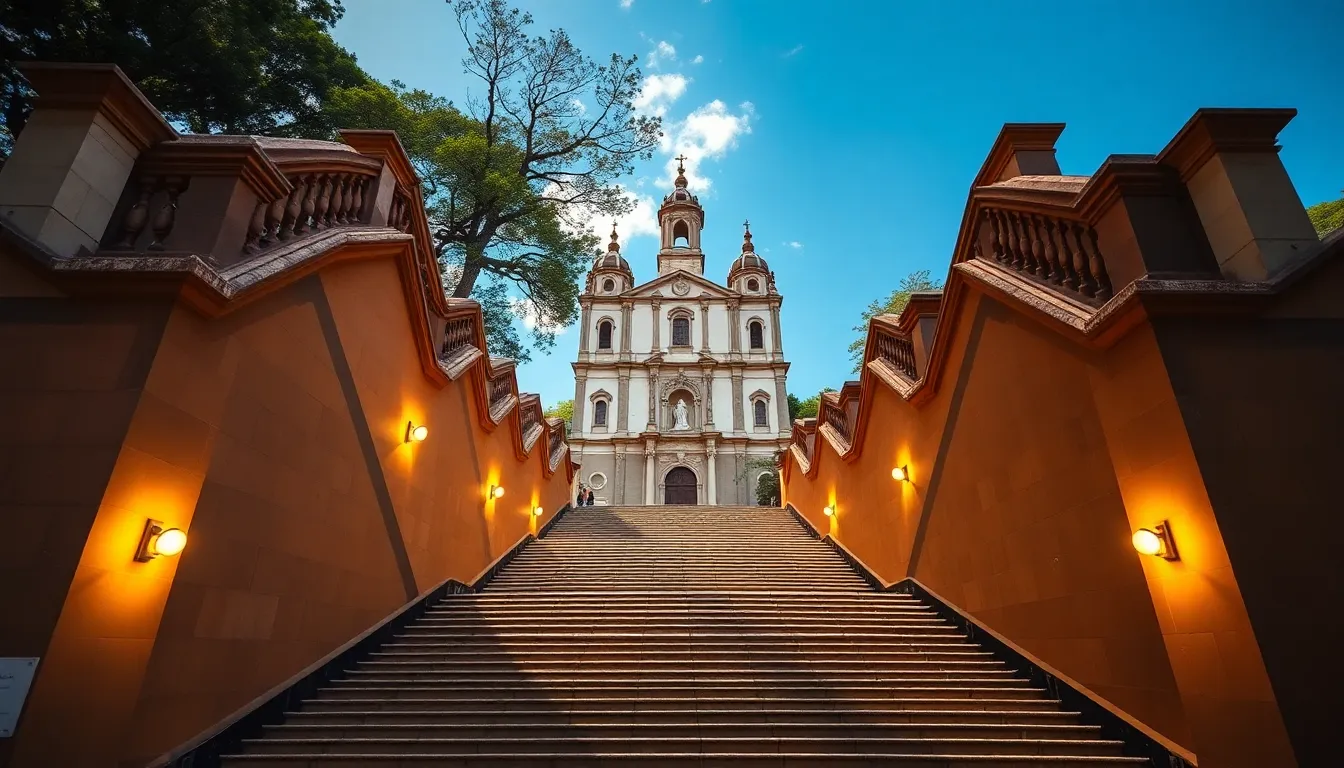
The first time most of my groups see a photograph of Bom Jesus do Monte, they assume it has been touched up. The great white zigzag stairway climbing the green hillside toward the church at the top looks too perfect to be real. It is real, and it is even better in person. But here is what the photographs never capture: Bom Jesus is not just a beautiful staircase. It is a sermon you climb. Every landing, every fountain, every statue is part of a single spiritual journey designed to lead the pilgrim, step by step, from the senses of the body to the heights of grace. Once your group understands what they are climbing, the ascent changes entirely.
Let me explain what makes this place extraordinary.
A Sanctuary Above Braga
Bom Jesus do Monte sits on a wooded hill just outside the city of Braga, in northern Portugal. The name means “Good Jesus of the Mount.” There has been a place of devotion on this hill since the medieval period, but the site as you see it today was built over the eighteenth and early nineteenth centuries, the great age of Braga’s Baroque building under its powerful archbishops. It belongs naturally with a visit to the city, and our guide to Braga, the religious capital of Portugal, covers the wider context.
The sanctuary was designed as a complete pilgrimage experience. The pilgrim does not simply arrive at a church. The pilgrim ascends to it, and the ascent is the point. In 2019, the whole sanctuary was inscribed as a UNESCO World Heritage Site, recognized as one of the finest examples in Europe of a Sacro Monte, a “sacred mount,” where a devotional journey is built into a landscape.
The Stairway of the Five Senses and the Three Virtues
The famous stairway is not one staircase but a sequence, and it was designed to be read as you climb. This is the part I most want groups to understand before they start.
The Sacred Way and the Chapels of the Passion
The journey begins lower down with the Sacred Way, lined with chapels that hold scenes from the Passion of Christ. As the pilgrim climbs, the story of Christ’s suffering unfolds chapel by chapel, so that the physical ascent mirrors the spiritual path of the Passion. By the time you reach the great staircase, you have already walked through the road to the cross.
The Stairway of the Five Senses
The lower section of the great Baroque stairway is the Escadaria dos Cinco Sentidos, the Stairway of the Five Senses. At each landing stands a fountain representing one of the bodily senses: sight, hearing, smell, touch, and taste, often rendered as fountains where water flows from a symbolic source, such as from the eyes or the ears of a carved figure. The meaning is theological. The pilgrim begins the ascent in the realm of the physical senses, the lowest rung of the spiritual life, and is meant to leave them behind while climbing.
The Stairway of the Three Virtues
Above the senses comes the Escadaria das Tres Virtudes, the Stairway of the Three Virtues, with fountains and symbols representing the three theological virtues: faith, hope, and charity. The progression is deliberate. Having risen above the bodily senses, the pilgrim now ascends through the virtues, climbing closer to God. By the time you reach the top, you have passed symbolically from the body, through the soul’s virtues, to grace. The whole structure is a journey of spiritual ascent built in granite and whitewash.
This is why I tell groups not to take the lift up. Yes, there is a famous funicular, the oldest water-powered funicular in the world, built in 1882, and it is a charming piece of history in its own right. But to ride up is to skip the entire meaning of the place. The stairway is designed to be climbed. Climbing it, pausing at each landing, reading the senses and the virtues as you rise, is the experience. Save the funicular for the descent, or for group members who cannot manage the climb.
The Sanctuary Church at the Top
At the summit stands the sanctuary church, a Neoclassical building completed in the early nineteenth century, with twin bell towers and a calm, ordered interior that contrasts with the drama of the climb. Inside, behind the altar, is a sculptural representation of the Crucifixion, the Good Jesus the whole sanctuary is dedicated to. After the layered symbolism of the ascent, the church itself is a place of arrival and rest.
From the terrace in front of the church, the view back down over the stairway and out across Braga and the surrounding countryside is one of the finest in northern Portugal. Groups often spend as long here, simply looking and catching their breath, as they spend in the church itself.
Why the Climb Matters for a Faith Group
I have led many kinds of people up this stairway, and the climb does something to a group that a flat walk through a church never does. There is a quiet that settles over people as they ascend. The symbolism gives the effort meaning, and the effort gives the symbolism weight. By the time a group reaches the top, having walked the Passion, risen above the senses, and climbed through the virtues, they have done more than visit a monument. They have made, in miniature, a pilgrimage.
That is the genius of a Sacro Monte. It does not explain the spiritual life to you. It makes you walk it. For Christian groups, it is one of the most effective devotional experiences in Portugal, precisely because the body participates. You feel the ascent in your legs, and that feeling becomes part of the meaning.
Bom Jesus pairs naturally with the other great sites of Portuguese faith. For the full picture, our overview of spiritual sites in Portugal for faith travelers maps how it relates to Braga, Fatima, and beyond, and a northern itinerary built around Braga’s religious heritage is the natural way to include it.
How Groups Visit Bom Jesus
A few practical notes from leading congregations here.
Climb the stairway, ride the funicular down. This is my standard advice. Walk up to get the meaning, take the historic funicular down to save the knees. Group members who cannot manage the climb can ride up too, and meet the rest at the top.
Allow a couple of hours. Between the Sacred Way, the stairway, the church, the terrace, and the wooded park around the summit, Bom Jesus deserves real time, not a rushed photo from the bottom.
Combine it with Braga. The sanctuary is only a short distance from the city center, so the two belong on the same day. A morning in Braga’s cathedral and historic center, an afternoon climbing Bom Jesus, makes a full and rewarding day.
Dress for a working sanctuary. The church is an active place of worship, so modest dress applies, and comfortable shoes are essential for the climb.
And the planning detail that helps: with Heritage Tours, group leaders travel free with fifteen or more participants. For a pastor or educator weighing whether a Portugal pilgrimage is realistic for the congregation, that lowers the barrier.
You can see how Bom Jesus fits into a structured journey on our Portugal destination page, and our group heritage tours page explains how the group leader experience works.
FAQ: Bom Jesus do Monte
What is Bom Jesus do Monte?
Bom Jesus do Monte is a Baroque pilgrimage sanctuary on a wooded hill just outside Braga in northern Portugal. Built mainly in the eighteenth and early nineteenth centuries, it is famous for its monumental zigzag stairway and its sanctuary church at the summit. In 2019 it was inscribed as a UNESCO World Heritage Site as one of Europe’s finest examples of a Sacro Monte, or sacred mount.
What is the Stairway of the Five Senses?
It is the lower section of the great Baroque stairway, where each landing holds a fountain representing one of the five bodily senses: sight, hearing, smell, touch, and taste. It is followed by the Stairway of the Three Virtues, representing faith, hope, and charity. Together they form a symbolic spiritual ascent, leading the pilgrim from the physical senses, through the virtues, toward grace.
Do you have to climb the stairs?
No. There is a historic funicular, built in 1882 and water-powered, that carries visitors to the top, and it is the oldest of its kind in the world. But the stairway is designed to be climbed as a devotional experience, so most groups walk up to absorb the symbolism and ride the funicular down. Group members who cannot manage the climb can take the funicular both ways.
How is Bom Jesus connected to Braga?
Bom Jesus sits on a hill just outside the city of Braga and was built during the same Baroque golden age that shaped the city under its powerful archbishops. The two are naturally combined on a single day, with a morning in Braga’s cathedral and historic center and an afternoon at the sanctuary.
How long should a group spend at Bom Jesus?
Plan a couple of hours. Between the Sacred Way with its Passion chapels, the symbolic stairway, the sanctuary church, the terrace view over Braga, and the surrounding park, there is far more here than a quick photo from the base. Giving it time is what turns the visit into a pilgrimage. You can plan the visit with us through our contact page.
If your community is drawn to an experience where the body shares in the prayer, Bom Jesus do Monte belongs on your itinerary. I would be glad to help you build a northern journey around it, so your group can climb the stairway the way it was meant to be climbed.
Contact us whenever you are ready to begin.