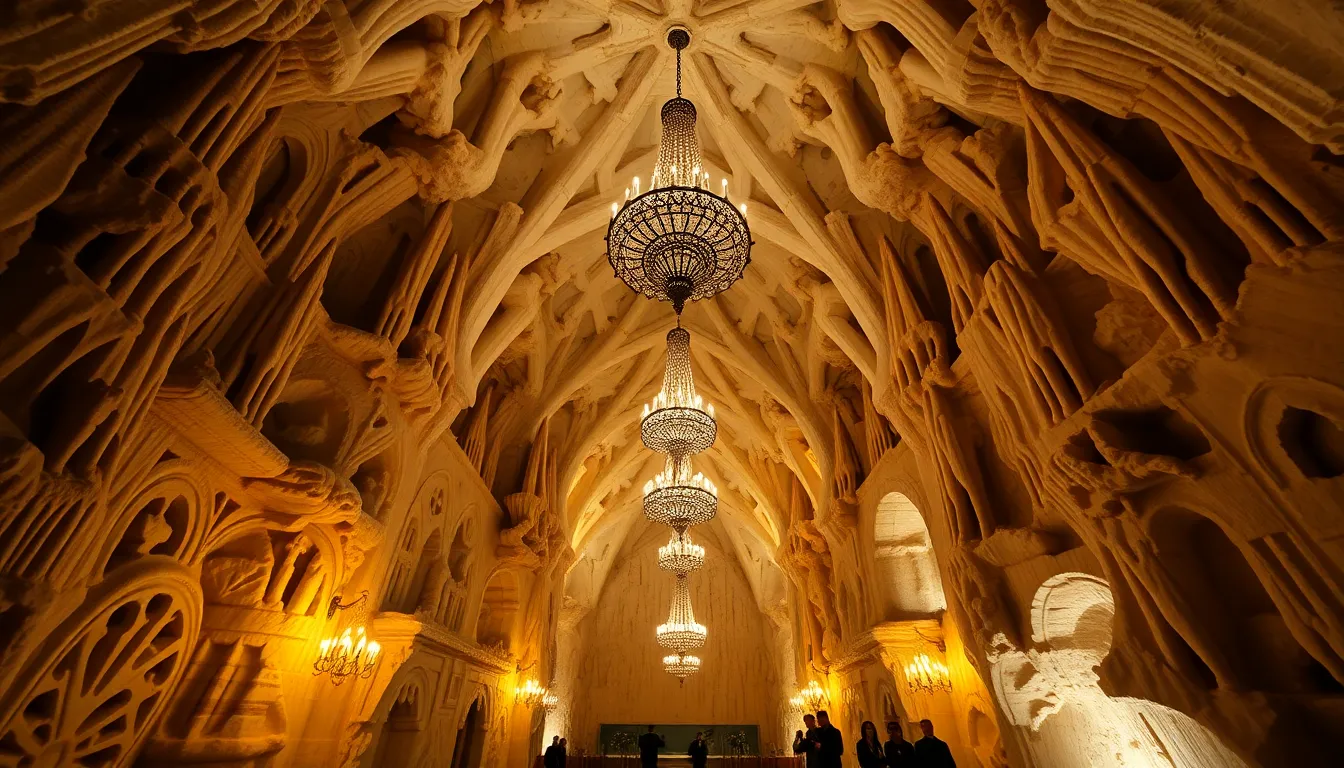
I have taken a lot of groups down into the Wieliczka Salt Mine over the years, and I still remember the first time. You descend a wooden staircase, hundreds of steps, into the dark. The air gets cooler and a little salty. And then, after a long walk through tunnels carved by hand, you step into a room that stops people cold: a full chapel, the size of a small church, with chandeliers, altarpieces, and a tiled floor, all of it carved out of solid rock salt.
People expect a mine. They do not expect a cathedral. That gap between what they expect and what they find is exactly why I include Wieliczka in so many Krakow itineraries. It is a short drive from the city, it works for almost any group, and it gives faith travelers a place to stand and simply marvel at what human hands made underground over seven centuries.
If you are already planning a Poland heritage trip and you are looking for a stop that lifts the mood without losing the depth, this is the one I reach for.
What the Wieliczka Salt Mine Actually Is
Wieliczka is a town about ten miles southeast of Krakow, and underneath it sits one of the oldest salt mines in the world. People have been pulling salt out of this ground since at least the 13th century. For most of Polish history, salt was wealth. The mine made kings rich and funded universities. It ran as a working salt mine for around 700 years, only stopping commercial extraction in the 1990s.
What was dug out over those centuries is staggering. There are more than 180 miles of tunnels and over 2,000 chambers spread across nine levels, going down nearly 1,000 feet. Visitors see only a small, carefully prepared section of it, the tourist route, which runs about two miles and takes you down to roughly 440 feet below the surface.
It was named a UNESCO World Heritage Site in 1978, in the very first group of sites ever placed on the list. That tells you something about how the world regards it.
Why the Miners Carved Chapels
Here is the part that matters most for faith groups. Salt mining was dangerous work. Cave-ins, flooding, and gas were constant threats, and the miners knew it. They were also deeply Catholic. So they did what people of faith do in dangerous places: they prayed, and they built places to pray.
Over the centuries, the miners carved chapels directly into the salt, down in the working levels where they spent their days. These were not decorations. They were functioning places of worship where men asked for protection before a shift and gave thanks after one. Some of the carving was done by miners who were also gifted sculptors, working in their own time, by candlelight, in a material that is hard, cold, and unforgiving.
The Chapel of St Kinga: A Church Carved From Salt
The Chapel of St Kinga is the heart of the mine, and it is the reason I never let a group skip Wieliczka. It is a full underground church, about 300 feet below the surface, measuring over 100 feet long and more than 30 feet high. Everything in it is carved from rock salt: the altar, the statues, the relief panels on the walls, even the chandeliers, whose crystals are made from dissolved and recrystallized salt to get the clarity right.
It took decades to build. Miners began the main carving work in the late 1800s, and sculptors continued adding to it well into the 20th century. The wall reliefs retell Gospel scenes, including a carved version of Leonardo’s Last Supper that looks like it was cut from stone but is, again, all salt.
Who St Kinga Was
The chapel is named for Saint Kinga, a 13th-century Hungarian princess who married into Polish royalty and is the patron saint of salt miners. The legend, which the miners cherished, says she threw her engagement ring into a salt mine in Hungary, and when she came to Poland and ordered a shaft dug at Wieliczka, the first lump of salt brought up contained her ring. Whether you take the story as history or as folklore, it tells you how the miners understood their work: as something blessed, watched over, and bound up with their faith.
Mass Underground
Mass is still celebrated in the Chapel of St Kinga. It is a consecrated Catholic church, and services are held there on Sundays and feast days, with people traveling down to attend. For Catholic groups, the chance to attend or simply stand in a Mass space carved by working miners hundreds of feet underground is something they talk about long after the trip. I have had pastors tell me it reframed the whole idea of where worship can happen.
How Heritage Groups Visit Wieliczka
The standard way in is the Tourist Route, a guided walk that takes two to three hours. You go down on foot, around 380 steps on a wooden spiral staircase, then follow your guide through a sequence of chambers, underground lakes, and chapels, ending at St Kinga’s. You come back up by a mining elevator, which is its own small experience, packed in tight the way the miners rode.
A few practical things I tell every group leader before we go.
The mine keeps a steady temperature of about 57 to 60 degrees Fahrenheit year-round, no matter the season. People are always surprised in summer when I tell them to bring a light jacket. Bring one anyway.
The route involves a lot of walking and that long initial staircase. It is doable for most people, but if your group includes anyone with serious mobility limits, tell your operator in advance. Wieliczka does run a separate accessible route with elevator access down, designed for visitors who cannot manage the stairs. It has to be arranged ahead of time.
Photography is allowed, though there is usually a small fee for a photo permit, and it is worth paying because people will want pictures of St Kinga’s.
Pairing It With Krakow
Wieliczka pairs naturally with a Krakow-based itinerary. Most groups do it as a half-day, either a morning before an afternoon in Kazimierz or a relaxed second-day stop after the heavier sites. I often place it the day after Auschwitz-Birkenau on purpose. After a day of that weight, descending into the salt and standing in a chapel that miners built out of devotion gives a group something to breathe into. It is not a distraction from the serious history. It is a different face of the same Polish story: faith expressed through labor, generation after generation.
For Jewish groups, Wieliczka works too. It is not a Jewish heritage site, but it is a remarkable window into Polish history and craftsmanship, and it gives a varied itinerary a lift between the synagogues of Krakow and the memorial sites.
Booking, Access, and Group Logistics
Wieliczka is one of the most visited attractions in Poland, drawing well over a million people a year, so it gets busy. Group slots need to be booked ahead, especially in summer and around holidays. Your tour operator handles this, but the point for a group leader is simple: this is not a place you can reliably walk up to with a group of 30 and expect to get in. Plan it.
Guided group entries are timed. Once your slot is set, the group goes down together with a dedicated guide, often one who speaks your group’s language, which makes a real difference for the storytelling.
Heritage Tours arranges Wieliczka as part of custom Krakow itineraries, with the booking, timing, guide, and transport from the city handled for you. As with every site we build into a journey, group leaders travel free with groups of 15 or more, so the person organizing the trip is not paying their own way to lead it.
FAQ: Visiting the Wieliczka Salt Mine
What is the Chapel of St Kinga at Wieliczka?
The Chapel of St Kinga is a full Catholic church carved entirely from rock salt about 300 feet underground in the Wieliczka Salt Mine. The altar, statues, wall reliefs, and even the chandeliers are made of salt. It was carved by miners and sculptors over several decades and is still a consecrated church where Mass is celebrated.
How long does a visit to the Wieliczka Salt Mine take?
The standard Tourist Route is a guided walk of about two to three hours. That includes the descent on foot, the walk through the chambers and chapels, and the elevator ride back to the surface. With travel from Krakow, most groups plan it as a half-day outing.
Is the Wieliczka Salt Mine accessible for visitors with mobility limits?
The standard route involves around 380 steps down and a lot of walking, so it is not suitable for everyone. The mine offers a separate accessible route with elevator access that must be arranged in advance. Tell your operator early if anyone in your group needs it.
Can a group attend Mass in the salt mine?
Yes. The Chapel of St Kinga is a working Catholic church, and Mass is celebrated there on Sundays and feast days. Attendance and timing need to be coordinated ahead through your operator, since the chapel is on the regular visitor route.
Is Wieliczka worth including for a faith-based heritage group?
For most groups, yes. It is a short trip from Krakow, it suits almost any age and fitness level when planned right, and the underground chapels show faith expressed through generations of hard labor. Many leaders place it after a heavier memorial day as a place of awe and recovery.
If you want to build Wieliczka into your group’s Krakow journey, with the booking, guide, and transport handled, reach out to us and tell us what your group is hoping for. We will plan it with you. You can also look at how we structure group travel, or read more about Poland’s lesser-known heritage sites and the spiritual sites worth seeing.