I have walked a lot of groups through Jewish sites in Poland where the building is all that is left. The community is gone. The synagogue is a museum, or a ruin, or a warehouse that someone forgot to tear down. You stand in the silence and you feel the absence. That is its own kind of witness, and it matters.
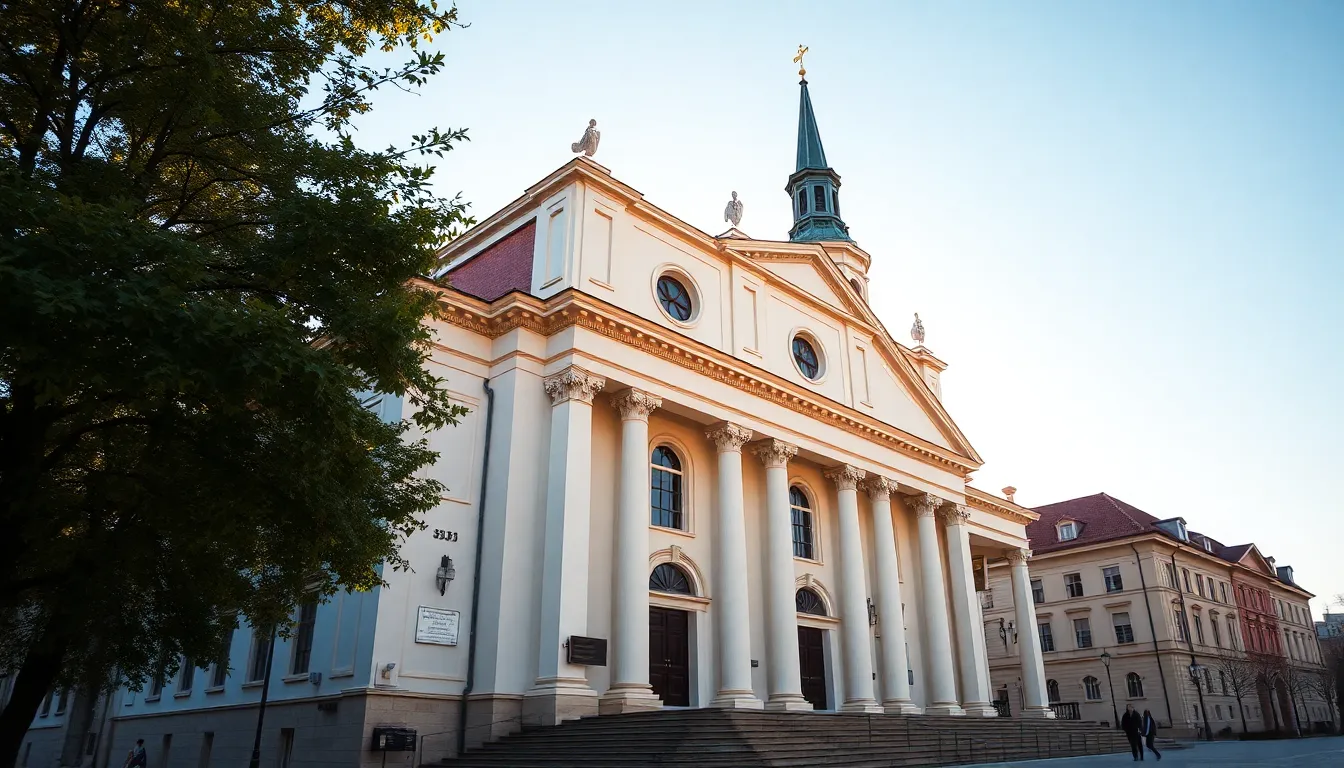
The White Stork Synagogue in Wroclaw is different, and I tell groups this before we go in. This is a place where the building survived, the community came back, and prayer happens here again. It is one of the few sites in Poland where the story does not end in 1943. For a group that has spent days in cemeteries and memorial sites, walking into a working synagogue with a living congregation changes something in the room.
If you have read our guide to hidden heritage sites in Poland, Wroclaw rarely makes those lists either. It should. Here is why.
A Synagogue That Survived Kristallnacht
The White Stork Synagogue was built between 1827 and 1829, in the neoclassical style, designed by the architect Carl Ferdinand Langhans. At the time the city was German and called Breslau, part of Prussia. Breslau had one of the largest and most influential Jewish communities in Germany, and the White Stork served the more traditional wing of that community for over a century.
The name comes from an inn that once stood on the site, called Zum Weissen Storch, the White Stork. The synagogue kept the name.
What makes this building remarkable is what did not happen to it. On the night of November 9, 1938, Kristallnacht, Nazi mobs burned and destroyed synagogues across Germany. Breslau’s grand New Synagogue, one of the largest in the country, was set on fire and gutted. The White Stork survived that night. It sat in a dense courtyard, surrounded by other buildings, and the Nazis did not torch it because the fire would have spread to the surrounding German-owned property.
So it stood. During the war the Nazis used the building as a warehouse and, in a detail that stays with most groups, as a holding point. Jews from Breslau were gathered in the synagogue’s courtyard before being deported east to the ghettos and the death camps. The last transport left in 1943. A building meant for prayer became the place where a community was assembled for its own destruction.
What Happened to Breslau’s Jews
Before the war, Breslau’s Jewish community numbered around twenty thousand people. The deportations of 1941 to 1943 emptied the city of nearly all of them. After the war, the German population of the city was expelled and the borders of Poland shifted west, so Breslau became Polish Wroclaw almost overnight.
A small number of Jewish survivors, mostly from elsewhere in Poland, resettled in Wroclaw in the late 1940s. For a few decades the synagogue stood in decline, used for storage, slowly falling apart under communist neglect. By the 1980s it was close to collapse.
The Restoration and the Revival
This is the part of the story I most want groups to understand, because it runs against the grain of almost everything else they will see in Poland.
In the 1990s and 2000s, after the fall of communism, the building was returned to the Jewish community and a long restoration began. The work was careful. The interior was brought back, the women’s galleries on three sides, the high vaulted ceiling, the bimah, the ark. It reopened formally in 2010 after years of effort funded by Polish, German, and international sources.
But a restored building is just a building. What gives the White Stork its weight is that a community formed around it again. Wroclaw today has an active Jewish congregation. There are Shabbat services. There is a Jewish cultural festival. The synagogue hosts concerts, lectures, and education programs alongside its religious life. The courtyard where Jews were once assembled for deportation is now a square where people gather for cultural events.
I do not romanticize this. The community is small, a few hundred people, nothing like the twenty thousand of prewar Breslau. But it is real and it is present, and that presence is rare enough in Poland that it is worth traveling for.
Why This Matters for a Heritage Group
Most of a Poland heritage journey asks your group to sit with loss. That work is necessary. But a journey built entirely on absence can leave a group heavy in a way that is hard to carry home.
The White Stork offers something to hold against that weight. It lets a group see that Jewish life in Poland is not only a thing of the past. For Jewish groups, that can be quietly powerful. For Christian groups bearing witness, it complicates the story in a good way, showing that destruction was not the final word in every place.
How Groups Visit the White Stork Synagogue
The synagogue functions as both a house of prayer and a cultural center, which shapes how a group experiences it. You are not walking into a static museum. You may arrive during a rehearsal, an exhibition, or preparation for a service.
Guided visits are available, and I strongly recommend booking one rather than walking in cold. A guide who knows the building can walk your group through the Kristallnacht story, the deportation history, and the restoration, standing in the actual spaces where each happened. The contrast between the courtyard’s past and present lands far harder when someone explains it on the spot.
If your timing allows, attending or observing a portion of community life, a service, a concert in the sanctuary, gives a group something a tour alone cannot. Our local operators can check the community calendar against your itinerary and arrange access where it fits.
Practical Access
Wroclaw sits in southwestern Poland, in Lower Silesia. It is well connected by train, roughly three and a half to four hours from Krakow and a similar distance from Warsaw. The city has its own airport with European connections. For groups already routing through Krakow and Auschwitz-Birkenau, Wroclaw works as a westward extension before flying out, rather than a backtrack.
The synagogue stands in the old Jewish quarter, on Wlodkowica Street, an area that has become a small district of cafes, the Jewish community offices, and cultural spaces. The quarter is walkable and your group can take in the surrounding streets as part of the visit.
Inside the synagogue, the usual respect applies. Men are asked to cover their heads in the prayer space, and head coverings are available. Modest dress is appropriate. During services, your group observes quietly and follows the lead of the congregation, the same posture I ask of any group entering a living house of prayer that is not their own.
For a group of 15 or more traveling with a leader, we arrange the group leader’s place at no cost as part of the booking, so the person organizing the journey can focus on shepherding their people rather than logistics.
Pairing Wroclaw With the Rest of Poland
Wroclaw rewards a group that has already done the harder work of the journey. After the gravity of the deportation memorial at Radegast Station in Lodz and the memorial sites further east, the White Stork offers a turn toward continuity. It is also a natural pairing with Lower Silesia’s other heritage, including the Peace Churches of Swidnica and Jawor, which sit within reach of Wroclaw and tell their own story of faith surviving against the odds.
A custom itinerary can place Wroclaw where it does the most good, usually toward the end, where its note of revival can carry a group home with more than grief.
FAQ: The White Stork Synagogue of Wroclaw
Why did the White Stork Synagogue survive Kristallnacht when others did not?
The synagogue sat in a dense courtyard surrounded by German-owned buildings. On Kristallnacht in November 1938, the Nazis did not set it on fire because the flames would have spread to the surrounding property. The building survived, though the Nazis later used it as a warehouse and as an assembly point for Jews being deported from the city.
Is the White Stork Synagogue an active place of worship today?
Yes. After a long restoration completed in 2010, the synagogue serves an active Jewish community in Wroclaw. It holds Shabbat services and functions as both a house of prayer and a cultural center, with concerts, exhibitions, and education programs. It is one of the few sites in Poland with a living congregation rather than only a preserved building.
Where is the White Stork Synagogue and how do groups reach it?
The synagogue is in Wroclaw, in southwestern Poland, on Wlodkowica Street in the old Jewish quarter. Wroclaw is about three and a half to four hours by train from both Krakow and Warsaw and has its own airport. Groups often visit it as a westward extension of a Krakow-based itinerary.
Can non-Jewish groups visit the White Stork Synagogue?
Yes. Guided visits are available to groups of all faiths. Men are asked to cover their heads in the prayer space, and head coverings are provided. Modest dress is expected. During services, groups observe quietly and follow the lead of the congregation.
What makes Wroclaw worth adding to a Poland heritage trip?
Most Poland heritage sites tell a story that ends in destruction. Wroclaw is different because the synagogue survived and a Jewish community returned. For groups that have spent days at memorial sites, the White Stork offers a turn toward continuity and revival, which helps a group carry the journey home with more than grief.
Tell us what your group needs from its Poland journey and we will build it around the right places. You can reach out here and we will plan it with you.