I bring a lot of Protestant groups to Poland, and most of them arrive thinking of it as a Catholic and Jewish country, which it largely is. So it surprises them when I tell them that two of the most remarkable Protestant buildings in the world are sitting quietly in the Polish countryside, southwest of Wroclaw, and almost nobody outside the region knows they exist.
The Peace Churches of Swidnica and Jawor are Lutheran churches built in the seventeenth century under conditions designed to make sure they failed. The story of how they were built, and what they meant to the people who built them, is one of the most moving accounts of faith under pressure that I know of in Europe. For a Protestant group, standing inside one of these churches is a chance to touch your own tradition’s history in a place you never expected to find it.
If your group is exploring the spiritual sites of Poland across both the Catholic and Jewish traditions, the Peace Churches add a Protestant chapter that most itineraries miss entirely.
Faith Built Under Restriction
To understand these churches you have to understand the situation that produced them, and it is a hard one.
After the Thirty Years’ War, the Peace of Westphalia in 1648 ended decades of brutal religious conflict across Central Europe. In the region of Silesia, which was then under Catholic Habsburg rule, the treaty granted the Lutheran population a narrow and grudging concession. They were permitted to build a small number of churches, but under conditions meant to keep them small, fragile, and temporary.
The restrictions were severe. The churches had to be built outside the town walls. They could not be built of brick or stone, only of perishable materials, timber, clay, and straw. They could have no tower and no bells. And, in some accounts, the work had to be completed within a single year.
The Lutherans were granted three such churches in Silesia. They were called Churches of Peace, named for the peace treaty that allowed them. Two survive today, at Swidnica and Jawor. The third, at Glogow, was lost to fire.
What the Builders Did With Those Limits
Here is the part that moves people. Given materials meant to produce something humble and short-lived, the Lutheran communities built something extraordinary instead.
Using only wood, clay, and straw, they constructed the largest timber-framed religious buildings in Europe. The Church of Peace in Swidnica can hold around 7,500 people. The one in Jawor holds roughly 6,000. These are enormous structures, raised without a single brick, by communities determined that their faith would have a worthy home no matter what restrictions were placed on it.
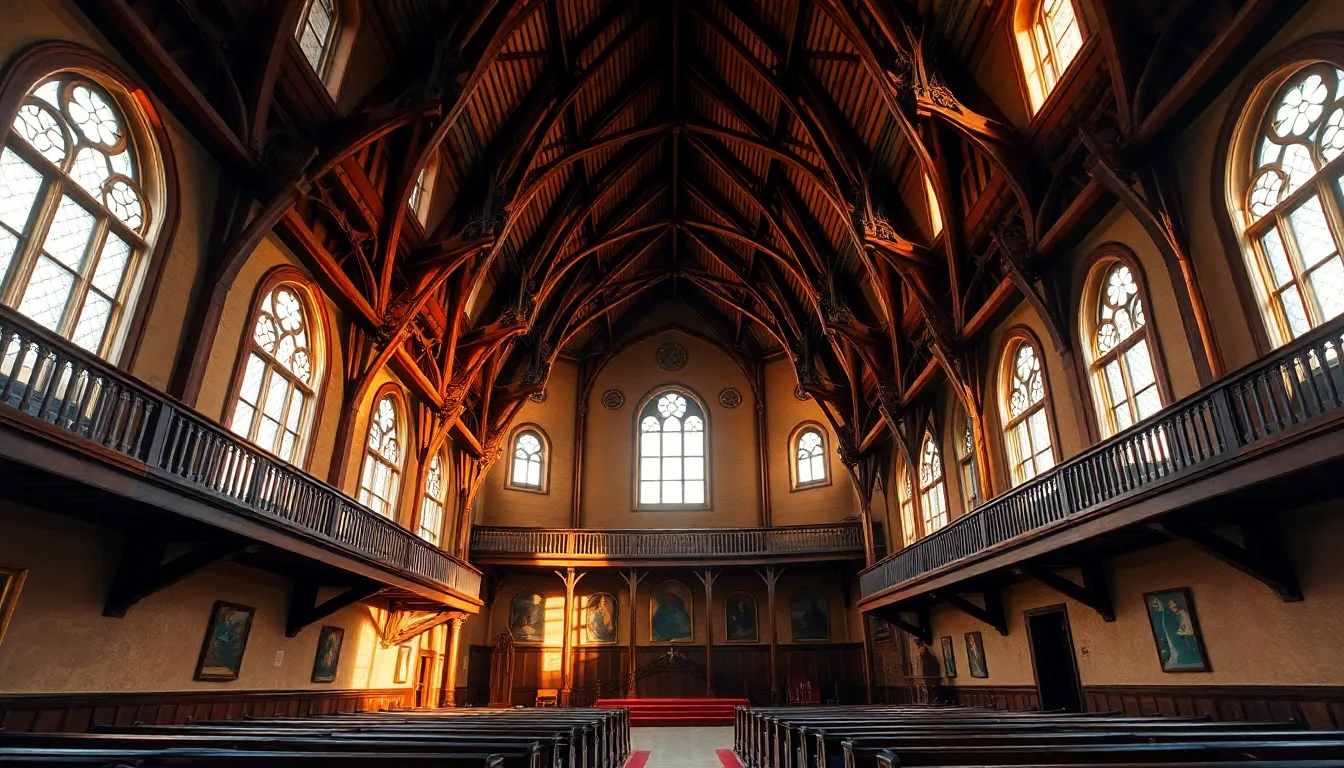
And they did not stop at size. Inside, the communities filled these timber halls with rich Baroque decoration, painted ceilings, tiers of galleries, carved altars and pulpits and organs. The interiors are dense with color and ornament, the painted panels covered in biblical scenes and the names of the families who paid for them. What was supposed to be a poor man’s church became a monument of faith and craftsmanship.
Swidnica and Jawor
The two surviving Peace Churches sit about thirty kilometers apart in Lower Silesia, and while they share the same story, each has its own character.
The Church of Peace in Swidnica
The Swidnica church, dedicated to the Holy Trinity, was completed in 1657. It is the larger and the more elaborately decorated of the two, with galleries rising in tiers and a painted interior of remarkable density. Standing in the center and looking up, a group takes in a ceiling and walls covered in Baroque painting, the whole hall built to hold thousands. It remains an active Lutheran parish church, which means the building is not a museum piece but a living place of worship.
The Church of Peace in Jawor
The Jawor church, dedicated to the Holy Spirit, was completed slightly earlier, in 1655. It too holds thousands and carries the same dense painted decoration across its galleries and ceiling, with biblical scenes and the heraldry of the families and guilds of the parish. Like Swidnica, it remains in use by a Lutheran congregation. Visiting both lets a group feel the shared achievement while noticing the differences in scale and detail.
Both churches were inscribed together on the UNESCO World Heritage List in 2001, recognized as exceptional testimonies to a moment of religious tolerance won at great cost, and as masterpieces of timber construction.
Why These Churches Matter for a Heritage Group
For a Protestant group, the Peace Churches offer something rare on a Poland journey, a direct encounter with your own tradition’s history of perseverance. These buildings were raised by people who were told their faith could have only the flimsiest, most temporary shelter, and who answered by building the largest wooden churches on the continent. That is a sermon in timber, and pastors often find it preaches itself.
For any group, the churches also complicate the simple picture of Poland’s religious past. This was never a country of only two faiths. Protestant communities lived here too, and held on through pressure that was meant to dissolve them. The Peace Churches are the evidence, still standing, still in use.
They also pair naturally with the heavier sites of the wider journey. A group that has stood at memorial sites and synagogues sees in these churches another version of the same theme that runs through all of Poland, faith and identity surviving deliberate attempts to extinguish them.
How Groups Visit the Peace Churches
Both churches welcome visitors and are accessible to groups, and because they remain active parishes, a visit can sometimes coincide with the life of the congregation. I recommend arranging a guided visit, since the meaning of these buildings, the restrictions, the materials, the defiance behind the decoration, is not obvious from the architecture alone. A guide who knows the history turns a beautiful old church into the moving story it actually is.
For a group, the two churches make a natural pairing in a single day, given how close they sit. Swidnica and Jawor together let a group grasp the full scope of what these communities built. Some groups attend a portion of a service or a concert, since both churches host music in their soaring acoustic, and our local operators can check the parish schedule against your itinerary.
Practical Access
The Peace Churches are in Lower Silesia, in southwestern Poland, within easy reach of Wroclaw. Swidnica is roughly an hour from Wroclaw by road, and Jawor about an hour and a half, with the two churches around forty-five minutes apart. That makes them a natural addition to any itinerary that already includes Wroclaw, and a good pairing with the White Stork Synagogue there, since both speak to faith communities holding on against the odds.
As active churches, modest dress is appropriate and quiet is expected, especially if a service is underway. The timber interiors are atmospheric and can be cool, which is worth noting for comfort. A visit to both churches with travel between them fills a half to most of a day, depending on how long a group lingers in each.
For a group of 15 or more traveling with a leader, we arrange the group leader’s place at no cost, so the person guiding the group can focus on their people rather than the logistics of reaching two rural churches.
Where the Peace Churches Fit
The Peace Churches work best as part of a Lower Silesia leg of a Poland journey, usually paired with Wroclaw, and often placed toward the end of an itinerary, where their note of endurance and faith lands well after the harder days further east. For groups continuing the heritage story across Poland, they connect naturally to the wider Poland destination and to a group itinerary that balances the country’s losses with its quieter testimonies of survival.
I have watched Protestant pastors stand in the middle of the Swidnica church, look up at that painted timber ceiling, and go quiet. They came to Poland to witness Jewish loss and Catholic devotion, and they found, unexpectedly, a monument to their own faith’s refusal to be small. That is the kind of moment these churches give a group.
FAQ: The Peace Churches of Swidnica and Jawor
What are the Peace Churches of Silesia?
They are Lutheran churches built in seventeenth-century Silesia after the Peace of Westphalia in 1648, which granted the Protestant population permission to build under harsh restrictions. They had to be built outside the town walls, without brick or stone, without towers or bells. Two survive, at Swidnica and Jawor, and both are UNESCO World Heritage Sites.
Why were the Peace Churches built only of wood?
The Catholic Habsburg authorities permitted the churches only on the condition that they use perishable materials, timber, clay, and straw, to keep them humble and temporary. Instead, the Lutheran communities used those materials to build the largest timber-framed religious buildings in Europe, richly decorated inside with Baroque painting and galleries.
How big are the Peace Churches?
They are enormous for timber buildings. The Church of Peace in Swidnica holds around 7,500 people, and the one in Jawor holds roughly 6,000. Both were raised without brick or stone and filled with tiered galleries, painted ceilings, and carved altars and pulpits.
Where are the Peace Churches and how do groups visit?
Both are in Lower Silesia in southwestern Poland, near Wroclaw. Swidnica is about an hour from Wroclaw by road and Jawor about an hour and a half, with the two churches around forty-five minutes apart. They make a natural pairing in a single day and are a good addition to a Wroclaw itinerary. Guided visits are recommended.
Why visit the Peace Churches on a heritage trip?
For Protestant groups, they are a rare chance to encounter their own tradition’s history of perseverance in Poland. For any group, they show that Poland’s religious past was never only Catholic and Jewish, and that Protestant communities held on through pressure meant to dissolve them. The churches are a living testimony to faith surviving deliberate restriction.
If you want the Peace Churches built into a journey that honors all of Poland’s faith communities, tell us what your group is looking for and we will plan it with you. You can reach out here.