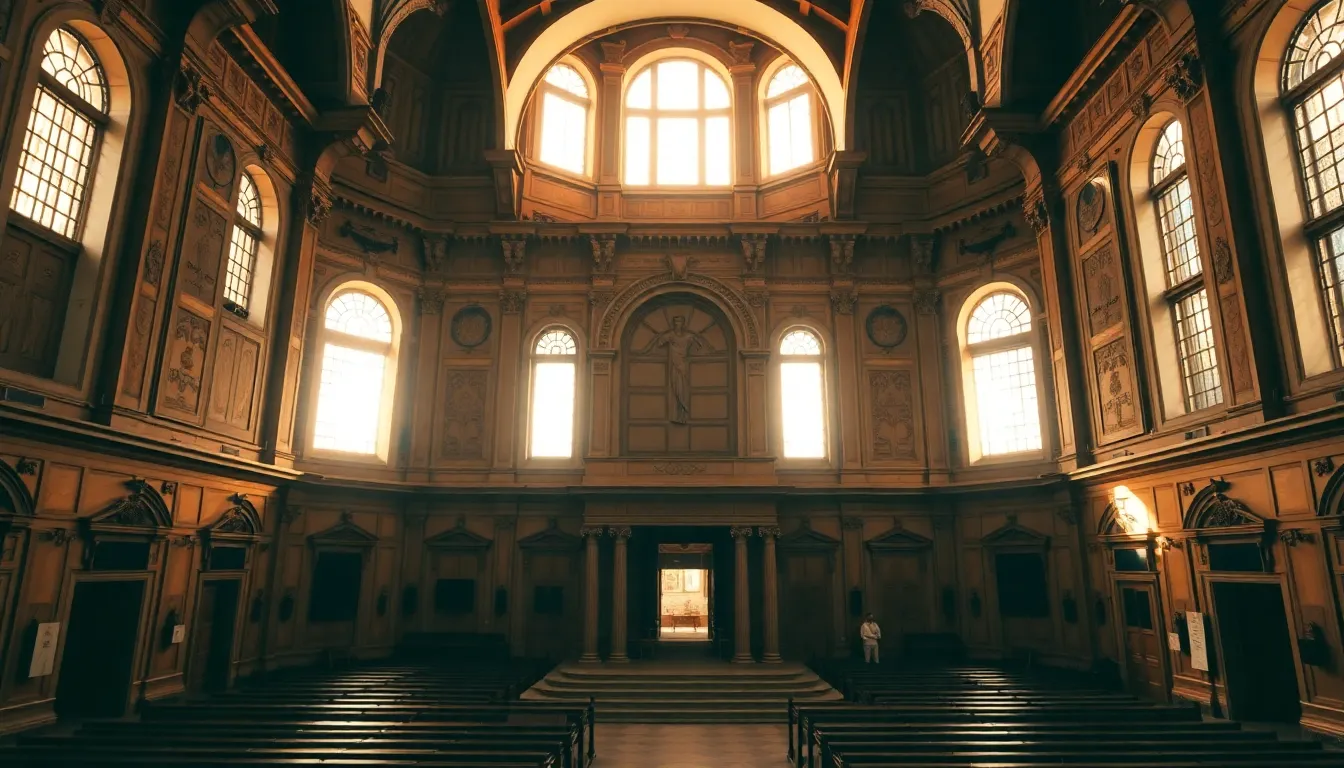
Tykocin is a small town in northeastern Poland that most travelers will never find on their own. It sits off the main routes, surrounded by quiet countryside, and on most days there is nothing to suggest that anything of significance happened here. That ordinariness is part of what makes Tykocin one of the most affecting places I bring groups to in all of Poland. Because in this quiet town stands one of the oldest and best-preserved synagogues in the country, built for a Jewish community that lived here for three hundred years and was erased in a single day.
I have stood inside the Great Synagogue of Tykocin with more groups than I can count, and I have watched the same thing happen each time. People grow quiet. They look up at the painted walls, at the central bimah, at the women’s gallery, and they understand without being told that they are standing inside a world that no longer exists. What follows is the story of that world, the synagogue at its heart, and the day it ended. I tell it with reverence, because Tykocin asks for nothing less.
A Community of Three Centuries
How Jewish Tykocin Began
Jews settled in Tykocin in the sixteenth century, invited by the local nobility under terms that allowed them to live, trade, and worship. This was the pattern across much of Poland in those centuries. While Western Europe expelled its Jews, Polish lands offered Jewish communities the legal right to exist and to build. Tykocin’s Jews took up that right and built a community that would last for three hundred years.
For long stretches of its history, Tykocin was a place of real importance in Jewish life. The community was large enough and prosperous enough to matter in the regional councils that governed Jewish communal affairs. Generations of families were born here, married here, raised children here, studied here, and were buried here in the Jewish cemetery. By the time of the war, Jews made up more than half of the town’s population. Tykocin was, in the truest sense, a shtetl: a small Jewish town with its own rhythms of prayer, study, work, and rest, a complete world unto itself.
The Texture of Daily Life
I always try to help groups feel the ordinariness of what was here, because the ordinariness is what makes the loss real. This was not a community of legend. It was a community of market days and Shabbat tables, of children walking to cheder, of arguments and weddings and funerals, of bread baking and prayers said at dawn. The people of Tykocin lived the same dense, ordinary, sacred life that Jews lived in hundreds of towns across Poland. Our broader guide to Jewish heritage in Poland describes that shtetl world in fuller detail, and Tykocin is one of the few places where you can still stand inside its physical center.
The Great Synagogue
A Baroque Treasure That Survived
The Great Synagogue of Tykocin was built in 1642. That date alone places it among the oldest surviving synagogues in Poland. It is a Baroque structure of stone, solid and dignified, built to serve a community that intended to remain for generations.
The interior is what stops people. The walls are covered with painted Hebrew inscriptions, prayers and verses rendered in decorative script across the plaster. At the center stands the bimah, the raised platform from which the Torah was read, set within four pillars in the traditional arrangement. The aron kodesh, the ark that held the Torah scrolls, stands against the eastern wall. The women’s gallery looks down on the main hall. Standing inside, you are in a space that was built by and for the Jews of Tykocin, and that has been preserved very close to the way they knew it.
There is a reason the building survived when the community did not, and it is a bitter one. During the occupation, the synagogue was repurposed as a warehouse. The same indifference that allowed the building to be used for storage also spared it from destruction. Today it has been restored and serves as a museum of the Jewish history of Tykocin, holding ritual objects, documents, and the memory of the community that built it.
Standing in a Preserved World
When I bring a group into the Great Synagogue, I try not to over-explain. The room does the work. To stand at the bimah, to look up at the painted walls, to imagine the hall full of worshippers as it was on an ordinary Shabbat three hundred years running, is to grasp something about Jewish Poland that no museum panel can convey. This is what was here. This is what daily life looked like. And then, in 1941, it ended.
August 1941: The Massacre in the Lopuchowo Forest
I now have to tell you what happened to the people who prayed in this synagogue, and I will tell it plainly, because the truth is owed to them.
In August 1941, shortly after German forces took the area, the Jews of Tykocin were gathered. Over the course of two days, the community was taken in groups to the nearby Lopuchowo Forest, a wooded area a short distance from the town. There, in pits that had been prepared, they were shot and killed. The great majority of Tykocin’s Jewish population, men, women, and children, were murdered in those two days. A community of three hundred years was destroyed in a matter of hours.
This was part of the wave of mass shootings that swept across the occupied eastern territories in 1941, in which entire Jewish communities were murdered near their own towns, often in nearby forests, by mobile killing units. The murder of the Jews of Tykocin was one such event among many, and like the others, it ended a world that had taken centuries to build.
Visiting the Forest
Many groups visit the site in the Lopuchowo Forest where the people of Tykocin were murdered. There are memorials there now, marking the place. I always give groups the choice about whether and how to visit. For those who do go, it is a place of profound stillness. The forest is quiet. The pits where the community was buried are marked. Standing among the trees, your group can say Kaddish for the people of Tykocin, for the worshippers of the synagogue you stood in that same day.
I find that visiting the synagogue and the forest together, in that order, is the truest way to honor Tykocin. First the place of life, the synagogue at the center of a living community. Then the place where that community was murdered. The two together hold the whole truth: what was built, and what was destroyed.
Why Tykocin Stays With People
Of all the sites I bring groups to in Poland, Tykocin is the one that group members mention most often afterward. I have thought about why, and I believe it comes down to scale and intimacy. Tykocin is small enough to hold in the mind. You can stand inside the synagogue and grasp the whole community. You can walk to the forest and grasp the whole destruction. The enormity of what happened across Poland can be too vast to feel. Tykocin makes it specific. One town. One synagogue. One community of neighbors. Three hundred years, then two days.
For groups planning a route through the lesser-traveled parts of Jewish Poland, Tykocin pairs naturally with other sites away from the standard circuit. Our guide to Poland’s hidden heritage sites covers several of them. But Tykocin earns its place on any itinerary, well-known or not, because it tells the whole story of a shtetl in a single, unforgettable day.
FAQ: Tykocin
What is the Great Synagogue of Tykocin?
The Great Synagogue of Tykocin is a Baroque synagogue built in 1642, making it one of the oldest surviving synagogues in Poland. Its interior features painted Hebrew inscriptions across the walls, a central bimah set within four pillars, the aron kodesh, and a women’s gallery. The building survived the war because it was used as a warehouse during the occupation, and it has since been restored as a museum of Tykocin’s Jewish history.
What happened to the Jewish community of Tykocin?
The Jewish community of Tykocin, which had lived in the town for roughly three hundred years and made up more than half its population, was murdered in August 1941. Over two days, the community was taken to the nearby Lopuchowo Forest and shot. This was part of the wave of mass shootings carried out across the occupied eastern territories in 1941. A community of three centuries was destroyed in a matter of hours.
Can you visit the Lopuchowo Forest?
Yes. The site in the Lopuchowo Forest where the Jews of Tykocin were murdered is marked with memorials and can be visited. It is a place of deep stillness. Many groups choose to visit the forest together with the synagogue, in that order, so that they witness both the center of the community’s life and the place of its destruction. Heritage Tours gives every group the choice about whether and how to include the forest.
Why does Tykocin affect groups so deeply?
Tykocin is small enough to comprehend as a whole. Inside the synagogue, you can grasp the entire community; at the forest, you can grasp the entire destruction. The vastness of what happened across Poland can be hard to feel, but Tykocin makes it specific and intimate: one town, one synagogue, one community of neighbors, three hundred years of life ended in two days. Many group members say it is the most affecting site of their entire journey.
How do I include Tykocin in a Poland heritage tour?
Tykocin sits off the main routes in northeastern Poland, so it requires intentional planning to include, but it rewards the effort. It pairs well with other less-traveled sites of Jewish Poland and fits within a broader itinerary that balances places of pre-war Jewish life with sites of remembrance. Heritage Tours can build Tykocin into your group’s journey, arrange a guide who understands its gravity, and coordinate a visit to both the synagogue and the forest.
If your community wants to stand inside the world of the shtetl and bear witness to what was lost at Tykocin, I would be honored to help you plan it. You can read more about how we design these journeys at our Poland destination page or our group heritage tours page. When you are ready to begin, contact us and we will talk it through with the care Tykocin deserves.